
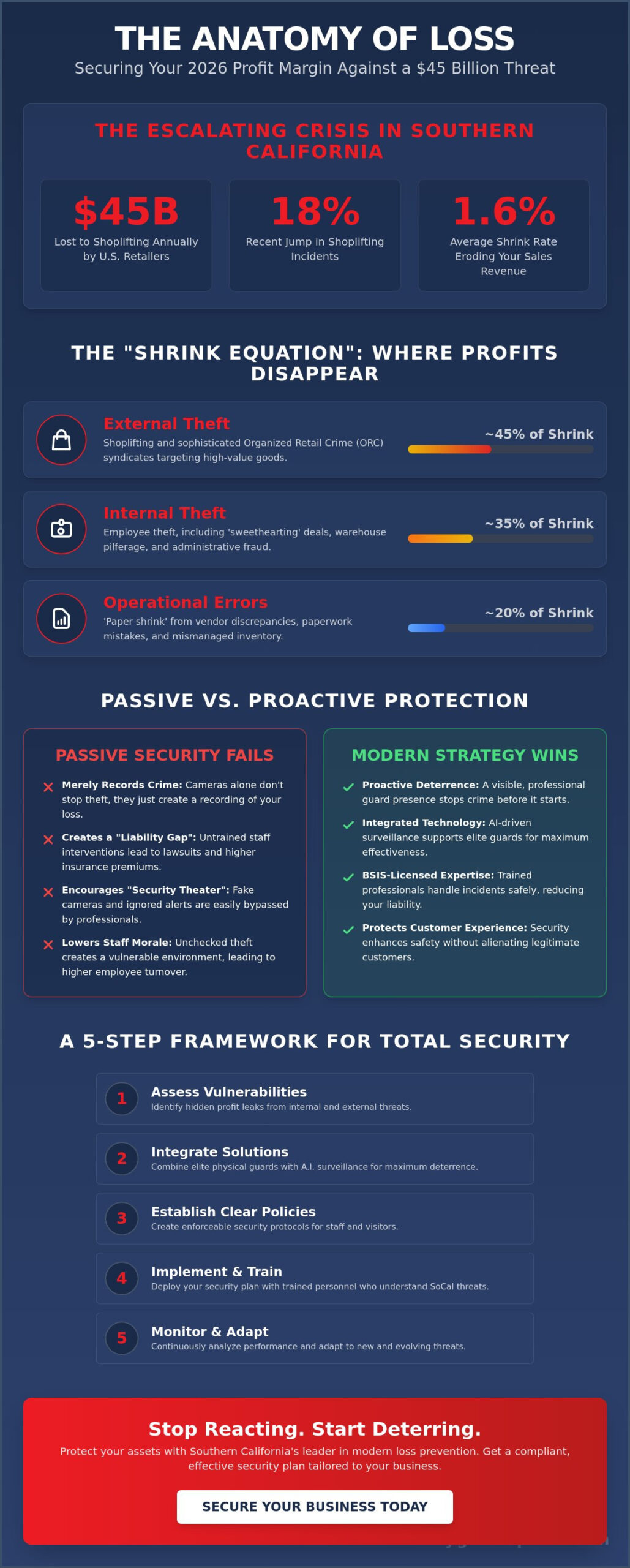
What if the biggest threat to your 2026 profit margin isn’t a slow sales quarter, but the $45 billion shadow economy of retail theft? With average shrink rates hitting 1.6% of sales and shoplifting incidents jumping by 18% recently, Southern California business owners are facing a crisis of both safety and solvency. You know that traditional methods often fail when Organized Retail Crime syndicates in Los Angeles and Orange County operate with such aggression. Implementing a modern loss prevention strategy is no longer optional; it’s a requirement for survival.
Deter theft and loss by focusing on your core operations while we handle the rest. This guide provides a clear framework to reduce shrink and secure your assets through a high-tech, high-touch approach. We’ll explore how to leverage AI-driven surveillance alongside elite, BSIS-licensed security guards to create a compliant, effective security plan. Stay protected by understanding the true ROI of professional protection. We’ll show you how to stop theft without hurting the customer experience, moving your business from a state of vulnerability to total security.
Key Takeaways
- Identify the hidden components of the ‘Shrink Equation’ to stop profit leaks from internal theft and operational errors.
- Discover why passive surveillance often fails and how to close the ‘Liability Gap’ that triggers insurance hikes.
- Master a modern loss prevention strategy that integrates elite physical deterrence with A.I. technology for maximum asset protection.
- Implement a professional five-step framework to assess your site’s vulnerabilities and establish clear, enforceable security policies.
- Learn how BSIS-licensed expertise and localized Southern California experience provide the ultimate deterrent against organized retail crime.
What is Loss Prevention? Defining Modern Asset Protection
Effective loss prevention is the proactive shield that guards your assets, your people, and your profits. While many associate the term strictly with Retail loss prevention, modern asset protection extends far beyond the sales floor. It’s a disciplined approach to eliminating ‘shrink’, the industry term for inventory loss that shouldn’t happen. In 2026, shrink is a complex equation where external theft, internal pilferage, and administrative errors combine to erode your margins. You can’t afford to treat security as a passive expense. It’s a vital investment in your company’s longevity.
Stop reacting to losses after they occur. The goal of a professional program is to shift your stance from detection after the fact to deterrence at the door. Whether you operate a distribution center in the Inland Empire or a retail hub in Orange County, your security must be a visible, formidable barrier. Traditional models often wait for a crime to happen before recording it on a camera. Modern strategies use elite physical presence and A.I. technology to ensure the crime never starts. This is especially critical in logistics and manufacturing environments where a single stolen pallet can represent thousands of dollars in lost revenue.
The Three Pillars of Shrinkage
Shrinkage isn’t a single problem; it’s a three-headed threat that requires a multi-faceted response. Understanding these pillars allows you to allocate resources where they’ll have the most impact.
- External Theft: This includes shoplifting and the surge in Organized Retail Crime (ORC) across Southern California. These are coordinated, often aggressive hits by professional groups that target high-value goods for resale.
- Internal Theft: Employee theft accounts for approximately 35% of retail shrinkage. It ranges from ‘sweethearting’ at the register to large-scale warehouse pilferage and administrative fraud.
- Operational Errors: Paperwork blunders, vendor discrepancies, and mismanaged inventory often look like theft. These failures in process account for a significant portion of ‘paper shrink’ that eats your profit without a single item ever leaving the building illegally.
Why Loss Prevention Matters in 2026
Economic pressures in 2026 have driven shoplifting incidents up by 18% compared to just a year ago. In major hubs like Los Angeles and San Diego, the cost of doing business is rising, making every lost dollar more painful. U.S. retailers lost an estimated $45 billion to shoplifting in 2024, and those numbers continue to climb as ORC groups become more sophisticated. For a large corporation, a 1.6% shrink rate is a manageable line item. For a Southern California small business, it’s the difference between staying open or closing your doors forever. You need a partner who understands the local landscape and the specific threats facing your industry.
Loss prevention in 2026 is a holistic business strategy that integrates human vigilance with advanced technology to neutralize threats before they impact the balance sheet.
Analyzing the Cost of Loss: Why Passive Security Fails
Passive security systems create a dangerous illusion of safety. Many business owners believe a wall of monitors equals protection, but cameras alone simply record the crime as it happens. They don’t stop it. When analyzing the latest industry data on retail shrink, it becomes clear that the financial damage extends far beyond missing inventory. To calculate the real cost of loss, you must factor in the replacement time, lost sales opportunities, and the administrative overhead required for investigations. Every stolen item carries a hidden price tag that drains your operational budget.
Relying on passive measures also opens a “Liability Gap.” Improperly managed loss prevention often leads to skyrocketing insurance premiums and potential legal fees. If an untrained employee attempts an apprehension, the resulting lawsuit could cost ten times the value of the stolen merchandise. There’s also a psychological impact. When theft goes unchecked, staff morale plummets and employee turnover rises. This creates a cycle where internal theft becomes more common because the team feels the business is an easy target. Protect your bottom line by addressing these vulnerabilities before they escalate.
The Failure of ‘Security Theater’
Professional criminals in Anaheim and Irvine aren’t deterred by “security theater.” They easily identify fake cameras and exploit automated alerts that no one responds to in real-time. A high-end CCTV system is a forensic tool, not a deterrent. For example, a San Bernardino warehouse recently suffered a $50,000 loss despite having expensive cameras. Because there was no immediate physical response, the footage was merely a high-definition record of the theft. Deter theft and loss by ensuring your technology is backed by a rapid, human response.
Legal and Compliance Risks in California
California has strict BSIS standards for all security personnel. Navigating the legalities of “hands-on” versus “hands-off” policies is a minefield for the uninitiated. If you need compliant security guard services los angeles, you must ensure your provider is PPO licensed and fully accountable. Don’t leave your liability to chance. Talk to an expert at Security Guard Pros to build a plan that keeps you both safe and compliant.
Physical Guards vs. Technology: Comparing LP Solutions
Choosing between physical security and technological solutions is a false dichotomy. In the modern landscape of loss prevention, the most successful businesses utilize a hybrid model. While technology provides the eyes, professional guards provide the hands and the immediate judgment necessary to stop a crime in progress. Technology is excellent for post-incident investigation, but it lacks the proactive capability to change a thief’s mind before they act. By comparing these solutions across key performance metrics, you can identify the gaps in your current strategy.
| Feature | Physical Guards | CCTV Systems | RFID / EAS Tags |
|---|---|---|---|
| Deterrence Level | High (Visual presence) | Low to Moderate | Moderate |
| Response Time | Instant / Real-time | Delayed (Review only) | N/A (Alarm only) |
| Evidence Collection | High (Witness + Video) | High (Video) | Low (Data point) |
| Cost-Effectiveness | High ROI (Preventative) | Moderate (Forensic) | Variable |
The “Human Element” remains the most powerful tool in your arsenal. A uniformed guard acts as a psychological barrier that a camera lens simply cannot replicate. Thieves often scan for “soft targets” where they won’t be challenged. When they see an accountable, BSIS-licensed professional, the risk-reward calculation shifts immediately. This is why loss prevention programs that rely solely on tech often see higher shrink rates than those with a visible human presence.
The Power of Visual Deterrence
Deter theft and loss by matching the level of protection to the specific threat. In retail environments, unarmed guards provide a reassuring presence for customers while serving as a stern deterrent to shoplifters. In high-value industrial zones or logistics hubs, armed security guards offer the necessary level of force to protect multi-million dollar assets from organized crime. Stay protected by choosing the right tier of visibility for your site’s specific vulnerability profile.
Integrating Tech with Human Response
Modern security isn’t just about guards standing at a door. We utilize “A.I. Technology driven” solutions to act as a force multiplier. By integrating 24/7 dispatch with smart cameras, a single guard can respond to multiple alerts across a large facility. Guards use electronic reporting apps to log incidents in real-time, providing you with transparent data and immediate proof of performance. This synergy between one guard and AI-powered surveillance is more effective than dozens of unmonitored cameras that only show you what you’ve already lost.
Building Your Loss Prevention Plan: A 5-Step Framework
Creating a robust loss prevention strategy doesn’t have to be overwhelming. It requires a disciplined, step-by-step approach that addresses your specific vulnerabilities. Don’t wait for an incident to expose your weaknesses. Use this framework to build a protective shield around your Southern California business operations today.
- Step 1: Conduct a Vulnerability Assessment. Identify every entry point, blind spot, and high-value zone. You must see your facility through the eyes of a thief to understand where your assets are most at risk.
- Step 2: Establish Clear Policies. Documentation is your best defense against liability. Create strict rules for employee conduct, bag checks, and apprehension protocols to ensure every action is legally compliant.
- Step 3: Deploy Targeted Deterrents. Layer your security. Combine high-visibility signage and improved lighting with the physical presence of professional guards to eliminate the opportunity for theft.
- Step 4: Train Your Team. Your employees are your first line of defense. Teach them to recognize behavioral red flags, such as aimless wandering or avoiding eye contact, without falling into illegal profiling.
- Step 5: Review and Refine. Security is an evolving process. Analyze daily logs and incident reports from your guards to identify emerging patterns and adjust your strategy accordingly.
Customizing LP for Your Industry
Every industry faces unique threats. In retail, your focus should remain on floor presence and receipt checks at exits to deter shoplifting. Logistics and warehousing operations require strict gate control and vehicle mobile patrols to secure massive perimeters. For construction sites, GPS tracking for equipment paired with dedicated perimeter guard services prevents high-value machinery theft during off-hours. Tailoring your loss prevention plan ensures you aren’t wasting resources on irrelevant measures.
The Role of Professional Consultation
A generic staffing agency can’t provide the strategic depth required for modern asset protection. You need a multi-step security analysis from a PPO licensed company that understands the local landscape. Evaluating security guard services based on their BSIS compliance and technical integration is the only way to ensure long-term safety. Accountable, highly trained professionals make the difference between a plan that works and one that fails under pressure. Talk to an Expert at Security Guard Pros to start your assessment today.
Why Security Guard Pros is the Standard for SoCal Loss Prevention
Choosing a partner for loss prevention requires more than just hiring warm bodies. It requires a seasoned veteran with a deep understanding of the California landscape. At Security Guard Pros, we bring over 70 years of collective management experience to every site we protect. We don’t just offer staffing. We provide a protective shield that allows you to focus on your core operations. Our approach strikes a balance between being a stern deterrent to threats and a reassuring partner to your team. We replace unreliable and unprofessional services with an accountable, highly trained force.
We distinguish ourselves through an “A.I. Technology driven” methodology. By integrating advanced surveillance with elite physical guards, we provide a level of oversight that traditional agencies can’t match. Every guard is BSIS Licensed and undergoes rigorous training tailored for the unique challenges of the Los Angeles and Orange County markets. Whether you need immediate coverage for a theft surge or 24/7 dispatch for ongoing loss prevention, our infrastructure is built for rapid deployment. We also provide specialized fire watch services to keep your facility compliant and safe during system downtimes.
Localized Expertise in Southern California
Our roots are firmly planted in the region. We possess a deep understanding of crime trends from Canoga Park to San Diego. This localized knowledge has allowed us to protect over 1 Billion Assets for California businesses, a metric that reflects our commitment to unwavering reliability. We don’t believe in one-size-fits-all commodities. Instead, we provide personalized solutions for gated communities, retail centers, and industrial hubs. Our PPO and BSIS Licensed status serves as a badge of legitimacy, ensuring that every protocol we implement is fully compliant with state regulations.
Take the First Step Toward Peace of Mind
Don’t settle for generic security. Our “Talk to an Expert” process is designed to be hassle-free and consultation-based. We begin with a high-level value proposition and move into a detailed, process-driven analysis of your specific facility. This logical progression moves you from a state of vulnerability to total security. Stay protected and secure your future by partnering with a modern guardian that respects traditional values while embracing the tools of tomorrow. Deter theft and loss by starting a conversation with our team today.
Protect your business today with a custom Loss Prevention plan from Security Guard Pros.
Secure Your Assets and Reclaim Your Profit
Your business deserves more than a high-definition recording of a crime after it happens. You need a proactive shield. By integrating elite physical guards with A.I. technology, you turn your facility into a hard target that deters theft before it begins. A successful loss prevention strategy is built on a foundation of clear policies and rapid, human response. Passive cameras don’t stop organized retail crime. Highly trained, BSIS-licensed professionals do.
Security Guard Pros stands ready as your seasoned veteran in the field. With over $1 Billion in assets protected and a 24/7 dispatch center, we provide the rapid deployment you need to stay safe. As a Licensed PPO #17631 agency, we ensure your security plan is both effective and legally compliant. Don’t let inventory shrink dictate your bottom line any longer. Focus on your core operations while we handle the distraction of security concerns. We provide the peace of mind you need to grow in a challenging landscape.
Talk to a Loss Prevention Expert at Security Guard Pros today to secure your facility’s future. You’ve worked hard to build your business; let us help you protect it.
Frequently Asked Questions
What is the primary goal of loss prevention?
The primary goal of loss prevention is to proactively protect a business’s assets, people, and profits by deterring theft before it occurs. It shifts the focus from simply recording a crime to preventing one. By establishing a visible deterrent and clear operational protocols, businesses can secure their bottom line and ensure a safe environment for both staff and customers. It’s about protecting your margin as much as your merchandise.
How do loss prevention guards differ from standard security guards?
Loss prevention guards specialize in inventory control and the reduction of retail shrink through targeted surveillance and behavioral analysis. While standard security guards provide general site protection, LP professionals are trained to identify specific red flags like “sweethearting” or organized retail crime patterns. They often work in a high-touch capacity, integrating closely with your store’s daily operations to stop merchandise loss in real-time through disciplined observation.
Is it legal for loss prevention to detain someone in California?
Yes, California law allows for the temporary detention of individuals suspected of theft under the “shopkeeper’s privilege.” This detention must be based on probable cause and conducted in a reasonable manner for a limited time. It’s critical that your personnel are BSIS licensed and follow strict PPO protocols to avoid legal liability. Improperly handled detentions can lead to costly lawsuits that far exceed the value of the stolen goods.
What are the most common causes of retail shrink in 2026?
The most common causes of retail shrink in 2026 include organized retail crime (ORC), internal employee theft, and administrative paperwork errors. External theft by professional syndicates remains a dominant threat in Southern California hubs. However, internal pilferage and simple operational mistakes, like miscounting inventory or vendor discrepancies, also account for a massive portion of total annual losses across the industry. Vigilance must cover both the front and back of the house.
How much does a professional loss prevention service cost?
Professional loss prevention service costs depend on the level of protection required and your specific location. In 2026, California hourly rates for unarmed guards typically range from $28 to $45, while armed guards range from $38 to $65. Rates are often higher in Los Angeles due to increased demand and risk profiles. Investing in these services provides a clear ROI by significantly reducing the billions lost globally to shrink each year.
Can loss prevention help with internal employee theft?
Yes, a professional program is highly effective at deterring internal employee theft, which accounts for approximately 35% of all retail shrinkage. Guards monitor staff behavior and point-of-sale transactions to identify administrative fraud or unauthorized discounts. Their presence alone creates a culture of accountability. This makes it much harder for dishonest employees to exploit operational gaps without being detected by trained, BSIS-licensed eyes.
What is the difference between loss prevention and asset protection?
Loss prevention traditionally focuses on reducing retail inventory shrink, while asset protection is a broader term covering all business resources, including intellectual property and physical infrastructure. In the modern landscape, these terms are often used interchangeably to describe a holistic security strategy. Both concepts aim to minimize risk and maximize profit by ensuring that every part of your operation, from the warehouse to the storefront, remains secure and profitable.
How do I know if my business needs armed or unarmed guards for LP?
Your choice between armed and unarmed guards depends on your facility’s specific risk assessment and the value of the assets you’re protecting. Unarmed guards are usually sufficient for standard retail environments where customer interaction is high. However, high-value industrial zones or logistics hubs in high-crime areas often require the stern deterrent of armed personnel. Talk to an expert to evaluate your site’s vulnerability and determine the appropriate level of force for your needs.