A single malfunctioning sprinkler head or a silent fire alarm panel isn’t just a maintenance issue; it’s a legal emergency that can shutter your business in hours. If your fire protection system fails, the clock starts ticking immediately against your bottom line. You must understand exactly when is a fire watch required to prevent a Fire Marshal from issuing a “Notice to Vacate” or levying heavy fines. You likely share the common anxiety of being held liable if a fire occurs during an outage, or the frustration of deciphering conflicting local codes while your facility hangs in the balance.
This 2026 California Compliance Guide provides the clarity you need to stay operational and secure. We’ll break down the strict 4-hour alarm rule in Los Angeles versus the 10-hour sprinkler threshold mandated by the state. You’ll learn why “sole-duty” guards are a legal mandate and how to navigate the new digital logbook requirements. This guide serves as your professional shield, allowing you to focus on your core operations while we handle the complexities of fire safety and legal liability.
Key Takeaways
- Identify the specific legal triggers for Southern California properties and learn exactly when is a fire watch required under the updated 2026 California Fire Code.
- Recognize the critical 4-hour and 10-hour impairment windows for fire alarms and sprinkler systems to avoid immediate building closures.
- Understand the mandatory safety protocols for hot work, including the essential 30-minute post-operation monitoring period to prevent smoldering fires.
- Learn the rigorous documentation standards and patrol frequencies required to satisfy Fire Marshal inspections and maintain insurance validity.
- Establish a rapid-response plan for emergency deployment to ensure continuous protection and full regulatory compliance during unexpected system outages.
What is a Fire Watch and Why is it Legally Mandated?
Understanding What is a Fire Watch begins with recognizing it as a specialized safety protocol rather than a simple staffing request. It’s a proactive, human-centric measure where trained personnel physically patrol a facility to detect early signs of smoke, fire, or hazardous conditions. This service becomes a legal necessity when your automated fire protection systems, such as sprinklers or alarms, are compromised. You don’t just hire a guard; you deploy a specialized shield to maintain the safety of your assets and the lives within them.
Federal standards established by the National Fire Protection Association (NFPA), specifically NFPA 101 and NFPA 25, create the national baseline for safety. These codes dictate that any building with a compromised fire system must implement alternative protection. However, the California Fire Code (CFC) enhances these federal requirements with even stricter mandates. California’s unique environmental risks and high-density urban centers mean state regulators leave zero room for error. If you are wondering when is a fire watch required, the answer often lies in the intersection of these complex codes and your current system status.
The ultimate power rests with the Authority Having Jurisdiction (AHJ), typically your local Fire Marshal. The AHJ has the final word on whether your facility is safe to remain open. They interpret the code based on your building’s specific risk profile, occupancy type, and the duration of the system outage. If the Fire Marshal determines your property is a hazard, you must establish a fire watch immediately. Failure to do so doesn’t just result in fines; it leads to immediate building closures and the total cessation of your business operations.
The Core Responsibilities of a Fire Watch Guard
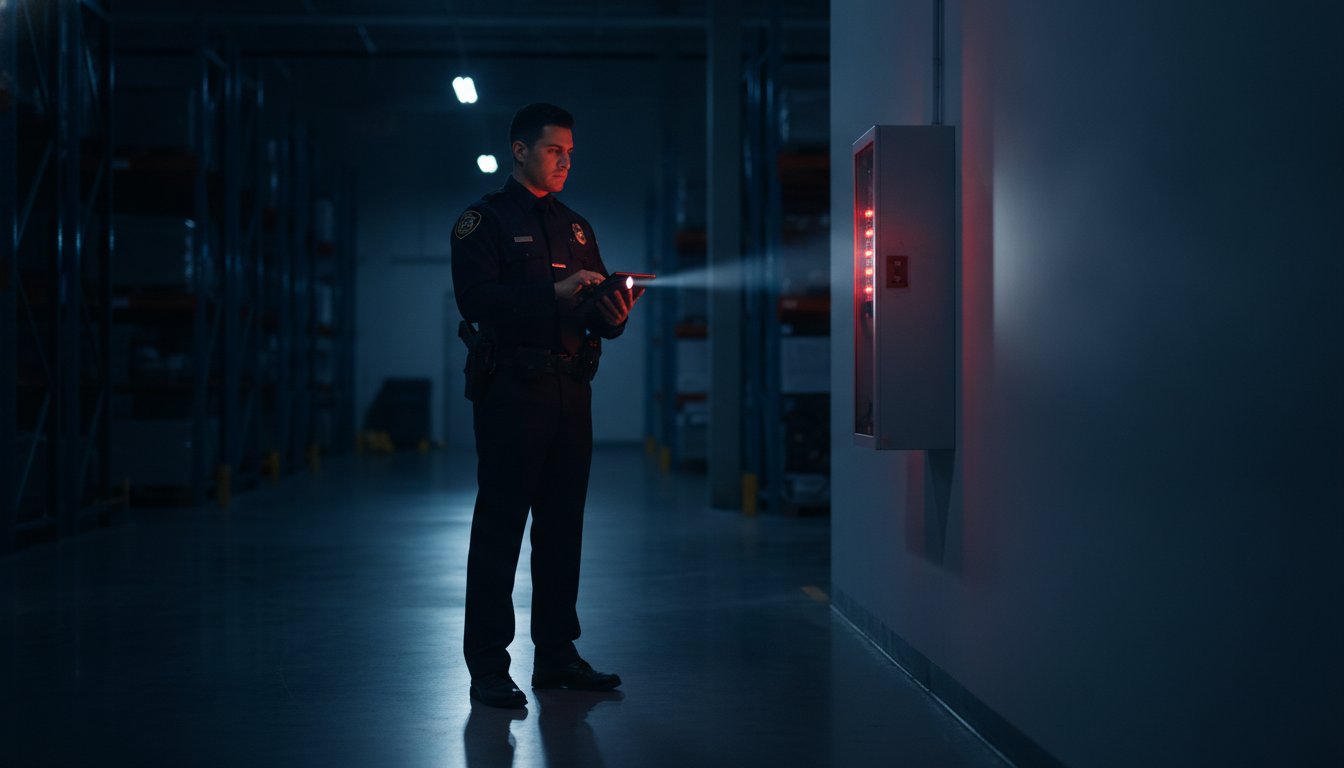
Vigilance is the only acceptable standard for a fire watch professional. Guards must conduct continuous patrols of all areas, including unoccupied rooms, mechanical closets, and hidden storage spaces where smoldering fires often begin unnoticed. They are trained to identify potential ignition sources, such as faulty wiring or improperly stored flammable chemicals, before they escalate. Every patrol must be documented in a detailed, time-stamped fire watch log. This log serves as your primary legal defense during a Fire Marshal inspection, proving your commitment to compliance and safety.
Why ‘General Security’ is Not Always Enough
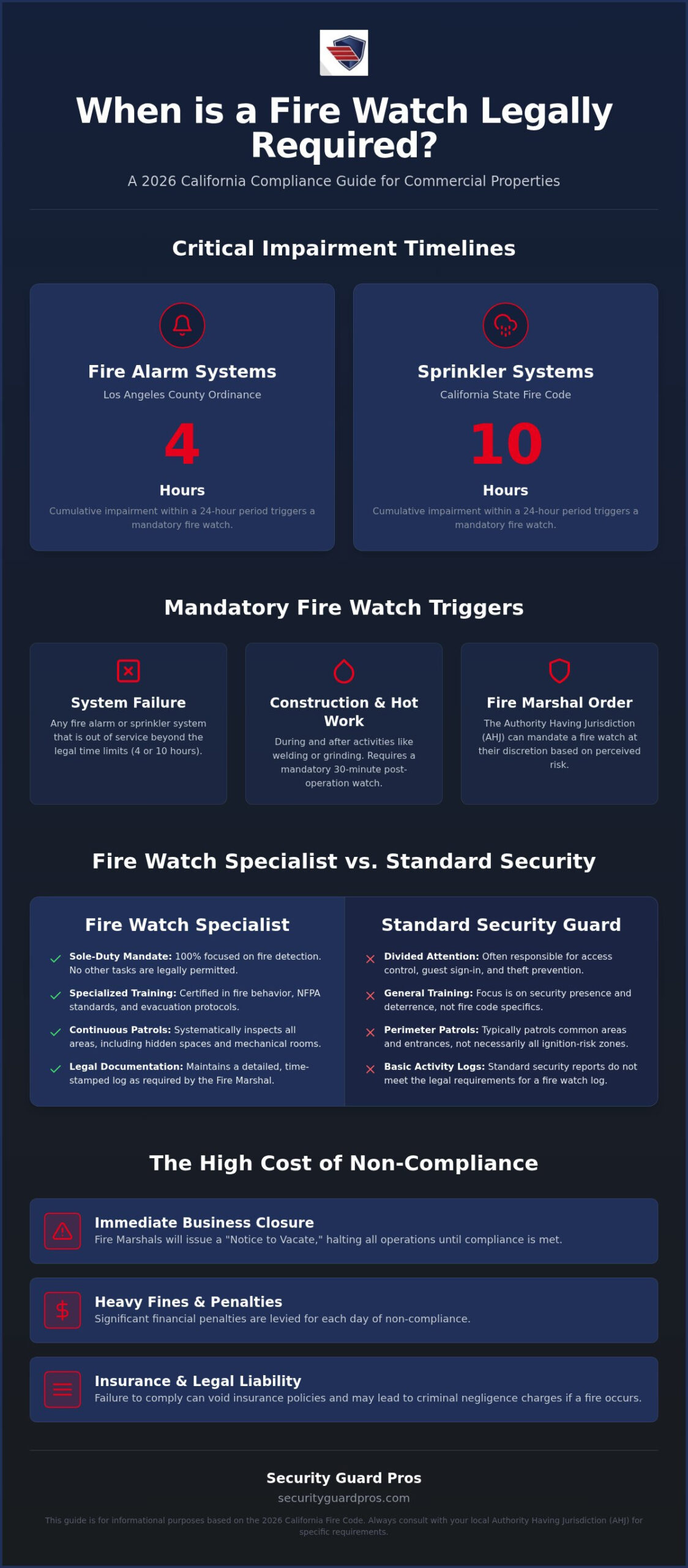
Don’t confuse a standard security guard with a fire watch specialist. While general security focuses on theft prevention and access control, fire watch requires specific training in fire behavior, emergency evacuation protocols, and NFPA standards. The law is incredibly strict regarding the “dedicated duty” rule. To comply with California regulations, fire watch personnel must remain entirely focused on fire detection and cannot be assigned any secondary tasks like answering phones, signing in guests, or performing maintenance rounds. This singular focus ensures that your property remains protected by a professional who is disciplined, vigilant, and ready to act the moment a threat is detected.
The 4-Hour Rule: When System Failures Trigger a Fire Watch
The timeline for legal compliance is shorter than many Southern California property managers realize. While some states allow a wider margin for error, the 2026 California Fire Code and local ordinances in regions like Los Angeles County are uncompromising. In Los Angeles, if your fire alarm system is impaired for four or more hours within a 24-hour period, you must establish a fire watch. For water-based suppression systems like sprinklers, the state threshold is 10 or more cumulative hours within a 24-hour period. Understanding exactly when is a fire watch required is the difference between a minor repair and a catastrophic legal event.
The cumulative rule is a common trap for the unprepared. Regulatory authorities don’t just look at single, continuous outages. If your alarm system fails for two hours in the morning and another two hours in the afternoon, you have hit the four-hour threshold. This triggers an immediate legal obligation to notify your local Fire Marshal and your insurance provider. Silence is not a strategy. Failure to report an impairment while continuing operations is considered a willful safety violation, which can lead to criminal negligence charges if an incident occurs. Securing professional security guard services ensures your facility remains compliant while technicians work on repairs.
Common System Failures Requiring Intervention
System impairments rarely happen at convenient times. You must deploy a watch during scheduled maintenance or major upgrades to fire sprinkler systems that require the water supply to be shut off. Physical damage to fire alarm control panels, often caused by power surges or aging circuitry, also mandates a human presence. Additionally, any water supply interruption, whether due to municipal pipe bursts or onsite pump failures, renders your automatic suppression useless. These scenarios create a high-risk environment where manual detection is your only line of defense.
The Risk of Non-Compliance in Southern California
The consequences of ignoring these windows are swift and severe. Fire Marshals in Southern California have the authority to issue “Stop Work” orders or mandate immediate building evacuations if a required watch isn’t present. Beyond government fines, your insurance coverage is at stake. Most commercial policies contain “protective safeguard” endorsements. If you suffer a fire loss while your system is down and no watch was active, your carrier may deny the claim entirely. California law is very specific about these Mandatory Fire Watch Triggers, leaving no room for interpretation. Protect your assets by maintaining a disciplined, vigilant presence until your systems are fully restored and certified.
Construction and Hot Work: Mandatory Fire Watch Triggers
Construction sites are high-stakes environments where a single spark can lead to a total loss of property. In the context of active job sites, knowing when is a fire watch required is critical for project managers who want to avoid stop-work orders. Hot work, which includes activities such as welding, cutting, brazing, or grinding, is a primary trigger for this mandate. These tasks generate extreme heat and molten slag that can hide in wall cavities or debris, only to ignite hours later. Because of this latent danger, California safety standards require a dedicated individual to monitor the work area exclusively, ensuring that any flare-up is extinguished immediately.
The danger doesn’t end when the welder turns off the torch. OSHA and the California Office of the State Fire Marshal mandate a post-work monitoring period of at least 30 minutes. This rule exists because smoldering embers can remain undetected for long periods before erupting into a full-scale fire. In high-density urban zones like Downtown Los Angeles or Anaheim, the risk is magnified by the proximity of neighboring structures and the difficulty of emergency access. A fire on a construction site in these areas can quickly become a regional disaster, making professional vigilance a necessity rather than an option.
Hot Work Permits and Compliance
A legitimate fire watch professional does more than just stand by with an extinguisher. They must verify that the work area is safe before hot work begins, ensuring that all flammable materials are moved or shielded. Regulations require monitoring a 35-foot radius around any spark-producing activity to account for the trajectory of molten metal. Integrating specialized construction site security guards into your workflow provides a layer of protection that general labor cannot offer. These experts understand the specific legal triggers and maintain the rigorous documentation needed to satisfy inspectors and insurance adjusters.
Special Events and High-Occupancy Triggers
Beyond construction, Southern California’s vibrant event scene often necessitates a fire watch. Large festivals or corporate events that use temporary structures or block existing exits must compensate for these safety gaps. Local ordinances frequently mandate a watch when occupancy exceeds certain limits or when “nuisance alarms” in residential towers lead to frequent system shutdowns. Whether you are managing a high-rise renovation or a temporary venue, understanding when is a fire watch required ensures you stay on the right side of the law. You protect your guests, your investment, and your professional reputation by choosing a veteran partner who takes these responsibilities with extreme seriousness.
Documentation and Logistics: Meeting Fire Marshal Expectations
Logbooks are your primary legal defense during a Fire Marshal audit. If you cannot prove a patrol occurred through a time-stamped record, the Authority Having Jurisdiction (AHJ) will treat it as if the patrol never happened. This is why understanding when is a fire watch required must be paired with a rigorous commitment to documentation. Every patrol must be recorded in real-time, creating a verifiable audit trail that protects your business from liability. In 2026, digital, GPS-verified logs have become the standard for California compliance, replacing easily falsified paper sheets with transparent, accountable data.
Patrol frequency is dictated by the specific risk profile of your facility. High-occupancy or high-risk environments, such as hospitals, nursing homes, or high-rise residential towers, often require 15-minute patrol cycles. Standard commercial warehouses, retail centers, or office buildings typically follow a 60-minute cycle. Regardless of the interval, the personnel must remain mobile and vigilant. Stationary monitoring or “front desk” fire watch is a direct violation of the California Fire Code and will lead to immediate citations.
Establish a clear communication chain before the first patrol begins. Your fire watch guards must have a direct line to facility management and a dedicated method to alert the fire department instantly. In an emergency, the priority is rapid notification and evacuation. Once the system is restored, keep your logs on file for at least one year. Many insurance carriers in Southern California now require these logs during annual renewals or after a claim to prove that you maintained professional oversight during system impairments.
Essential Elements of a Fire Watch Log
A compliant log must be legible, accurate, and ready for inspection at a moment’s notice. Each entry must include the guard’s full name, the exact start and end time of the patrol, and a list of specific areas inspected, such as stairwells, mechanical rooms, and unoccupied storage zones. Any identified hazards, like a blocked fire exit or an improperly stored flammable material, must be noted along with the corrective action taken. A compliant fire watch log entry must follow a structured format: “02:15 PM – Patrol started; checked floors 1-4, all exits clear, no smoke or heat detected; 02:45 PM – Patrol completed.”
Ending the Fire Watch: The Restoration Process
Don’t terminate the watch prematurely just because a repair seems finished. You must verify that the fire protection system is 100% operational through certified testing by a licensed fire protection technician. Once the system is fully restored and green-lit, provide the final notification to the AHJ and your insurance provider to confirm the watch has concluded. Only then should you manage the transition back to standard security protocols. To ensure your documentation meets these rigorous standards, secure professional Fire Watch Services to maintain a disciplined and compliant safety shield.
Rapid Deployment: How Security Guard Pros Ensures Compliance
Identifying exactly when is a fire watch required is only the first step in protecting your assets. The second, and more critical, step is executing a compliant response before the Fire Marshal arrives. In Southern California, the window between a system failure and a legal citation is dangerously narrow. Security Guard Pros eliminates this vulnerability through a 24/7 emergency dispatch system designed for immediate mobilization. We don’t just provide personnel; we deploy a disciplined safety infrastructure that meets the exact specifications of the 2026 California Fire Code. Our team acts as an expert shield, allowing you to maintain business continuity while we manage the complexities of fire safety and liability.
Transparency is the cornerstone of our service. We replace the uncertainty of traditional paper logs with advanced technological solutions. Our digital logbook management provides time-stamped, GPS-verified entries that satisfy the most rigorous inspections. This level of accountability ensures that your property’s safety record is beyond reproach. By choosing a partner with over 70 years of collective management experience, you gain the peace of mind that comes from unwavering reliability. We handle the documentation and the patrols so you can focus on your core operations without the distraction of regulatory threats.
Serving Southern California’s Unique Industries
Our expertise is grounded in geographic and industry-specific knowledge. We provide specialized construction site security for projects in Riverside and Canoga Park, where hot work triggers are a daily reality. In Los Angeles County, we ensure healthcare facilities and hospitals remain in full compliance with strict life-safety codes during system upgrades. For the retail and hospitality sectors in Orange County and San Diego, our guards maintain a professional, vigilant presence that protects guests without disrupting the customer experience. We understand the unique pressures of each sector and tailor our fire watch plans accordingly.
Getting Started with Security Guard Pros
Securing your facility begins with a targeted consultation to assess your specific AHJ requirements. We analyze your building’s risk profile and the nature of the system impairment to create a customized patrol plan. Whether you need a recurring patrol for ongoing construction or a short-term emergency contract for a sudden alarm failure, our process is designed to be hassle-free. Contact our 24/7 dispatch team immediately to initiate protection. We are ready to deploy trained, licensed professionals to Los Angeles, San Diego, and Anaheim at a moment’s notice, ensuring your property remains safe, compliant, and open for business.
Protect Your Assets with Vigilant Oversight
Navigating the 2026 California Fire Code requires more than just awareness; it demands immediate action. You now understand the critical windows for system impairments and the mandatory oversight required for hot work. Whether you are managing a high-rise in Los Angeles or a construction site in San Diego, knowing exactly when is a fire watch required is your first line of defense against catastrophic liability. Don’t let a technical failure turn into a business-ending legal crisis. A single oversight can lead to heavy fines or an immediate “Notice to Vacate” from the Fire Marshal.
Security Guard Pros stands ready as your modern guardian. As a fully licensed and insured California security firm, we provide 24/7 emergency dispatch to ensure you never face a compliance audit alone. We serve LA, Orange County, and San Diego with the disciplined professionalism your property deserves. Our team provides the expert shield you need to stay focused on your core operations while we handle the complexities of fire safety. Secure Your Property Now: Get Professional Fire Watch Services from Security Guard Pros. Take control of your compliance today and maintain the safety of your facility with unwavering confidence.
Frequently Asked Questions
Is a fire watch required for a failed fire sprinkler system?
Yes, a fire watch is mandatory when a water-based fire protection system is impaired for 10 or more cumulative hours within a 24-hour window. This requirement ensures that a human presence monitors for ignition while the automated suppression is offline. You must notify the Fire Marshal and your insurance carrier immediately upon discovering the failure to remain in legal compliance with the California Fire Code.
How many fire watch guards do I need for my building?
The number of guards depends on your building’s layout and the patrol frequency mandated by the local Fire Marshal. A single guard must be able to walk the entire facility within the required 15-minute or 60-minute cycle. For large industrial complexes or multi-story high-rises, you’ll likely need multiple personnel to maintain a continuous, vigilant presence in every zone.
Can my regular maintenance staff perform a fire watch?
Your staff can perform the watch only if it’s their “sole duty” during the entire shift. They cannot answer phones, perform repairs, or manage janitorial tasks while on watch. Most business owners find this impractical and prefer hiring a specialized firm to avoid the risk of a Fire Marshal citation for non-compliant, multi-tasking personnel.
What is the 4-hour rule for fire watch in California?
The 4-hour rule applies specifically to fire alarm system impairments in jurisdictions like Los Angeles County. If your alarm system is non-functional for four or more hours in a single day, the law mandates an immediate fire watch. This shorter window reflects the high-density risk of Southern California urban centers and clarifies when is a fire watch required for local property managers.
What happens if I don’t provide a fire watch during a system outage?
Failure to implement a watch leads to severe penalties, including hefty daily fines and the potential for an immediate “Notice to Vacate” order. Beyond government action, your insurance company may void your coverage for any fire-related losses. If a fire occurs while the system is down and no watch is present, you face catastrophic financial and legal liability.
How long must a fire watch stay on duty after hot work is completed?
A fire watch must remain on-site for at least 30 minutes after all hot work activities have concluded. This period is critical for detecting smoldering embers that could ignite long after the welding or cutting crew has left. Some local Fire Marshals or high-risk project specs may extend this requirement to 60 minutes or longer to ensure total site safety.
Does insurance cover the cost of a fire watch service?
Insurance policies generally don’t reimburse the hourly cost of fire watch services, but they often require them as a condition of coverage. Maintaining a watch is a “protective safeguard” that keeps your policy valid during an outage. Consult your broker to see if your specific endorsement provides any financial relief for emergency safety measures.
What should be included in a professional fire watch log?
A professional log must include the guard’s name, precise patrol start and end times, and a list of all areas inspected. You must also document any hazards found, such as blocked exits or flammable debris, and the steps taken to resolve them. Because the law is strict about when is a fire watch required, the resulting log becomes your primary evidence of compliance during an official Fire Marshal audit.