
Last Tuesday, a warehouse manager named David discovered three individuals camping in his loading dock, causing a four-hour operational delay and significant property damage. This scenario is an all too common reality for business owners, as California retail theft and commercial burglary incidents continue to challenge local operations. You need a disciplined, professional strategy for how to deal with trespassers on commercial property that protects your assets without triggering a costly lawsuit.
We understand the anxiety that comes with these encounters. You likely feel caught between the urgent need for safety and the fear of legal liability for a wrongful removal. This 2026 guide provides the legal, safe, and professional protocols you need to manage unauthorized individuals while maintaining strict compliance with the California Penal Code. We’ll examine the latest updates to SB 602 “no trespass” letters, the strategic use of professional security as a legal buffer, and the proactive technologies that deter intruders before they breach your property line.
Key Takeaways
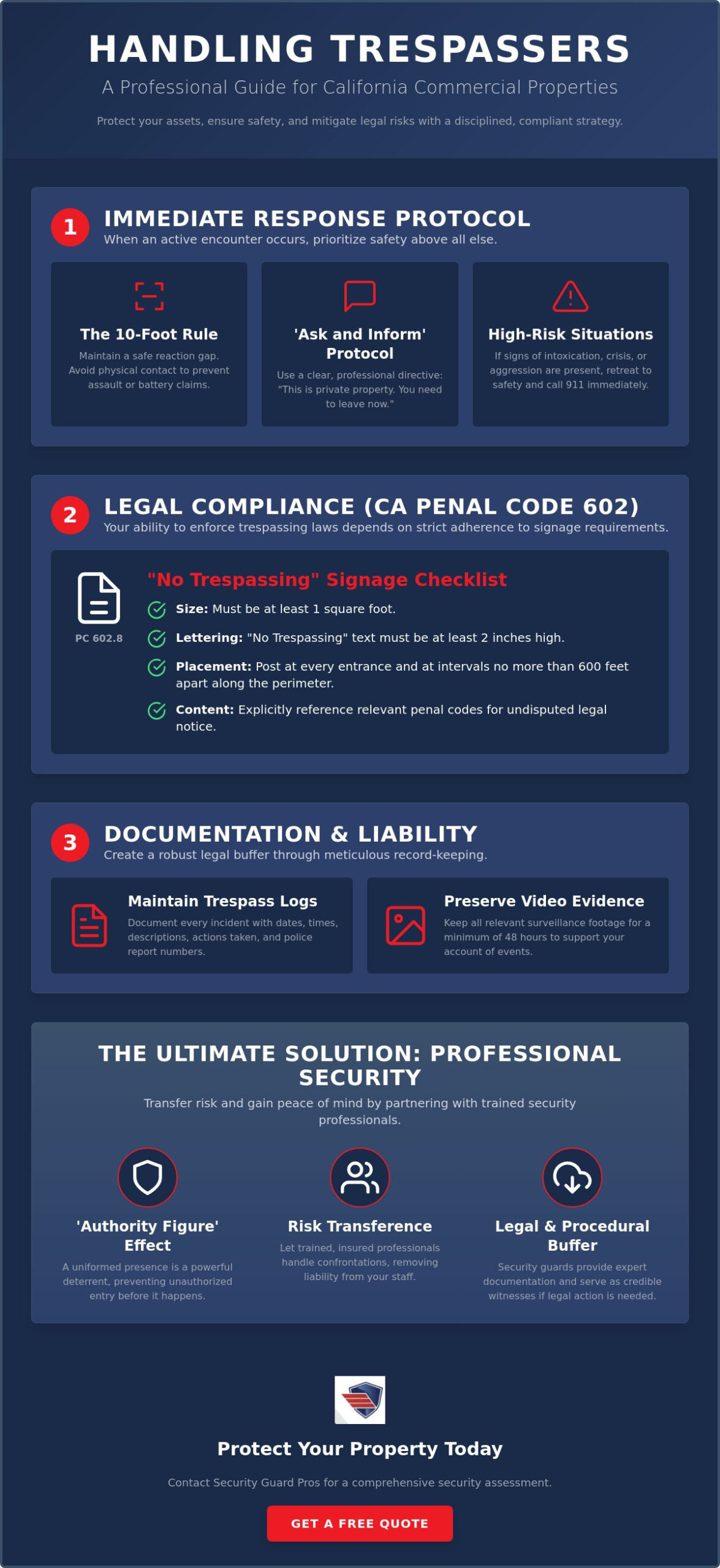
- Prioritize safety by utilizing the ‘Ask and Inform’ protocol to de-escalate active encounters without the risk of physical confrontation.
- Ensure legal enforceability by adhering to California Penal Code 602.8 requirements for specific signage size, placement, and intervals.
- Master how to deal with trespassers on commercial property by applying CPTED principles to harden your perimeter and deter loitering.
- Create a robust liability buffer through meticulous documentation, including detailed trespass logs and 48-hour video evidence preservation.
- Discover how professional security guard services provide an ‘Authority Figure’ effect that deters unauthorized entry while transferring operational risk.
Immediate Response: How to Handle an Active Trespasser Safely
An active encounter with an unauthorized individual on your premises demands a disciplined, professional response. You must prioritize safety above all else. Avoid physical contact at all costs. Touching a trespasser quickly leads to assault or battery counter-claims, shifting the legal focus from their intrusion to your conduct. To master how to deal with trespassers on commercial property, implement the 10-foot rule. This distance provides a necessary reaction gap that keeps your staff safe while allowing for clear, authoritative communication.
Use the ‘Ask and Inform’ protocol. This isn’t a debate; it’s a professional directive. Clearly state that the individual is on private property and must leave immediately. If you observe signs of intoxication, a mental health crisis, or immediate aggression, bypass dialogue entirely. In these high-risk scenarios, retreat to a secure location and contact 911. Professionalism means knowing when a situation exceeds your staff’s training and requires law enforcement intervention. Don’t trade your safety for a verbal confrontation that could spiral out of control.
The Verbal Trespass Warning
California law requires a clear ‘notice to depart’ to establish a criminal trespass violation. Use neutral, direct language. Say, “This is private property and you don’t have permission to be here. I’m asking you to leave now.” Avoid ‘fighting words’ or threats of violence. These inflammatory phrases create liability and can escalate a minor incident into a physical altercation. Whenever possible, ensure a second staff member is present. This witness provides a crucial account that a proper verbal warning was issued if legal proceedings follow. Understanding the legal concept of trespassing helps clarify why this specific notice is a prerequisite for police action.
Evaluating the Threat Level
Not every intruder has the same intent. Distinguish between a simple loiterer seeking shade and a ‘newcomer’ squatter attempting to establish residency. Look for ‘burglary tools’ like crowbars or heavy-duty bolt cutters. These items suggest an intent to commit a crime under PC 459, which elevates the situation from a simple nuisance to a felony threat. If you encounter an unauthorized vehicle, treat it as a potential mobile staging area. Record the license plate and make from a distance rather than approaching the driver directly. This disciplined assessment allows you to match your response to the actual risk level, ensuring a measured and legally sound resolution for your business.
Navigating California Trespassing Laws (Penal Code 602)
Understanding the legal framework is your first line of defense against unauthorized entry. In California, criminal trespass is governed primarily by California Penal Code 602. This statute defines trespassing as entering or remaining on a property without the owner’s permission. However, the burden of proof rests on the property owner to demonstrate that the intruder had clear notice that their presence was prohibited. This is where many businesses fail. Knowing how to deal with trespassers on commercial property requires more than just a locked door; it requires a documented legal strategy that stands up in a courtroom.
Time is a critical factor in these disputes. You must act immediately to prevent a simple trespasser from transitioning into a “squatter.” While the specific timeline can vary based on local ordinances, allowing an individual to remain on your property for even 24 to 48 hours can complicate removal. Once an intruder establishes what a court might consider “residency,” the matter shifts from a criminal issue to a civil one, necessitating a lengthy and expensive unlawful detainer process. Don’t let a nuisance become a permanent liability through inaction.
Signage Requirements for Southern California Businesses
To enforce California Penal Code 602.8, your property must be “posted.” This isn’t a suggestion; it’s a strict legal requirement. In Los Angeles and San Diego, signs must be at least one square foot in size with “No Trespassing” lettering at least two inches high. You must place these signs at every entrance and at intervals of no more than 600 feet along your entire perimeter. Generic signs often fail in court because they lack the necessary technical citations. Ensure your signage explicitly references the relevant penal codes to provide undisputed notice to any intruder. Retail centers should prioritize placement at pedestrian entry points, while industrial sites require heavy-duty signage at every gate and loading dock.
The Role of a ‘Letter of Agency’ (602 PC Letter)
A ‘Letter of Agency’ is a powerful tool that pre-authorizes local law enforcement to act on your behalf when you aren’t present. Following the SB 602 amendment that took effect on January 1, 2024, these “no trespass” letters can now remain active for up to one year. For properties that are permanently closed and properly posted, this authorization can last for three years. Filing this document with your local precinct allows officers to make arrests without contacting you first, which is essential for maintaining construction site security during late-night or weekend hours. Consider partnering with professional security guard services in Los Angeles to ensure your 602 letters are filed correctly and renewed before they expire.
Proactive Deterrents: Hardening Your Property Against Intrusion
Hardening your perimeter is the most effective way to reduce the frequency of unauthorized entry. While the legal framework provides a pathway for removal, physical deterrents prevent the incident from occurring in the first place. Adopting Crime Prevention Through Environmental Design (CPTED) principles allows you to manipulate the physical environment to influence offender behavior. This starts with the ‘Broken Windows’ theory. If a trespasser sees graffiti, broken glass, or overgrown landscaping, they perceive the property as unmonitored. Immediate repairs signal that the site is under active management, which is a core component of how to deal with trespassers on commercial property effectively.
Modernize your access control by transitioning from traditional metal keys to trackable RFID or biometric systems. Physical keys are easily duplicated and offer zero accountability once lost. Electronic systems provide a digital audit trail, allowing you to identify exactly who entered a specific zone and when. This data is invaluable when investigating security breaches. By strictly controlling entry points, you reinforce the boundaries defined under California Penal Code § 602, making it nearly impossible for an intruder to claim they entered by mistake.
Lighting and Surveillance Integration
Lighting is your primary nighttime deterrent. Install high-intensity LED systems that eliminate shadows where loiterers congregate. Pair this with strategic camera placement at eye level to capture high-definition facial features and license plates at every entry point. For remote or high-risk sites, utilize ‘Active Deterrence’ cameras. These units use AI to identify human movement and immediately trigger strobe lights and sirens, warning the intruder that they are being watched before they reach your building. This proactive technology stops a trespasser before they can cause damage.
The Power of Mobile Patrols
Visible authority disrupts the ‘scouting’ phase of a trespasser. Utilizing vehicle mobile patrols creates a high-profile deterrent that randomized schedules reinforce. Unlike predictable internal staff checks, a professional patrol unit arrives at different times, making it impossible for intruders to time their entry. These patrols provide electronic reporting, giving you GPS-verified proof of ‘due diligence’ that satisfies insurance requirements and strengthens your defense in liability cases. A marked vehicle on your property is a clear sign that you take your security with extreme seriousness.
Documentation and Liability Management
Meticulous documentation is your best defense against wrongful removal lawsuits. When you are determining how to deal with trespassers on commercial property, the physical removal is only half the battle. The other half is ensuring your actions are legally defensible in a courtroom. Maintain a dedicated ‘Trespass Log’ for every incident. This chronological record should include the exact time of the encounter, a detailed physical description, the specific behavior observed, and a confirmation that a verbal warning was issued. Without this paper trail, your word carries less weight against an intruder’s claims of harassment or injury.
Avoid the trap of ‘self-help’ evictions. You might feel tempted to move an intruder’s belongings or change locks on a space they have occupied, but these actions often lead to massive liability. In California, such moves can be interpreted as illegal evictions, resulting in civil judgments that far exceed the cost of the original trespassing damage. Always work within the legal system. This includes preserving high-definition video evidence immediately. Most commercial DVR systems operate on a loop; if you don’t download and secure footage within a 48-hour window, you risk losing the primary evidence needed for a prosecutable statement.
Incident Reporting Standards
Standardized reporting ensures that every encounter is treated with disciplined consistency. Your reports must include GPS-verified timestamps and high-resolution photos of any damage or ‘burglary tools’ found. Professional security guard services in Los Angeles provide these digital tools as part of their standard operation. They deliver real-time incident reports that serve as a legal buffer between your business and potential litigation. Request a professional security assessment to ensure your current reporting meets these rigorous standards.
Managing the ‘Civil vs. Criminal’ Gray Area
Your documentation strategy is the foundation of how to deal with trespassers on commercial property without inviting unnecessary risk. You will eventually encounter a situation where responding officers claim a trespass incident is a ‘civil matter’. This usually happens when an intruder has been present for several days. To overcome this, use your documented log to prove the individual was warned and is not a lawful tenant. If trespassing becomes a recurring pattern, use your records to seek a formal injunction or ‘stay away’ order. Having a licensed security professional as your primary witness adds a layer of expert testimony that police and judges respect, making it much harder for an intruder to exploit legal loopholes.
Why Professional Security is the Ultimate Solution
Delegating your protection to a licensed agency is the most decisive step in mastering how to deal with trespassers on commercial property. While signage and surveillance provide the necessary evidence for prosecution, a uniformed guard provides an immediate ‘Authority Figure’ effect. This presence prevents trespassing before it even starts. Most intruders seek the path of least resistance. A disciplined, vigilant guard signals that your property is not an easy target. This proactive deterrent is far more effective than reacting to a breach after your alarms have already triggered.
Hiring a professional firm also facilitates a critical liability transfer. When your own staff attempts to confront or remove an unauthorized individual, your business assumes 100% of the legal risk. A single misstep during an encounter can lead to claims of assault, battery, or civil rights violations. By partnering with an expert agency, you shift the operational risk of physical removal to professionals trained in de-escalation and California law. This allows your team to focus on their core operations while we serve as your protective shield, ensuring your site remains secure without the distraction of security concerns.
Our customized security plans are designed for the unique demands of Southern California. Whether you manage a high-traffic retail center, a quiet gated community, or a sprawling industrial complex, your protection must be tailored to the specific threats of your neighborhood. We offer 24/7 dispatch and rapid deployment for emergency situations. This includes specialized fire watch services to keep your site compliant and safe during system outages or maintenance. We provide a steady, efficient, and professional pace that mirrors the service promise you deserve.
Armed vs. Unarmed Protection
Choosing between different levels of security depends on your property’s specific risk profile. High-value assets or locations in volatile areas often require armed security guards to provide a stern deterrent against aggressive threats. Conversely, many low-risk retail environments benefit from the cost-effective presence of unarmed guards, who prioritize customer visibility and professional loitering deterrence. We help you match guard training to the demographics and crime trends of your specific neighborhood, ensuring your security is a functional asset rather than a generic commodity.
The Security Guard Pros Advantage
Security Guard Pros brings over 70 years of management experience to your perimeter. We don’t offer one-size-fits-all solutions; we provide expert-led, human-centric protection backed by 24/7 accountability and transparent performance metrics. Our seasoned veterans understand the nuances of how to deal with trespassers on commercial property and the practical realities of Southern California property management. Contact Security Guard Pros today for a free site assessment and trespass prevention plan.
Take Command of Your Property Security
Mastering how to deal with trespassers on commercial property requires a shift from reactive panic to disciplined, proactive management. Success depends on three primary pillars: strict adherence to California Penal Code 602 signage requirements, the implementation of environmental deterrents like high-intensity lighting, and the maintenance of a rigorous trespass log. These steps build a legal and physical fortress around your business. They ensure that unauthorized individuals are deterred and that your liability remains minimal if an encounter occurs.
Don’t wait for a security breach to expose the vulnerabilities in your current protocol. As a Licensed Private Security Company (PPO #119934), Security Guard Pros provides the seasoned expertise and 24/7 dispatch needed to maintain a safe environment across Los Angeles, Orange, San Diego, and Riverside Counties. We act as your modern guardian, combining traditional vigilance with rapid deployment capabilities. Secure Your Property Now: Get a Professional Security Quote and gain the peace of mind that comes with a professional protective shield. You have the power to protect your assets; let’s start today.
Frequently Asked Questions
Can I use physical force to remove a trespasser from my business?
Avoid using physical force at all costs. Shifting to hands-on tactics often results in assault or battery counter-claims that put your business at legal risk. Instead of manual removal, rely on the “Ask and Inform” protocol or professional security guards. This disciplined approach protects your staff from physical harm and your company from expensive litigation. Safety and legal compliance must remain your top priorities during any active encounter.
What is the difference between a loiterer and a trespasser in California?
Loitering involves lingering in a public or private place without an apparent purpose. Trespassing occurs when an individual enters or remains on your premises without permission after receiving notice to depart. In California, the distinction often relies on the intent to commit a crime or the refusal to leave. Understanding these differences is key to knowing how to deal with trespassers on commercial property without violating civil rights.
Do I need to have a ‘No Trespassing’ sign to call the police?
You don’t strictly need a sign to call the police if you’ve already issued a verbal warning to leave. However, signs compliant with PC 602.8 provide immediate legal notice. They allow law enforcement to act faster because the “notice to depart” is already established. Properly posted signage acts as a constant, silent deterrent that strengthens your case if a criminal trespass arrest becomes necessary for your property.
How do I get a ‘Letter of Agency’ for my property in Los Angeles?
Contact your local LAPD or Sheriff’s station to request a Trespass Arrest Authorization form. This document, often called a 602 letter, allows officers to enter your property and make arrests when you aren’t present. Under the 2024 SB 602 amendment, these letters are now valid for up to 12 months. Ensure you renew this authorization annually to maintain a continuous legal buffer for your commercial site.
What happens if a trespasser is injured on my commercial property?
Property owners can be held liable for injuries to trespassers if the harm results from gross negligence or intentional traps. While you don’t owe an intruder the same duty of care as a customer, you must avoid creating hazardous conditions. Maintain your premises to standard safety codes. Clear documentation and video evidence are essential to prove that any injury wasn’t caused by unprofessional conduct or unsafe property conditions.
Can a security guard arrest a trespasser?
Security guards have the authority to perform a private person’s arrest under California law. This typically involves detaining the individual until local law enforcement arrives to take custody. Guards prioritize de-escalation and verbal commands first. This disciplined approach ensures that the arrest is legally sound and minimizes the physical risk to everyone involved. It’s a professional resolution that avoids the chaos of unprofessional, uncoordinated removals.
How can I prevent homeless individuals from setting up encampments on my property?
Prevention requires a combination of environmental design and consistent enforcement. Use high-intensity LED lighting and remove secluded alcoves where encampments might start. Combine these CPTED principles with regular inspections to identify early signs of loitering. A proactive security presence ensures that individuals don’t establish “residency” on your site. This is a critical component of how to deal with trespassers on commercial property before they become long-term squatters.
Does a mobile patrol actually stop trespassing?
Mobile patrols are highly effective because they disrupt the “scouting” phase of an intrusion. A marked security vehicle provides a visible authority figure that randomized schedules reinforce. Unlike static cameras, a mobile unit can actively investigate suspicious activity in real-time. This creates a psychological deterrent that convinces most trespassers to move on to a less-protected target. It’s a cost-effective way to secure large perimeters like parking lots or industrial yards.