Is your current security provider a professional deterrent or a six-figure liability waiting to happen? You already understand that a “warm body” in a uniform won’t protect your assets or lower your insurance premiums. Hiring an unvetted firm often creates more risks than it solves, particularly with California’s strict 2026 training mandates under SB 1203. To find a partner that actually mitigates risk, you must know the specific questions to ask a private security company before hiring.
We’re providing a professional vetting framework designed to filter out unprofessionalism and identify true industry veterans. You’ll learn how to verify BSIS PPO licenses and evaluate de-escalation training protocols that align with the latest legal requirements. This article breaks down 15 critical vetting points, from real-time electronic reporting to use-of-force compliance, so you can secure a partner that functions as a disciplined extension of your management team. We’ll guide you through a logical progression from perceived vulnerability to absolute site security, ensuring your choice is based on measurable performance rather than generic promises.
Key Takeaways
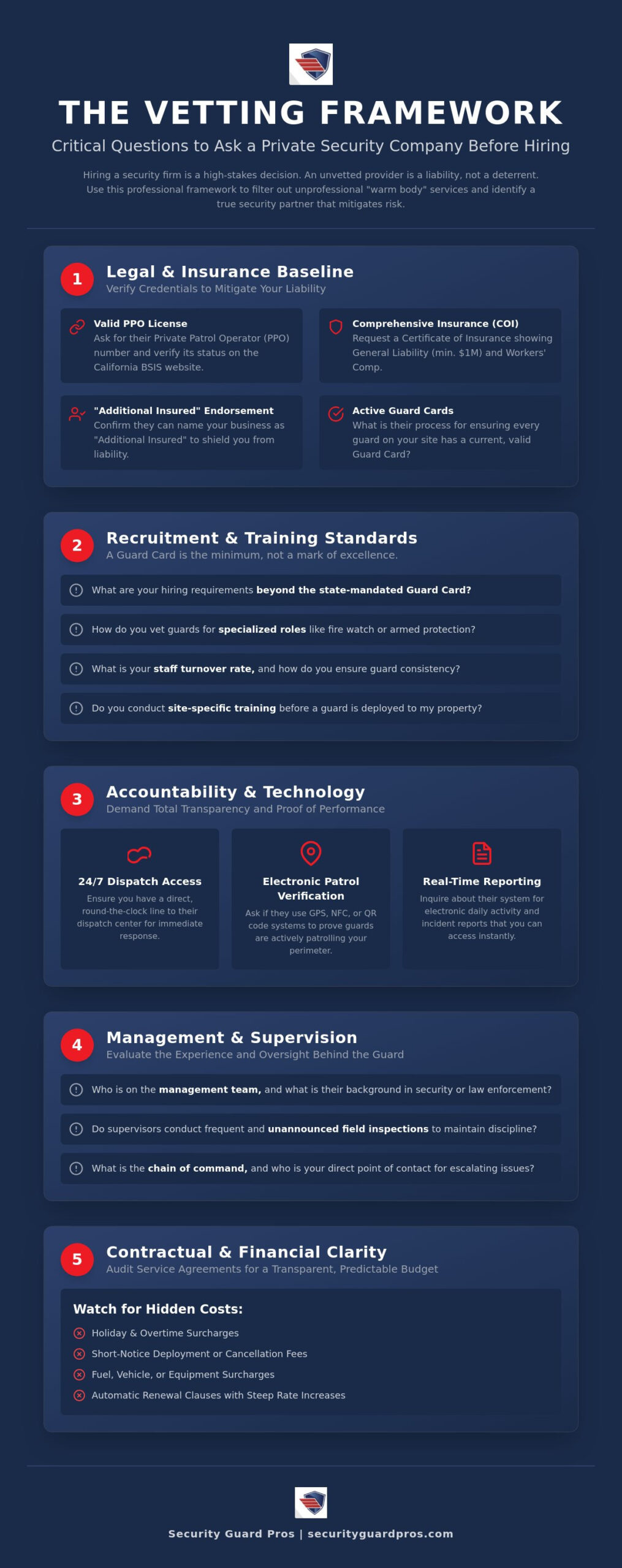
- Confirm your provider holds a valid Private Patrol Operator (PPO) license and comprehensive insurance to shield your business from unnecessary liability.
- Utilize our professional framework of questions to ask a private security company before hiring to evaluate their internal recruitment standards and specialized training.
- Demand total accountability through 24/7 dispatch access and electronic patrol verification systems that prove guards are actively securing your perimeter.
- Identify firms led by experienced management teams who conduct unannounced field inspections to maintain a disciplined deterrent on your property.
- Audit service agreements for hidden costs like holiday surcharges or short-notice deployment fees to ensure a transparent and predictable security budget.
The Legal Baseline: Questions About Licensing and Insurance
Hiring a security firm without verifying their legal credentials is a gamble with your company’s future. Professional protection starts with a robust legal foundation that shields you from liability and regulatory fines. Before you sign any contract, you must establish that the provider is a legitimate entity capable of absorbing the risks inherent in security work. These are the non-negotiable questions to ask a private security company before hiring to ensure they are a “Modern Guardian” rather than a legal liability.
- What is your Private Patrol Operator (PPO) license number and is it in good standing with the BSIS?
- Can you provide a COI (Certificate of Insurance) specifically including General Liability and Workers Comp?
- How do you handle “Additional Insured” endorsements for specific client properties?
- What is your process for ensuring every guard on my site has a valid, current Guard Card?
Understanding the California PPO Requirement
In California, the Private Patrol Operator (PPO) license is the only legal authorization for a company to provide security services. It serves as the baseline for professionalism. Hiring an unlicensed firm is a dangerous shortcut that leaves you exposed to massive lawsuits, state-level fines, and a total lack of insurance coverage if an incident occurs. You can verify a PPO license status in seconds by visiting the Bureau of Security and Investigative Services (BSIS) website and using their “Verify a License” portal.
Insurance Coverage Limits and Liability Protection
Insurance is your secondary shield. While many small agencies carry minimal policies, a $1 million coverage limit is the absolute bare minimum for commercial sites in 2026. You must distinguish between general liability, which covers physical accidents like slips and falls, and professional liability, which covers errors in security judgment or failure to perform. If a firm cannot produce a Certificate of Insurance (COI) that names you as “Additional Insured,” they aren’t protecting you; they’re leaving you to face the financial consequences alone.
Security Guard Pros structures security guard services in Los Angeles to maximize client protection by maintaining high-tier coverage and rigorous compliance. Our management team audits every guard’s credentials weekly to ensure Guard Cards are current and valid. We treat these legal requirements as a badge of legitimacy, providing you with the calm confidence that your property is guarded by a disciplined, fully insured workforce. Don’t settle for “warm body” services that ignore these critical legal questions to ask a private security company before hiring; demand the transparency of a seasoned veteran.
Recruitment and Training: Vetting the Personnel on Your Property
A state-issued Guard Card is a legal minimum, not a certificate of excellence. It simply proves the individual has met the basic requirements to work in the industry. When you’re entrusting a firm with your assets, you must look for the “Modern Guardian” who possesses the discipline and technical skill to manage complex threats. High turnover and inadequate training are the primary drivers of site incidents and liability claims. Use these targeted questions to ask a private security company before hiring to ensure they deploy seasoned professionals rather than “warm bodies” in a uniform.
- What are your minimum hiring requirements beyond the state-mandated Guard Card?
- How do you vet guards for specialized roles like fire watch or armed protection?
- What is your turnover rate, and how do you ensure consistency in guard placement?
- Do you conduct site-specific training before a guard ever steps foot on my property?
Recruitment should involve a rigorous behavioral assessment. You want a team that exhibits calm confidence under pressure. If a company’s turnover rate is high, your site protocols will never be mastered, as a revolving door of new guards will constantly be “learning on the job” at your expense. Insist on a partner that prioritizes long-term placement and provides a stern deterrent through consistent, familiar personnel. These are the essential questions to ask a private security company before hiring that separate professional guardians from generic staffing agencies.
Armed vs. Unarmed Guard Standards
The distinction between armed and unarmed service is a critical matter of liability and lethal force responsibility. Armed personnel must maintain valid firearms permits and undergo frequent requalification. Under 2026 California legislation, specifically SB 1203, security guards now require 16 hours of annual training, with 8 of those hours dedicated strictly to de-escalation skills. This ensures that any use of force is a last resort, protecting your brand’s reputation and your legal standing. You can compare high-tier protection options in our guide to armed security guards in Los Angeles.
Specialized Training for Industry Needs
Generic security training fails in specialized environments like industrial zones or construction sites. For construction security, guards must be trained to recognize equipment theft patterns and adhere to OSHA safety standards to prevent workplace accidents. Fire watch services require even deeper expertise, including mastery of NFPA standards and meticulous logbook maintenance to avoid heavy municipal fines. We leverage over 70 years of collective management experience to build training modules that address these specific industry risks. If you’re concerned about the quality of personnel currently on your site, consult with a regional expert to audit your current training requirements.
Accountability and Technology: Who Guards the Guardians?
“Who guards the guardians?” is more than a philosophical inquiry; it’s a pragmatic business requirement. Accountability is the bridge between a signed contract and actual site safety. Without active oversight, guard performance inevitably degrades over time. To prevent this, you must investigate the systems used to monitor personnel. These are the essential questions to ask a private security company before hiring to ensure you aren’t paying for “ghost” coverage or stagnant patrols.
- Do you have a 24/7 dispatch center, and how can I reach a supervisor at 3:00 AM?
- What technology do you use to verify that guards are actually performing their rounds?
- How are incident reports delivered, and can I see a sample of your electronic reporting?
- How do you handle ‘no-call, no-show’ situations to ensure my site is never left vacant?
A security firm’s infrastructure should be as disciplined as its personnel. If a provider lacks a centralized command structure, they can’t guarantee the unwavering reliability you need to focus on your core operations. These questions to ask a private security company before hiring will reveal if a firm is a modern guardian or a low-tech staffing agency.
24/7 Dispatch and Rapid Deployment
A dedicated, 24/7 dispatch center is the central nervous system of any professional security operation. It ensures that an expert is always available to handle emergencies, coordinate fire watch outages, or manage unexpected site issues. If you can’t reach a supervisor during the graveyard shift, your provider has failed you. Ask about their protocols for “no-call, no-show” scenarios. A veteran firm maintains a reserve of on-call guards to ensure your property is never left vacant. Localized expertise in Los Angeles, Orange, and San Diego counties allows for faster transit and more efficient rapid deployment than firms managed from out-of-state.
Electronic Reporting and GPS Tracking
The industry has shifted from unreliable paper logs to real-time digital accountability. Digital reporting provides a transparent window into site activity, allowing you to review guard rounds as they happen. GPS geofencing technology acts as a virtual perimeter, ensuring guards stay within their assigned zones and complete every mandatory checkpoint. These digital logs provide a permanent, tamper-proof audit trail for insurance claims, offering concrete evidence of patrol activity during a liability event. If a company still relies on handwritten notes, they lack the modern tools required to protect a commercial asset in 2026. Request a sample of their electronic incident reports to verify the level of detail they provide before you sign a contract.
Management Structure: Evaluating the Experience Behind the Guard
The quality of a security operation isn’t determined by the individual at the gate, but by the leadership in the office. Many agencies function as mere staffing pools, hiring guards and leaving them to their own devices without professional oversight. This “management gap” is where most security failures occur. You need to know if the firm’s leadership has the tactical depth to handle a crisis. These are the management-focused questions to ask a private security company before hiring to ensure they possess the seasoned discipline required for high-stakes protection.
- What is the background of your management team, and do they have law enforcement or military experience?
- How often do field supervisors conduct unannounced inspections of the guards on my site?
- Will I have a dedicated account manager who understands my specific industry?
- How do you handle client feedback or requests for guard replacements?
A firm’s years in business don’t guarantee quality, but the specific experience of its leaders does. Look for a team with a background in disciplined environments like the military or law enforcement. This ensures that the “Modern Guardian” persona isn’t just marketing; it’s a standard enforced from the top down. A transparent and accountable management team will be eager to discuss their performance metrics and specific implementation plans for your property.
The Importance of Field Supervision
“Set it and forget it” security is a recipe for negligence. On high-risk properties, guards need regular, unannounced check-ins to maintain vigilance and ensure all post orders are followed. Ask about the supervisor-to-guard ratio. If one supervisor is responsible for fifty guards across the county, your site isn’t receiving the attention it deserves. We leverage over 70 years of collective management experience to oversee our operations, ensuring that field supervisors are active participants in your site’s safety. This rhythmic pattern of inspection and immediate resolution maintains the steady, efficient pace of a professional shield.
Industry-Specific Management Expertise
Generic management fails when faced with the nuances of specific sectors. Property managers need leaders who understand how to handle transient issues or HOA disputes with a balance of stern deterrent and professional courtesy. In contrast, construction site security guards require management that understands a perimeter that changes daily as the project progresses. Industry-specific knowledge prevents the “one-size-fits-all” failures that lead to asset loss and liability. If your current provider lacks this specialized oversight, it’s time to consult with our management team about a tailored protection plan that prioritizes your core operations.
Contractual Clarity: Understanding Fees and Service Terms
The final layer of your protective shield is the service agreement itself. A contract should be a transparent roadmap of expectations and costs, not a confusing document filled with fine print. If a provider is vague about their billing or cancellation terms, they’re likely hiding inefficiencies that will eventually cost you more than just money. Use these financial questions to ask a private security company before hiring to ensure your budget is utilized for actual protection rather than administrative overhead.
- Are there hidden fees for holidays, overtime, or emergency “short-notice” deployments?
- What is the cancellation policy if the service does not meet my expectations?
- How do you handle billing for mobile patrols, is it per visit or per hour?
- Can you provide a customized security plan before I sign a long-term contract?
Transparency in pricing is a hallmark of professional authority. A disciplined firm understands that your commercial management needs predictable expenses to maintain focus on core operations. By securing clear answers to these questions to ask a private security company before hiring, you eliminate the anxiety of “invoice shock” and establish a partnership built on mutual accountability.
Transparent Pricing vs. The Lowest Bid
The “low-bid” trap is one of the most significant risks in the security industry. Cheap security is almost always the result of low guard wages, which leads to high turnover, poor morale, and a lack of vigilance on your property. When a company undercuts the market, they’re often cutting corners on training or insurance compliance. Ask if their rates allow them to attract and retain seasoned veterans who can act as a stern deterrent. For specific needs like large-scale gatherings, a flat-rate contract often provides better value than hourly staffing. You can learn more about these structures in our guide to event security companies.
The Custom Security Analysis
Never accept a generic quote over the phone. A professional firm identifies blind spots in your perimeter that you might have missed; this requires an on-site evaluation. A site walk-through allows the provider to assess lighting, access points, and specific industry risks like equipment theft or transient issues. This process transforms security from a generic commodity into a tailored implementation plan. It ensures that every guard hour billed is an hour spent actively mitigating your specific vulnerabilities. To begin this process, contact Security Guard Pros for a customized security analysis of your SoCal property. We provide the calm confidence that comes from a plan designed by experts who respect traditional security values while utilizing modern tools.
Securing Your Asset with Professional Oversight
Selecting a security partner is a high-stakes decision that’ll impact your liability profile and operational peace of mind. You’ve now got the professional framework needed to identify a “Modern Guardian” who provides more than just a uniform. Focus on verifying legal credentials like a valid PPO license and demanding real-time electronic reporting. These steps ensure your provider isn’t a high-risk staffing agency. Demand excellence.
By utilizing this strategic framework of questions to ask a private security company before hiring, you’ll move from a state of vulnerability to absolute site security. We bring over 70 years of collective management experience and a 24/7 dispatch center to every property we protect. As a licensed Private Patrol Operator (PPO #119854), we prioritize accountability and rapid deployment across Los Angeles, Orange, and San Diego counties.
Secure your property today with a professional consultation from Security Guard Pros. Our veteran-led team’s ready to conduct a site-specific analysis that eliminates blind spots and allows you to focus on your core business without the distraction of security concerns. Take the first step toward a safer environment now.
Frequently Asked Questions
What is the most important license for a security company in California?
The Private Patrol Operator (PPO) license is the most critical credential for any security firm operating in California. This license, issued by the Bureau of Security and Investigative Services (BSIS), authorizes a business to contract out security services to third parties. It’s the legal foundation for the industry. Without a valid PPO number, a company is operating illegally and cannot provide you with the insurance protections or regulatory oversight required to shield your business from liability.
How do I verify if a security guard is actually licensed?
You can verify a guard’s license status in seconds by using the BSIS “Verify a License” online portal. Every legitimate security professional must carry a valid “Guard Card” while on duty. Enter their name or license number into the state database to confirm their status is “Current.” This is one of the essential questions to ask a private security company before hiring to ensure they maintain strict compliance with California’s 2026 training mandates.
What is the difference between a security guard and a private patrol operator?
A security guard is an individual employee, whereas a Private Patrol Operator is the licensed business entity that employs them. Guards carry a registration card to perform security work, but only a PPO has the legal authority to sign contracts and provide services to commercial clients. Understanding this distinction helps you vet the company’s corporate legitimacy rather than just the person at your gate. Always ensure you’re contracting with a licensed PPO, not an individual.
Should I hire armed or unarmed guards for my business?
Choose armed guards only for high-threat environments where a lethal deterrent is a verified necessity for asset protection. For most retail, corporate, or construction sites, unarmed guards with advanced de-escalation training provide sufficient protection with significantly lower liability risk. Evaluate your specific site threats and insurance requirements before deciding. A professional consultation can help determine which level of force aligns with your property’s risk profile without creating unnecessary legal exposure.
How much does it cost to hire a private security company in Los Angeles?
Security costs in Los Angeles are determined by the guard’s experience level and the specific risk profile of your property. Rates in Southern California are influenced by strict training mandates and high insurance premiums. You should focus on the value of the protection rather than seeking the lowest hourly rate. Firms that undercut the market often provide “warm body” services that increase your liability and fail to deliver the disciplined results you need to focus on operations.
What happens if a security guard is injured on my property?
If a guard is injured on your property, a professional firm’s Workers’ Compensation policy should cover the claim. This is why you must verify that the provider carries robust insurance before deployment begins. If you hire an uninsured or underinsured firm, the legal and financial responsibility for the injury could fall on your business. Always demand a Certificate of Insurance that names you as an additional insured party to maintain your financial shield.
Can a security company provide fire watch services on short notice?
Professional security firms with 24/7 dispatch centers can often deploy fire watch services on short notice to prevent building closures. Rapid deployment is critical when a fire alarm or sprinkler system fails, as local fire marshals require an immediate physical watch to maintain safety compliance. Veteran providers maintain a reserve of on-call personnel specifically for these emergency scenarios. This ensures your operations continue without interruption while meeting all NFPA standards and municipal requirements.
What should be included in a standard security guard contract?
A standard security contract must include a clear scope of work, insurance requirements, and a transparent fee schedule. It should detail the specific post orders, the frequency of patrols, and the technology used for accountability. Ensure there’s a defined cancellation policy and no hidden surcharges for holidays or emergency deployments. These details are vital questions to ask a private security company before hiring to transform a generic agreement into a disciplined implementation plan for your site.