A single malfunctioning sprinkler head or a “trouble” signal on your fire panel can trigger a mandatory building evacuation by the Fire Marshal in under four hours. For California property owners, this scenario is a high-stakes race against the clock. You need to understand exactly what is fire watch to prevent a forced shutdown or a massive fine due to technical failure. We understand the anxiety that comes with navigating complex NFPA 25 and California Title 19 regulations during a crisis. It’s frustrating when safety systems fail, but your business shouldn’t have to stop.
This guide provides the clarity you need to stay protected. You will learn how to deploy BSIS licensed professionals to maintain legal occupancy 24/7. Master the legal requirements, safety protocols, and implementation steps to ensure your property remains a secure environment during repairs. We’ll break down the specific duties of a PPO-backed guard and the immediate actions required to satisfy local authorities and protect your liability. This roadmap ensures you remain compliant while focusing on your core operations.
Key Takeaways
- Define what is fire watch and understand its critical role in maintaining Life Safety Code compliance when your primary protection systems fail.
- Identify the specific regulatory triggers, such as the “4-Hour Rule,” that mandate immediate fire watch deployment to avoid legal penalties.
- Master a professional 5-step compliance checklist to ensure your safety protocols satisfy both insurance carriers and local fire departments.
- Learn why a detailed fire watch log is your most vital legal shield during inspections and which specific data points must be recorded.
- Evaluate the liability risks of using untrained in-house staff versus the cost-effective reliability of professional, BSIS-licensed guards.
What is Fire Watch? Definition and Core Safety Functions
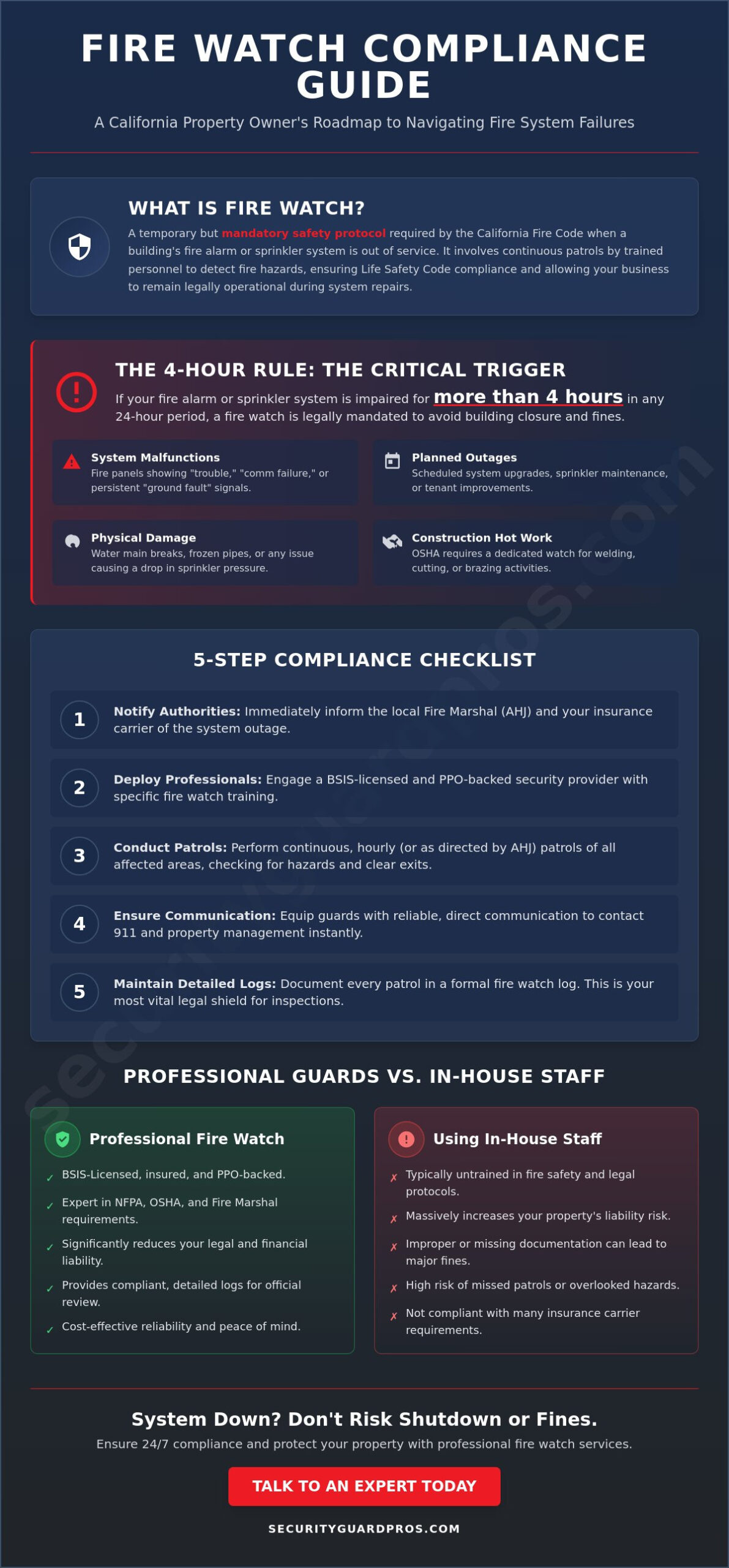
Understanding what is fire watch starts with recognizing it as a critical compensatory safety measure. It’s a human-led surveillance operation mandated when a building’s automatic fire sprinkler or alarm system is impaired for more than four hours in a 24-hour period. Under the 2022 California Fire Code, property owners must implement this protocol to maintain Life Safety Code compliance. This prevents the immediate evacuation and closure of a facility, allowing business operations to continue while repairs occur. Unlike meteorological fire weather alerts that track regional wind and humidity, fire watch is a localized, tactical response to specific mechanical or structural vulnerabilities within a property.
The Primary Responsibilities of a Fire Watch Guard
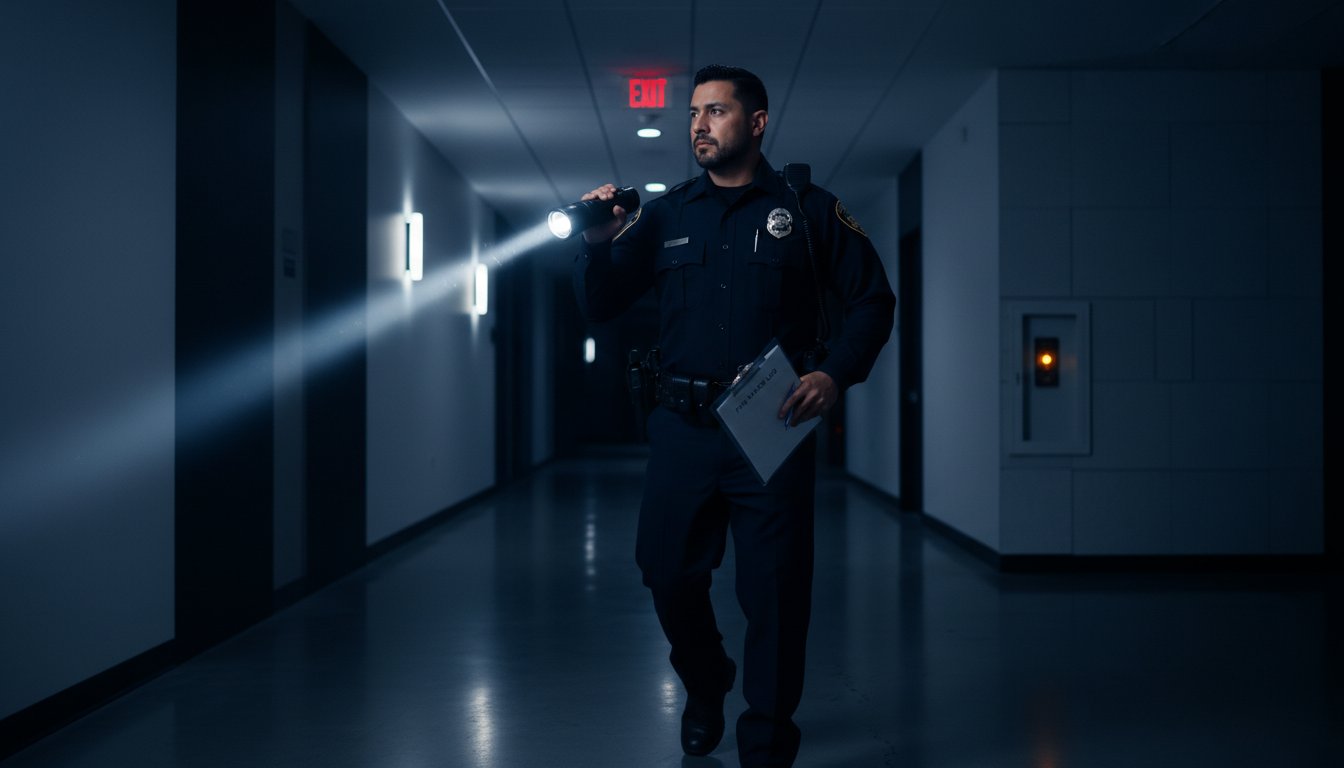
A professional fire watch guard provides a vigilant presence that technology cannot replicate during a system outage. They perform continuous patrols of all affected areas, searching for early signs of smoke, flame, or unusual heat. In industrial settings where welding or grinding occurs, Wikipedia’s Guide to Fire Watch highlights the guard’s role in monitoring sparks that could ignite flammable debris. Our BSIS Licensed guards verify that communication pathways to emergency services are functional, ensuring a 911 call is placed the moment a hazard is detected. They also identify and mitigate secondary risks, such as blocked fire exits or improperly stored hazardous materials. Deter loss and stay protected by ensuring these patrols are documented in a formal fire log for the Fire Marshal.
Key Terminology: NFPA and the Fire Marshal
Meeting the requirements of the NFPA 101 (Life Safety Code) and NFPA 25 standards is non-negotiable for California property owners. These codes dictate the frequency of patrols and the specific training required for personnel. The Authority Having Jurisdiction (AHJ), typically a local Fire Marshal in Southern California, oversees these requirements and possesses the legal power to tag a building as “Unsafe for Occupancy” if protocols fail. Compensatory measures are temporary safety substitutes that provide a necessary level of protection while primary fire systems are offline. Security Guard Pros utilizes PPO licensed staff and 24/7 dispatch to meet these AHJ standards, providing the accountability needed to satisfy regulatory inspections and insurance mandates. Talk to an expert today to ensure your facility remains compliant and secure during system maintenance.
When is Fire Watch Required? Triggers and Legal Mandates
California law is clear. If your fire alarm or sprinkler system fails for more than 4 hours in a 24-hour window, you must initiate a fire watch. This “4-Hour Rule” isn’t a suggestion; it’s a legal mandate to avoid immediate building closure. Many property managers ask what is fire watch only after they face a sudden system failure. Understanding these triggers ahead of time prevents the anxiety of a forced evacuation by the Fire Marshal.
Planned outages for sprinkler maintenance or system upgrades require advance preparation. Unplanned outages are more dangerous. These include malfunctioning fire alarm panels, persistent “trouble” signals that won’t clear, or water main breaks that drop sprinkler pressure. You can’t leave your assets vulnerable when technology fails. When your electronic smoke detection goes dark, human vigilance becomes your only line of defense.
Construction sites face additional scrutiny under federal and state law. High-heat activities like welding, cutting, or brazing are primary fire risks that require a dedicated observer. Per OSHA Fire Watch Requirements, you must have personnel on-site to monitor for sparks and smoldering materials for at least 30 minutes after the work finishes. This prevents “hidden” fires from igniting hours after the crew leaves. To understand the full scope of these time-based obligations — including the 30-minute post-work requirement, the 4-hour alarm threshold, and the 10-hour window for suppression systems — review the complete breakdown of how long is fire watch required under California duration standards.
Occupancy types dictate the intensity of the mandate. Hospitals, schools, and high-density HOAs have a zero-tolerance policy for system downtime. In these environments, the risk to life is too high to ignore. If you’re managing a facility with non-ambulatory patients or young children, your response to a system failure must be instantaneous. You can talk to an expert to establish a pre-approved fire watch plan that keeps your doors open.
Common Scenarios for Emergency Fire Watch
- System Malfunctions: Fire panels displaying “comm failure” or “ground fault” signals that technicians can’t resolve within 240 minutes.
- Infrastructure Failure: Water main breaks or frozen pipes that disable the building’s sprinkler suppression capabilities.
- Utility Disruptions: Prolonged power outages that exhaust battery backups for smoke detectors and emergency lighting.
California-Specific Regulatory Triggers
The 2026 updates to Title 19 of the California Code of Regulations emphasize “imminent hazard” protocols. In jurisdictions like Los Angeles and San Diego, Fire Marshals interpret any system impairment as a critical threat. Construction sites in high-fire-risk zones must maintain a 24/7 watch if systems aren’t fully operational. Failure to comply leads to immediate “Stop Work” orders and daily fines that can exceed $1,000. When you understand what is fire watch in the context of California’s strict 2026 codes, you realize it’s a vital tool for business continuity. Our BSIS licensed guards ensure your property meets every regional mandate without delay.
How to Conduct a Fire Watch: A 5-Step Compliance Checklist
Implementing a fire watch is a high-stakes operation where technical compliance meets physical vigilance. It’s not a suggestion; it’s a legal mandate when fire protection systems fail for more than four hours. Understanding what is fire watch involves mastering a rigorous, five-step protocol that satisfies the California Fire Code and protects your bottom line.
Immediately alert the Authority Having Jurisdiction (AHJ) and your insurance provider. In California, failure to report a system outage can lead to heavy fines or the immediate evacuation of your building. Your insurance carrier requires this notification to ensure your liability coverage remains active during the vulnerability period.
California law requires “competent” individuals to staff the watch. These guards must have zero other duties. They don’t answer phones, they don’t monitor security cameras, and they don’t move freight. Their sole focus is fire detection and life safety.
A compliant watch leaves no corner unexamined. Your patrol must include every floor of the structure and every individual room within those floors. If a guard skips a mechanical closet or a basement storage area, the entire watch is considered non-compliant.
Every guard needs a dedicated cell phone or two-way radio with a guaranteed 24/7 signal. They must also carry a portable fire extinguisher and have the training to use it on incipient-stage fires. Reliable communication is the only way to ensure a 911 call happens the moment smoke is spotted.
Documentation is your primary defense. You must maintain a written log that records the start and end time of every patrol, the specific areas inspected, and any hazards found. If the Fire Marshal asks to see your logs and they’re incomplete, you face immediate citations. Knowing exactly how long is fire watch required for your specific impairment type ensures your log covers the full legally mandated duration without gaps.
Setting Up Your Patrol Route
Mapping your route requires identifying high-risk “blind spots” that automated systems usually cover. You must include storage rooms, basements, and mechanical closets in every circuit. Patrol frequency is usually dictated by the Fire Marshal, typically occurring every 15, 30, or 60 minutes. Ensure guards have unobstructed access to all locked areas. If a guard can’t enter a room, they can’t clear it for fire, which breaks the chain of safety. Stay protected by providing master keys or fobs to the watch team before the first round begins.
Essential Equipment for Fire Watch Guards
When you ask what is fire watch equipment, think of it as a mobile command center. Guards must wear high-visibility vests to remain identifiable during a chaotic evacuation. They require high-lumen LED flashlights to inspect dark crawl spaces and floor maps to navigate complex layouts. Most importantly, they need reliable two-way radios. In large concrete structures, standard cell signals often fail, making dedicated radio frequencies a requirement for unwavering reliability. This equipment allows our team to act as a protective shield for your property.
Documentation and the Fire Watch Log: Your Legal Shield
A Fire Marshal inspection in California centers on one primary artifact: the logbook. When asking what is fire watch in a legal context, it isn’t just the physical presence of a guard. It’s the chronological record of their movements. This document serves as your primary defense against citations and lawsuits. If a fire occurs and you cannot produce a minute-by-minute account of your safety patrols, your insurance carrier may deny your claim based on negligence. For properties in high-density areas like Southern California, the logbook is the difference between a routine inspection and a $5,000 fine.
Understanding what is fire watch requirements means recognizing that documentation is just as critical as the patrol itself. Every entry must capture three non-negotiable data points: the exact time of the patrol, the specific area inspected, and the guard’s printed name or signature. We recommend documenting “negative findings” consistently. Recording that a stairwell was clear at 03:15 proves the guard was vigilant even when no hazards were present. Under California Fire Code standards, you should retain these records for at least three years after the fire protection system is fully restored. This duration covers the typical statute of limitations for property damage and personal injury claims in the state.
What a Compliant Fire Watch Log Entry Looks Like
Precision is the standard for every entry. A standard, compliant entry follows this structure: Date, Time, Location, Status, and Personnel. For example: “Oct 12, 2026, 14:00, Parking Level P2, Fire Exit Clear, R. Martinez.” If a guard discovers a hazard, such as a propped-open fire door or an accumulation of combustible trash, they must record the specific issue and the immediate action taken to resolve it. In the eyes of the law and the fire department, if it isn’t in the log, it didn’t happen.
Avoiding Common Documentation Errors
The most dangerous mistake a property manager can permit is “pre-filling” logs. This occurs when a guard fills out entries for the entire shift at the start of their watch. Fire Marshals look for identical handwriting pressure and ink shades as signs of this fraudulent practice. Gaps in the log are equally hazardous. A missing 30-minute window creates a massive liability gap that trial lawyers can exploit during litigation. Utilizing professional Security Guards in Los Angeles: Elite Protection ensures that every patrol is tracked via digital timestamps, eliminating the risk of human error or falsification.
Professional Fire Watch vs. In-House Staff: Making the Choice
California property owners often face a difficult choice when a fire alarm or sprinkler system fails. You might think about asking a janitor or a warehouse manager to walk the floor, but this is a dangerous gamble. Using untrained staff creates a massive liability gap. These employees lack the BSIS-certified training necessary to spot subtle hazards that lead to catastrophic losses. When you truly understand what is fire watch under California law, you realize it’s a specialized safety function, not a secondary task for your existing crew.
Professional dispatch is the only way to guarantee 24/7 coverage. If a pipe bursts or a panel fails at midnight, your in-house team isn’t ready to respond. Security Guard Pros operates with a sense of no-nonsense professionalism, deploying guards who act as a stern deterrent to fire risks. We currently protect over $1 billion in assets across the state. This scale of experience provides a level of accountability and peace of mind that in-house staff simply can’t match.
Why Professional Guards Save Money in the Long Run
The upfront cost of a professional guard is a small fraction of a Fire Marshal fine. In many California jurisdictions, daily penalties for fire code violations start at $500 and quickly escalate to over $2,500 per day. Professional oversight also protects your insurance standing. Many carriers will deny claims if they discover a fire watch was conducted by uncertified personnel. By hiring us, you allow your employees to focus on their actual jobs while we provide the professional, time-stamped reporting needed to stand up in regulatory hearings or court.
Hiring Fire Watch Services in Southern California
Regional expertise is vital because fire codes in Los Angeles differ from those in San Diego or Orange County. You must verify that your provider holds a valid PPO (Private Patrol Operator) license and follows all BSIS regulations. When evaluating providers, use a fire watch company compliance checklist to confirm they meet every 2026 California requirement before signing a contract. Security Guard Pros brings a modern, A.I. technology-driven approach to traditional security values. We ensure every patrol is logged and every hazard is documented instantly. This ensures you stay protected and compliant with every local ordinance.
Don’t wait for a fire inspector to shut down your building or issue a costly citation. A professional guard service is your protective shield against liability. Our experts are ready to deploy immediately to secure your facility and your bottom line.
Secure Your Property and Maintain California Compliance
Understanding what is fire watch is the first step toward shielding your investment from legal liability and fire hazards. California law demands immediate action the moment life safety systems fail. You’ve seen that a compliant fire watch requires a meticulous 5-step checklist and a rigorous logbook to serve as your legal defense. Don’t risk heavy fines or business closure by relying on untrained staff. Rely on a partner with 70+ years of collective management experience to handle your safety protocols with precision.
Security Guard Pros provides the professional authority you need to stay safe and focused on your core operations. As a BSIS Licensed PPO #18131, we deliver 24/7 emergency dispatch and rapid deployment throughout Southern California. Our team eliminates the anxiety of non-compliance by providing accountable, highly trained guards who understand the gravity of their role. Secure your perimeter today and experience the peace of mind that comes with expert protection.
Request Immediate Fire Watch Deployment for Your SoCal Property
Your assets are too valuable to leave to chance. Stay vigilant and stay protected.
Frequently Asked Questions
Is fire watch required if only part of the sprinkler system is down?
Yes, you’re required to implement a fire watch if any portion of your fire protection system is non-functional for more than 4 hours. California Fire Code Section 901.7 mandates this protocol to ensure life safety across the entire premises. Even if only one floor or a specific zone’s sprinklers are down, the risk remains high. You’re responsible for maintaining a continuous patrol until the system is fully restored and tested by a certified technician.
Can I use my existing security guards for fire watch duties?
You can only use existing guards if they’re dedicated 100 percent to fire watch duties and have no other responsibilities. NFPA 101 standards prohibit guards from multitasking during a fire watch. If your current team is monitoring cameras or checking IDs, they aren’t compliant. Security Guard Pros provides BSIS licensed personnel who focus exclusively on fire detection to maintain your legal standing and safety.
How long can a fire watch last before I must evacuate the building?
A fire watch can continue indefinitely as long as you maintain 24/7 coverage and receive approval from your local Fire Marshal. Most California jurisdictions require a formal plan if repairs take longer than 24 hours. If you fail to provide a certified guard or the hazard increases, the Fire Marshal may issue an immediate evacuation order to protect occupants. Stay protected by ensuring your patrol logs are impeccable and up to date.
What happens if I don’t start a fire watch when my system fails?
Failing to initiate a fire watch results in immediate citations, heavy fines, and a potential “Red Tag” closure of your facility. Under California Health and Safety Code 13110, property owners face criminal liability if an injury occurs during an unmonitored system failure. Fines in cities like Los Angeles can exceed $1,000 per day. Beyond legal penalties, your insurance provider will likely deny claims for damages occurring while the system was down.
How many fire watch guards do I need for a multi-story building?
You typically need one guard for every floor to ensure a complete patrol of the facility every 30 to 60 minutes. The specific count depends on your building’s square footage and the complexity of the layout. For a 10 story high rise, the Fire Marshal may require multiple guards to ensure no area is left unobserved for too long. Talk to an expert at Security Guard Pros to determine your specific staffing needs based on your floor plan.
Do fire watch guards need to be armed?
Fire watch guards don’t need to be armed because their primary objective is fire detection and emergency notification. Their focus remains on identifying smoke, heat, or flames and alerting the fire department immediately. While Security Guard Pros offers armed options for high threat environments, standard fire watch duties are performed by unarmed, BSIS licensed professionals trained in fire safety protocols. This keeps your costs manageable while ensuring total compliance with local ordinances.
Can I perform a fire watch myself as a property owner?
You can legally perform the watch yourself, but you must remain awake and perform no other tasks for the entire duration of the shift. Most property owners find this impossible to sustain for more than a few hours. What is fire watch if not a commitment to 24/7 vigilance? Using a professional PPO licensed agency ensures that your patrol logs meet the rigorous standards required by California fire inspectors and insurance adjusters.
What is the ‘4-hour rule’ in fire watch regulations?
The 4 hour rule refers to the maximum time a fire protection system can be impaired before you must notify the Fire Marshal and start a fire watch. According to NFPA 25, if your sprinklers or alarms are down for more than 4 hours within a 24 hour window, you’re legally out of compliance. This rule prevents property owners from ignoring minor outages that actually pose significant risks to life and property. Before your system fails, it’s wise to research and vet a qualified fire watch company so you can deploy certified personnel immediately when the clock starts ticking.