Maintaining an in-house security team in 2026 isn’t just a management challenge; it’s a direct threat to your company’s balance sheet. As California labor costs climb and payroll taxes squeeze margins, the debate over in-house vs contract security guards has shifted from a simple staffing choice to a critical risk management strategy. You’re likely feeling the weight of managing complex 24/7 schedules while worrying about the looming shadow of a negligent security lawsuit. Your security model should be a protective shield, not a source of constant operational anxiety.
We understand that protecting your assets shouldn’t distract you from growing your core business. This guide provides a data-driven framework to justify your 2026 security budget to the board by emphasizing liability transfer and operational scalability. You’ll learn how to lower insurance premiums and eliminate the administrative burden of internal HR management. We’ll break down the fully burdened costs of direct hiring versus the streamlined efficiency of a licensed Private Patrol Operator (PPO), ensuring you choose a model that is both cost-effective and legally robust.
Key Takeaways
- Define the core differences between proprietary hiring and third-party agencies to determine which structural model aligns with your 2026 corporate goals.
- Uncover the “hidden killers” of security budgeting by calculating fully burdened costs, including payroll taxes, workers’ compensation, and administrative overhead.
- Analyze the strategic advantages of in-house vs contract security guards to determine which model offers the most effective liability transfer under California law.
- Identify how a scalable contract model provides the operational agility needed for rapid deployment during peak seasons or sudden business expansion.
- Equip yourself with the metrics needed to justify a professional security budget as a high-value deterrent rather than a low-bid commodity.
In-House vs. Contract Security Guards: Defining Your Protection Model in 2026
The security landscape in 2026 demands more than just a physical presence. It requires a strategic decision on how you structure your defense. Choosing between in-house vs contract security guards is the first step in fortifying your Southern California property against evolving threats. This decision dictates your operational flexibility and your long-term financial stability.
Proprietary security involves hiring guards directly onto your company payroll as internal employees. Conversely, contract security utilizes professional services from a licensed third-party agency, known as a Private Patrol Operator. As a seasoned veteran in this field, I can tell you that this choice isn’t just about who stands at the gate. It’s about who carries the weight of the risk and who manages the fallout of a security breach.
Southern California is currently facing sophisticated property crime trends that require a disciplined, professionalized response. Organized retail theft and complex logistics breaches have evolved beyond the capabilities of untrained staff. In 2026, a “warm body” approach is no longer sufficient. You need a model that balances deterrent power with absolute legal compliance. Choose the model that allows you to focus on your business while we handle the vigil.
The Proprietary Model: Control vs. Burden
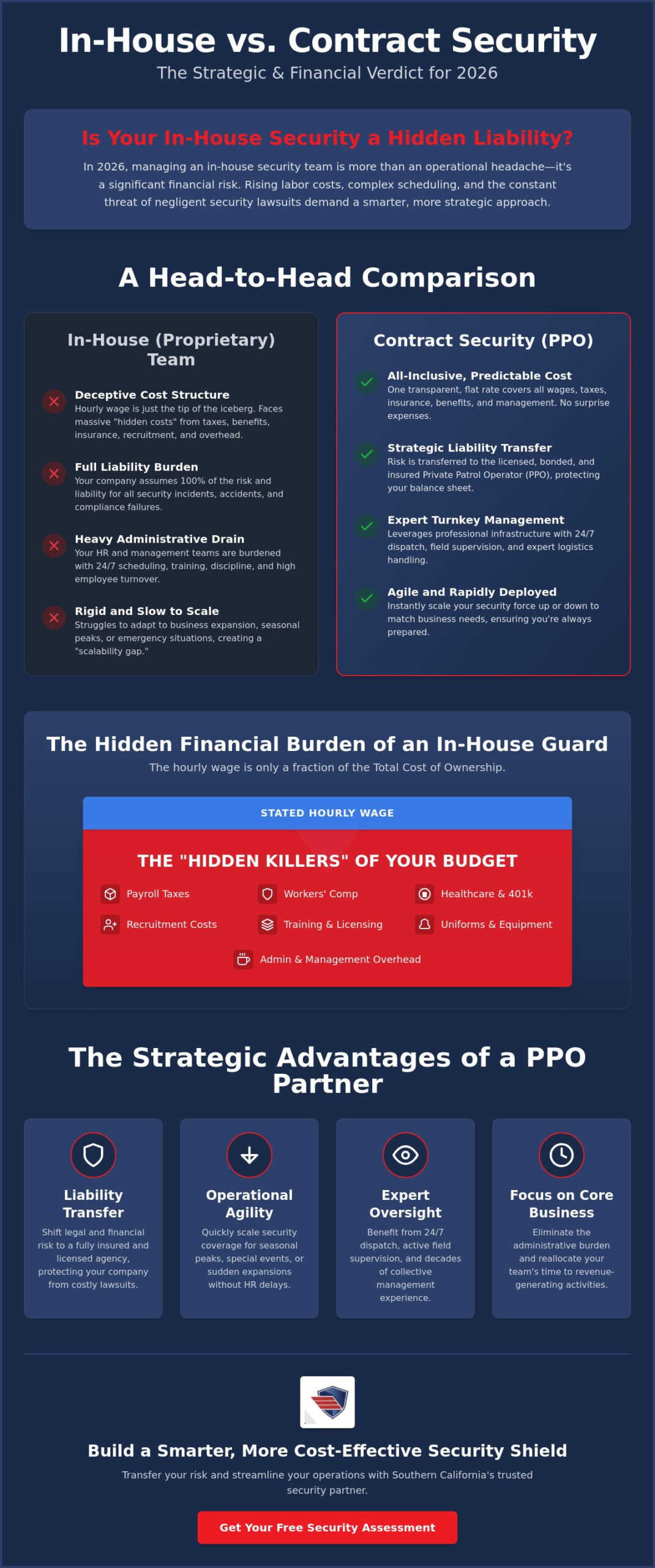
The primary appeal of In-house, private, or proprietary security is the level of brand-specific training you can implement. You have direct supervision over every guard. However, this control comes with a heavy administrative price. You must manage the entire lifecycle of the employee, including recruitment, background checks, and constant training. In-house vs contract security guards comparisons often overlook the hidden reality of high turnover in proprietary teams. Security is often a secondary function of your business, leading to a lack of specialized career paths for guards. This stagnation creates a “scalability gap” where your team fails to adapt when your business expands or faces a crisis.
The Contract Model: Accountability and Expertise
Partnering with a professional security guard service gives you instant access to a battle-tested infrastructure. You aren’t just hiring personnel; you’re gaining a protective shield. Professional agencies provide 24/7 dispatch and active field supervision to ensure standards never slip. We leverage over 70 years of collective management experience to handle complex site logistics that internal HR departments aren’t equipped to manage. This model ensures that every guard on your property is vetted, licensed, and ready to act. You gain a scalable defense that adapts to your needs without the friction of internal hiring processes. This allows your leadership team to focus on core operations while experts manage the front lines.
The Hidden Financial Burden: Calculating the True Cost of Proprietary Teams
Salary is a deceptive metric. When evaluating in-house vs contract security guards, many C-suite executives focus solely on the hourly wage. This oversight ignores the massive iceberg of indirect expenses lurking beneath the surface. You must account for the “hidden killers” that erode your profitability: payroll taxes, workers’ compensation insurance, healthcare benefits, and 401k matches. In California, these statutory and fringe costs inflate your base labor expense far beyond the initial quote.
The administrative drain is equally taxing. Your HR department wasn’t designed to manage a 24/7 security schedule, handle guard disciplinary actions, or navigate the intricacies of private patrol regulations. Every hour your management team spends on security logistics is an hour stolen from your core business objectives. For a single in-house guard post, the Total Cost of Ownership is the sum of all direct wages, secondary benefits, equipment, training, and the prorated cost of the management time required to oversee that position.
Recruitment, Training, and Retention Costs
Building a proprietary team requires a constant cycle of recruitment. You bear the high price of background checks, drug testing, and uniform procurement for every new hire. California’s Bureau of Security and Investigative Services (BSIS) mandates specific training hours and guard card maintenance that you must track and fund internally. Perhaps most damaging is the cost of “The Empty Post.” When an in-house guard calls out, you’re forced to pay remaining staff overtime rates or leave your facility vulnerable. This volatility is a liability your balance sheet doesn’t need.
Contract Transparency: The All-Inclusive Hourly Rate
Outsourcing transforms a complex web of expenses into a single, transparent invoice. This all-inclusive rate replaces dozens of internal administrative tasks, from payroll processing to liability insurance management. It also provides what we call the “Deterrence Multiplier.” You’re paying for a managed system that includes professional field supervision and advanced reporting technology. As noted in a GAO report on federal security staffing, contract models often provide greater flexibility in adjusting force size based on immediate threats. Aligning your 2026 security spend with board-approved growth objectives requires this level of financial predictability. If you’re ready to streamline your operations, consider how professional Security Guard Services can stabilize your budget.
Liability Transfer and Compliance: Why California Regulations Favor Contracted Firms
Vicarious liability is a silent profit killer. When you weigh the merits of in-house vs contract security guards, you’re deciding who stands in the crosshairs of a lawsuit if an incident occurs on your property. If an in-house guard oversteps their authority, your company is the primary defendant. There’s no buffer. Contracted firms provide an indemnification clause that acts as a legal firewall. This contractual agreement ensures the security provider’s insurance handles the defense, shifting the financial burden away from your corporate treasury.
California law imposes a strict “Duty of Care” on property owners. You’re legally obligated to provide a safe environment for employees and visitors. Professional guards are specifically trained to meet these standards, which significantly mitigates negligence claims before they ever reach a courtroom. For businesses operating in high-density environments, consult our security guard services in Los Angeles guide to understand specific urban risk profiles and the professionalized responses required to manage them effectively.
Don’t let a tactical error on the front lines derail your corporate strategy. Liability isn’t a theoretical risk; it’s a line item on your risk assessment that requires a definitive resolution. Outsourcing provides that resolution by placing a licensed, insured entity between your assets and potential litigation. This is the difference between being a target and being protected.
The Insurance Premium Hedge
Documented activity is your best defense against rising insurance costs. Regular mobile patrols and detailed digital reporting prove you’ve met your safety obligations. This transparency is vital when defending against “slip and fall” or “wrongful detention” lawsuits that often trigger rate hikes. By operating under a professional agency’s multi-million dollar umbrella policy, your organization gains a critical layer of insulation that separates corporate assets from the financial fallout of a security incident. This hedge protects your long-term fiscal health from the volatility of unpredictable legal claims.
BSIS Standards and Legal Compliance
The Bureau of Security and Investigative Services (BSIS) regulates the California security industry with zero tolerance for administrative errors. Managing an in-house team requires you to track every guard card renewal and mandatory training hour. Non-compliance leads to heavy fines and increased legal exposure that your board won’t appreciate. A “Licensed Private Security Company” status is a non-negotiable budget driver. It guarantees that every operative on your site is vetted, licensed, and fully compliant with state law. Stop managing regulatory paperwork and start managing your business.
Operational Agility: Scaling Your Defense with Rapid Deployment
Business growth is the primary objective of any board, yet expansion often introduces unforeseen vulnerabilities. When your operational footprint increases, your security force must adapt instantly. This is where the “Scalability Gap” becomes a liability for proprietary models. In the debate of in-house vs contract security guards, agility is a deciding factor. An in-house team is inherently rigid; adding personnel requires weeks of recruiting, vetting, and onboarding. A professional agency maintains a deep roster of qualified operatives, allowing for surge capacity without a permanent increase in your headcount.
Rapid deployment is essential for short-term projects or seasonal spikes. Whether you’re managing a retail surge or vetting event security companies for a corporate summit, you need a partner that can scale up or down on demand. For sprawling Southern California industrial sites, randomized vehicle patrols provide a dynamic deterrent that static in-house guards simply cannot match. This flexibility ensures your defense remains unpredictable to bad actors while staying responsive to your shifting business needs.
Fire Watch Compliance: A Critical Use Case
Fire Watch is a high-stakes compliance requirement that often catches in-house teams off guard. If your fire alarm or sprinkler system fails, California law requires a dedicated watch to maintain business continuity. In-house staff are often legally unqualified to perform these mandatory duties, as they lack the specific BSIS certifications and reporting protocols required by the Fire Marshal. A failure to comply can result in an immediate facility shut-down. Professional agencies provide rapid-response Fire Watch services, ensuring your doors stay open and your legal exposure remains at zero.
Construction and Industrial Logistics
Securing high-theft areas, such as Canoga Park jobsites, requires more than a physical presence. The specific challenges faced by construction site security guards include managing complex logistics and preventing equipment loss during off-hours. We go beyond the “warm body” approach by integrating advanced technology like GPS tracking and real-time electronic incident reporting. This provides the Board with total transparency and data-driven proof of protection. If your current model lacks this level of accountability, it’s time to upgrade. Secure your perimeter with a scalable plan that protects your assets and your bottom line.
The Boardroom Verdict: Choosing the Strategic Partner for Southern California
In the high-stakes commercial environment of 2026, “cheap” security is the most expensive mistake a Board can make. Selecting between in-house vs contract security guards shouldn’t be a race to the bottom on price. Low-cost providers often cut corners on vetting, training, and field supervision, which leads to catastrophic liability when a crisis hits. You need a partner that offers active deterrence, not just passive observation. Active deterrence involves proactive engagement and technological integration that stops threats before they escalate. Passive observation is a reactive failure that leaves your assets vulnerable and your company open to negligence claims.
Vetting a partner requires looking beyond the uniform to the leadership behind it. We bring 70+ years of collective management experience to the table. This depth of knowledge is what separates a simple staffing agency from a true protective shield. When you present your final recommendation to the Board, structure your argument around three pillars: Risk mitigation through liability transfer, the long-term ROI of specialized protection, and the unwavering reliability of a managed force. This strategic approach transforms security from a “grudge purchase” into a value-added asset.
Vetting Your Contract Partner
Ask the hard questions to ensure your provider can meet the demands of the current legal climate. Does the firm hold a valid Private Patrol Operator (PPO) license? What are their specific insurance limits, and do they offer an indemnification clause? Ensure they have 24/7 dispatch capabilities to handle emergencies in real-time. Local expertise is non-negotiable. A firm that understands the specific crime patterns and regulatory nuances in Los Angeles, Orange, and San Diego counties can anticipate threats that others miss. Demand a customized security plan that addresses your site’s unique vulnerabilities rather than a cookie-cutter staffing solution.
The Security Guard Pros Advantage
We provide more than just personnel; we provide a disciplined defense system. Our rapid deployment teams specialize in protecting high-risk zones and maintaining business continuity under pressure. We follow a “Veteran Guardian” approach, acting as a vigilant partner in your loss prevention strategy. This no-nonsense professionalism ensures your leadership can focus on core operations without the distraction of safety concerns. We respect traditional security values while embracing contemporary tools to deliver transparent, accountable results. Don’t settle for a vulnerable perimeter. Request a professional threat assessment and budget consultation today.
Secure Your 2026 Strategy with Professional Resilience
The choice between in-house vs contract security guards is a defining moment for your organization’s risk profile. You’ve seen how proprietary models often hide massive financial burdens and leave your corporate bottom line exposed to direct legal action. By contrast, a professional partnership provides the transparency and liability transfer necessary to satisfy a demanding Board. You gain the ability to scale your defense instantly, ensuring business continuity regardless of the crisis.
As a Licensed California Private Security Firm with 70+ years of collective management expertise, we provide the unwavering reliability your assets deserve. Our 24/7 dispatch and rapid deployment capabilities act as a protective shield, allowing your leadership to focus on core operations with total peace of mind. Stop managing the anxiety of security logistics and start investing in a scalable, data-driven defense. Secure Your Southern California Assets with a Custom Protection Plan today. Your property’s safety is a mission we take with extreme seriousness; let’s build a secure future together.
Frequently Asked Questions
What are the primary cost differences between in-house vs contract security guards?
Contract security provides a single, all-inclusive hourly rate that covers recruitment, training, and management. In-house models require you to manage payroll taxes, workers’ compensation, and administrative overhead separately. This fragmentation often leads to budget overruns. Choosing between in-house vs contract security guards requires looking at the total cost of ownership, not just the base wage. Outsourcing eliminates the financial volatility of overtime and turnover.
How does hiring a contract security company reduce my business liability?
Hiring a licensed Private Patrol Operator (PPO) transfers vicarious liability from your company to the security provider. Professional contracts include indemnification clauses that protect your corporate assets if an incident occurs. You rely on the agency’s multi-million dollar insurance coverage instead of exposing your own policy. This legal buffer is essential for mitigating the financial impact of negligence claims or wrongful detention lawsuits.
Is it better to have armed or unarmed guards for an in-house team?
Unarmed guards are typically the safer choice for proprietary teams because of the immense liability associated with firearms. Armed personnel require specialized insurance, rigorous ongoing training, and strict legal compliance that most internal HR departments aren’t equipped to manage. If your site requires an armed deterrent, utilizing a professional agency is the most effective way to manage that risk without directly endangering your company’s legal standing.
Can contract security services help lower my commercial insurance premiums?
Contract security services can help lower commercial insurance premiums by providing documented proof of risk mitigation. Carriers often offer favorable rates to businesses that utilize licensed PPOs with rigorous reporting standards. Digital patrol logs and GPS tracking demonstrate that you’re meeting your “Duty of Care.” This proactive approach reduces the likelihood of claims, which keeps your experience modification factor low and your premiums stable.
What is the ‘Cost of Inaction’ when delaying a professional security upgrade?
The “Cost of Inaction” represents the financial and reputational damage sustained while maintaining an obsolete security model. Delaying a professional upgrade leaves you vulnerable to property theft, vandalism, and skyrocketing legal fees from negligent security lawsuits. In 2026, the risk of a single major incident far outweighs the cost of implementing a professionalized contract force. Proactive investment prevents these catastrophic losses before they hit your balance sheet.
How does California’s BSIS regulation affect in-house security teams?
BSIS regulations mandate that any business employing in-house guards must register as a Proprietary Private Security Employer (PSE). You’re legally responsible for ensuring every guard maintains a valid registration and completes mandatory training hours. Non-compliance results in significant fines and increased legal exposure during litigation. Professional agencies handle all BSIS compliance internally, removing this administrative and legal burden from your management team’s plate.
What metrics should I show the Board to justify a security budget increase?
Justify a budget increase by presenting the Total Cost of Ownership (TCO) for in-house vs contract security guards. Highlight the reduction in secondary labor costs like payroll taxes and benefits. Use data regarding incident response times and the value of liability transfer through the agency’s insurance. Emphasize how a professional force protects the company’s reputation and long-term valuation by preventing high-profile security failures.
Why is contract security more scalable for Southern California businesses?
Contract security is more scalable because agencies maintain a deep bench of vetted operatives across Los Angeles, Orange, and San Diego counties. You can increase or decrease your force size instantly to match seasonal peaks or sudden expansion. This flexibility prevents the delays and costs associated with internal hiring cycles. It allows your business to remain agile and protected as you grow your footprint in the competitive Southern California market.