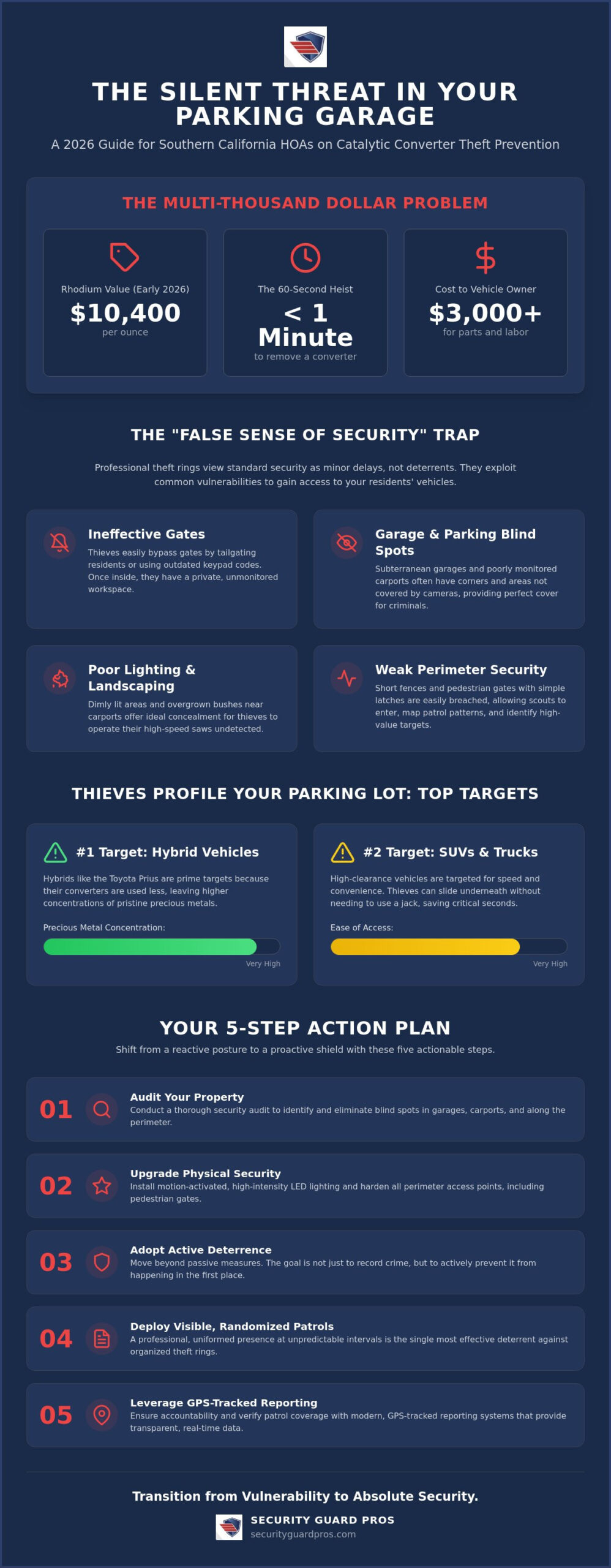
Did you know that the price of rhodium, a key metal found in catalytic converters, surged to $10,400 per ounce in early 2026? This market shift has triggered a resurgence in professional theft rings that don’t respect your perimeter gates. You’re likely facing a wave of resident complaints and the looming threat of increased insurance premiums. Effective catalytic converter theft prevention for HOAs is no longer about individual car alarms; it requires a disciplined, community-wide strategy that acts as a stern deterrent to criminals.
We recognize the frustration of feeling vulnerable despite having traditional security measures in place. It’s our mission to help you reclaim control over your property. This guide provides a clear security plan that fits your HOA budget while ensuring resident peace of mind. You’ll learn how to implement multi-layered security protocols, leverage 2026 legislative changes, and establish a protective shield that allows your board to focus on operations instead of liability concerns. Stop the cycle of theft and transition from a state of vulnerability to a position of absolute security.
Key Takeaways
- Understand why Southern California HOAs remain prime targets for professional theft rings in 2026 and how to counter their 60-second tactics.
- Identify the “False Sense of Security” trap by auditing your property for blind spots in subterranean garages and carports.
- Discover five actionable physical upgrades, such as motion-activated LED lighting, designed to harden your community’s perimeter.
- Master the deployment of multi-layered community strategies for catalytic converter theft prevention for HOAs that focus on active deterrence.
- Learn how randomized vehicle mobile patrols and GPS-tracked reporting provide a superior, unpredictable shield against organized crime.
The State of Catalytic Converter Theft in Southern California HOAs (2026)
Southern California serves as the epicenter for organized theft rings. In cities like Los Angeles and San Diego, the high density of luxury vehicles and hybrids creates a target-rich environment that is difficult to ignore. Professional crews operate with military precision. They don’t just look for a single car on a dark street; they target entire residential complexes for “sweeps.” A crew can enter a subterranean garage and strip a dozen vehicles in under fifteen minutes. This shift toward high-volume hits makes catalytic converter theft prevention for HOAs a top priority for property managers in 2026.
The 60-second heist is no exaggeration. Modern thieves use high-speed, cordless reciprocating saws and specialized jacks to lift a vehicle and remove the component in less time than it takes to check your mail. They’ve mastered the layout of common parking structures, identifying exits and blind spots before they even arrive. For the HOA, this speed renders traditional, slow-moving security measures like standard gates almost entirely ineffective.
Why Precious Metals Drive the Theft Epidemic
To understand the motivation, one must first ask: what is a catalytic converter? These components contain rare metals like rhodium, which hit values of $10,400 per ounce in early 2026. Palladium and platinum prices also remain volatile, making these parts more valuable than the gold they’re often compared to. For a resident, the loss is staggering. Between the part itself and labor, repairs often exceed $3,000. Supply chain delays in 2026 mean victims might wait weeks for a replacement, adding rental car costs to the bill. Hybrids like the Toyota Prius remain the primary target because their converters contain significantly higher concentrations of these precious metals compared to standard internal combustion engines.
The HOA Liability and Resident Trust Factor
When a community is hit, the damage extends beyond the tailpipe. Property values suffer when word spreads that a complex is “easy pickings” for criminals. HOA boards face a difficult legal landscape regarding their “duty of care.” If a board ignores known vulnerabilities in a parking structure, they may face liability concerns or surging insurance premiums. Beyond the numbers, there is a psychological toll. Residents who pay high dues expect a secure environment. Seeing a neighbor’s car on jacks in a supposedly “secure” garage shatters that trust and creates a pervasive feeling of helplessness. Effective catalytic converter theft prevention for HOAs is the only way to restore that sense of safety and protect the community’s reputation.
Vulnerability Audit: Why Your Gated Community is at Risk
Many HOA boards fall into the “False Sense of Security” trap. You assume that because there is a gate at the entrance, the property is a fortress. It isn’t. Professional theft rings view a standard gate as a minor delay, not a deterrent. They often gain access through tailgating, simply following a resident’s car through the entrance before the arm or gate closes. Alternatively, they exploit outdated keypad codes that haven’t been changed in years. Once inside, they have a private, unmonitored workspace to strip vehicles at their leisure.
Effective catalytic converter theft prevention for HOAs starts with a cold, hard look at your perimeter. Blind spots in subterranean garages are a thief’s best friend. If your cameras don’t cover the corners or if the lighting is dim, you’re providing cover for a crime that takes less than a minute. Overgrown landscaping near carports also offers the concealment needed to operate a saw without being seen from a distance. Implementing a comprehensive strategy for catalytic converter theft prevention for HOAs requires more than just hardware; it requires constant vigilance.
Common Entry Points for Theft Rings
Perimeter fencing is often the weakest link. Short fences or pedestrian gates with simple latches allow scouts to enter on foot and map out the property. These scouts look for patrol patterns and identify where the most valuable vehicles are parked. They often use “scout vehicles” that look like delivery or ride-share cars to blend in while they monitor your security response times. Unmonitored guest parking areas are particularly vulnerable, as they often sit near the edge of the property with easy escape routes.
Vehicle Profiling: What’s in Your Residents’ Lots?
Thieves don’t pick cars at random; they profile your residents’ lots for “value density.” High-clearance vehicles like SUVs and trucks are preferred because they don’t require a jack. A thief can simply slide under and cut. Southern California also has a high concentration of Ultra-Low Emission Vehicles (ULEVs). As noted by the California Bureau of Automotive Repair, these vehicles often have more precious metals in their converters to meet strict emission standards.
Auditing these risks is the first step toward a real solution. If you aren’t sure where your vulnerabilities lie, consider a professional assessment from a team specializing in Gated Community and HOA Security to harden your perimeter and protect resident property.
Active vs. Passive Deterrence: Choosing the Right HOA Strategy
Passive security measures are essentially post-mortem tools. While many HOAs rely on cameras and signage, these methods do nothing to interrupt a crime in progress. When a professional thief can strip a vehicle in under 60 seconds, a camera is merely a witness to your community’s loss. Effective catalytic converter theft prevention for HOAs requires a transition from reactive recording to active deterrence. You must create an environment where the risk of capture outweighs the potential reward. Relying on residents to install individual shields or cages is a fragmented approach that fails to protect the community as a whole. Professional theft rings carry specialized hydraulic tools that can bypass most physical barriers if they have the luxury of time and privacy.
The financial logic for an HOA board is clear when you consider the return on investment. A single overnight “sweep” of ten vehicles can result in over $30,000 in combined repair costs and rental fees for your residents. This doesn’t account for the inevitable surge in insurance premiums and the damage to your property’s reputation. Investing in active, community-wide security layers isn’t just a budget line item; it’s a strategy to mitigate massive financial liability and resident dissatisfaction. By stopping the crime before it starts, you preserve the trust and property values of the entire association.
The Myth of the ‘Secure’ Camera System
Grainy, night-vision footage of a masked individual in a hoodie rarely leads to an arrest or the recovery of stolen property. Thieves in 2026 are well-aware of camera placements and often use infrared-reflecting clothing or simple masks to remain anonymous. There is also a critical delay between the crime and its discovery. By the time a resident starts their car in the morning and hears the unmistakable roar of a missing exhaust, the thief is long gone. Professional crews often disable static cameras or simply move to the blind spots you’ve left unmonitored, rendering your expensive CCTV system useless against a 60-second heist.
Visible Security Guards as a Hard Deterrent
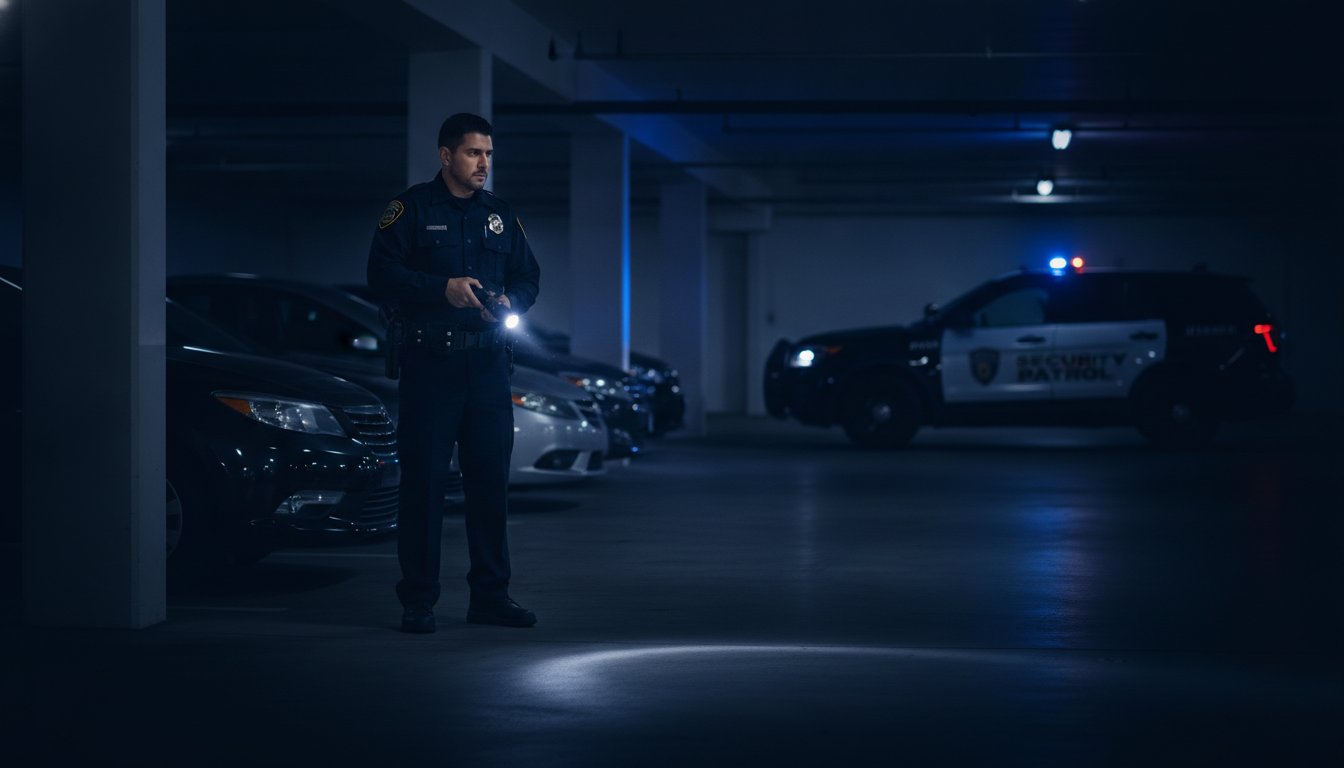
The “Broken Windows” theory suggests that visible signs of discipline and oversight prevent the escalation of crime. This principle is highly effective for catalytic converter theft prevention for HOAs. When a theft ring scouts a property and sees a uniformed professional on patrol, the property is immediately classified as a “hard target.” Criminals are pragmatic; they want the path of least resistance. A clearly marked patrol vehicle remains the single most effective deterrent for catalytic converter thieves because it signals an immediate, physical threat to their operation. This visible presence forces organized crews to bypass your community in favor of softer, unmonitored targets, ensuring your residents’ property remains intact and secure.
5 Actionable Steps for HOA Boards to Secure Parking Areas
Securing a community requires a transition from passive hope to tactical execution. HOA boards must implement community-wide security layers that disrupt the criminal’s workflow. Professional theft rings look for the path of least resistance. If your property presents a series of high-friction obstacles, they’ll move on. This is the essence of catalytic converter theft prevention for HOAs: making your property too difficult and too risky to target. Here are five actionable steps to harden your property immediately.
- Upgrade to motion-activated LED lighting: Dark carports are the preferred workshop for thieves. High-intensity lighting that triggers upon movement strips away the anonymity criminals rely on. Ensure every dark corner of your parking structure is illuminated.
- Implement a strict ‘No Tailgating’ policy: Upgrade gate hardware to close faster and install signage that reminds residents not to allow following vehicles. This simple change closes the primary entry point for professional crews.
- Schedule a professional security assessment: You can’t fix what you haven’t identified. An expert can pinpoint physical vulnerabilities in your perimeter that a standard maintenance check would miss.
- Establish a communication loop: Use resident apps to create a modern ‘Neighborhood Watch.’ Real-time reporting of suspicious ‘idling’ vehicles, which often serve as scouts, can prevent a heist before it begins.
- Contract for randomized nighttime patrols: Predictability is a vulnerability. By introducing an unpredictable, professional presence, you make it impossible for thieves to time their ‘sweeps’ effectively.
Environmental Design (CPTED) for HOAs
Crime Prevention Through Environmental Design (CPTED) is a disciplined approach to property management. Trimming foliage to maintain clear lines of sight ensures that guards and residents can see threats from a distance. You should also use signage to broadcast that the property is under professional patrol. This psychological barrier is often enough to make a crew choose a softer target down the street. Eliminate hiding spots near high-value vehicle clusters, such as SUVs and hybrids, to ensure there’s no place for a thief to crouch unseen with a saw.
Access Management and Resident Education
Audit your gate codes and remote clickers. Over time, codes are shared with delivery drivers and former residents, creating a massive security hole. Change master codes quarterly and deactivate lost clickers immediately. Educate residents on the importance of catalytic converter theft prevention for HOAs by hosting ‘VIN etching’ events with local police. While etching doesn’t stop the cut, it makes the part harder to sell to scrap dealers who must now comply with 2026 regulations like California Assembly Bill 1740. Encourage your community to report suspicious activity instantly rather than waiting until the morning.
Take the first step toward a safer community by requesting a comprehensive Gated Community and HOA Security audit to identify and eliminate your property’s hidden risks.
Professional Security Guard and Mobile Patrol Solutions
Professional security staffing is the final, most critical layer in any community-wide strategy. While lighting and gates create obstacles, only a human presence provides the judgment and rapid response needed to catch a thief in the act. Catalytic converter theft prevention for HOAs requires a force that is as agile and professional as the criminal rings they aim to stop. Security Guard Pros delivers this through a combination of veteran expertise and advanced technology, ensuring your parking lots are never left to chance. We position ourselves as a protective shield, allowing your board to focus on core operations while we handle the complexities of property protection.
Accountability is a core pillar of our service. We utilize GPS-tracked reporting to provide property managers with transparent, real-time data on every patrol. You won’t have to guess if a guard checked the subterranean garage; you’ll have the digital breadcrumbs to prove it. This data is backed by our 24/7 dispatch center, which serves as the brain of our operation. When suspicious activity is reported via a resident app or spotted by a guard, our dispatchers coordinate an immediate response. This infrastructure closes the gap between detection and deterrence, providing the peace of mind that residents demand.
Randomized Patrols: Keeping Thieves Guessing
Static guard stations at the front gate often leave the far corners of a property vulnerable. Thieves simply wait for the guard to be occupied or find a path around the booth. To counter this, we recommend Vehicle Mobile Patrols. These “hit-and-run” style checks involve guards visiting high-risk zones at irregular intervals. By eliminating a predictable schedule, you make it impossible for criminals to map your security response. They can’t time a theft if they don’t know when the next patrol car will round the corner. This unpredictability is a stern deterrent that forces theft rings to seek softer targets elsewhere.
Why Security Guard Pros is the Southern California Leader
With over 70 years of collective management experience, we understand the unique pressures facing Southern California property managers. We maintain rigorous standards for licensing and compliance that exceed industry norms, ensuring every guard on your property is a disciplined professional. Our expertise in Gated Community and HOA Security allows us to customize a plan that fits your specific layout and budget. We don’t offer generic, one-size-fits-all commodities. Instead, we provide a human-centric, consultation-based strategy designed to eliminate liability and stop loss before it occurs. Trust a seasoned veteran to guard your community’s future.
Contact Security Guard Pros today for a free HOA security assessment.
Securing Your HOA’s Future Against Professional Theft
The rise in professional theft rings requires a shift from passive observation to active deterrence. You’ve seen how traditional gates and static cameras often fail to stop a 60-second heist. Effective catalytic converter theft prevention for HOAs depends on a multi-layered strategy that integrates environmental design with unpredictable, randomized patrols. By hardening your perimeter and introducing a visible security presence, you transform your community from a soft target into a fortified zone that criminals will bypass.
Security Guard Pros stands as your protective shield in Southern California. As a licensed private security company, we bring a veteran’s discipline to every property we guard. Our 24/7 dispatch center and rapid deployment capability ensure that suspicious activity is met with an immediate, professional response. We leverage our deep expertise in residential, construction, and industrial security to provide a hassle-free experience that prioritizes resident safety and board peace of mind. Don’t wait for the next sweep to occur. Secure Your Community: Request a Professional HOA Security Quote. Take the lead in protecting your residents’ property today.
Frequently Asked Questions
Does our HOA’s insurance cover catalytic converter theft in common areas?
HOA master policies generally do not cover the theft of personal property like catalytic converters; this loss falls under the resident’s individual comprehensive auto insurance. The board’s responsibility typically covers damage to common areas, though failing to provide adequate security could lead to liability concerns for the association. Review your specific policy with a broker to understand the exact boundaries of your “duty of care” regarding resident property.
How quickly can thieves steal a catalytic converter in a gated lot?
Professional crews can strip a component in under 60 seconds using high-speed cordless tools. This extreme speed is why passive measures like standard gates often fail to protect a community. Effective catalytic converter theft prevention for HOAs must focus on interrupting the crime during this narrow window through active, visible patrols that make your property a “hard target.”
Are electric vehicles (EVs) at risk for catalytic converter theft?
No, fully electric vehicles are not at risk because they do not have exhaust systems or catalytic converters. However, hybrid vehicles remain the highest-risk targets because their converters contain significantly higher concentrations of precious metals. Ensure your security plan accounts for the specific “value density” of hybrids parked in your residential lots.
Will installing more cameras stop thieves from entering our parking structure?
Cameras alone will not stop a determined thief from entering your parking structure. Most criminals in 2026 use masks and specialized clothing to remain anonymous on film. While cameras provide evidence after the fact, they don’t offer the immediate physical deterrent provided by a uniformed security professional who can disrupt a crime in progress.
How much do mobile patrol services typically cost for a mid-sized HOA?
Costs for mobile patrol services are determined by the frequency of visits and the specific size of your property rather than a flat rate. Boards should view this as a strategic investment in liability reduction and property value preservation. Preventing a single “sweep” of multiple cars often saves the community more in insurance stability than the annual cost of the service.
What should a resident do if they catch a thief in the act?
Residents should never confront a thief; instead, they should immediately call 911 and the HOA’s security dispatch center from a safe distance. Professional theft rings are often organized and may be dangerous. The safest course of action is to provide a detailed description of the suspects and their scout vehicle to law enforcement and on-site guards.
Can security guards legally detain someone caught stealing on HOA property?
Licensed security guards can legally detain individuals caught in the act of a crime on HOA property under specific regulatory guidelines. This is a standard part of professional protocol for high-level security firms. Our guards are trained to handle these high-tension situations with discipline and professionalism while waiting for local law enforcement to arrive and take custody.
How often should an HOA conduct a security audit of their parking areas?
HOAs should conduct a professional security audit at least once every quarter or immediately following any reported incident. Criminal tactics evolve quickly, and a regular review ensures your catalytic converter theft prevention for HOAs remains effective against new threats. These audits should check for new blind spots, lighting failures, and outdated access codes that compromise your perimeter.