A single crowd injury lawsuit in California can exceed $1 million under Civil Code Section 1714. For organizers in 2026, the margin for error has vanished. You understand that managing access control for a large event is no longer just about checking tickets; it’s about mitigating high-stakes liability while maintaining a professional atmosphere. When perimeters fail or VIPs are stuck in stagnant lines, your brand’s reputation and your legal compliance are both at risk.
We’ve developed this strategy guide to help you transition from reactive oversight to proactive protection. You’ll learn how to master complex entry logistics to ensure attendee safety and achieve a secure perimeter with zero unauthorized entries. We’ll preview the essential 2026 requirements, from the 1 per 250 crowd manager ratio mandated by the Fire Code to the latest AB 2113 drone restrictions. By the end, you’ll have a blueprint for efficient, fast-moving check-in lines that satisfy both high-value guests and California state security standards.
Key Takeaways
- Implement a “Three-Ring” perimeter strategy to master managing access control for a large event, layering security across outer, middle, and inner zones.
- Combine digital credentials like RFID and biometrics with disciplined guard oversight to maintain a “human-in-the-loop” fail-safe against technical bypasses.
- Optimize crowd flow by strategically separating VIP, General Admission, and staff entry points to eliminate bottlenecks and protect high-value attendee experiences.
- Establish rigid manual override protocols and breach response plans to maintain total site integrity during system outages or unauthorized gate-crashing incidents.
- Align your operational plan with 2026 California standards by leveraging regional expertise familiar with the specific regulatory climates of major Southern California venues.
The Architecture of Event Access Control: Defining the Perimeter
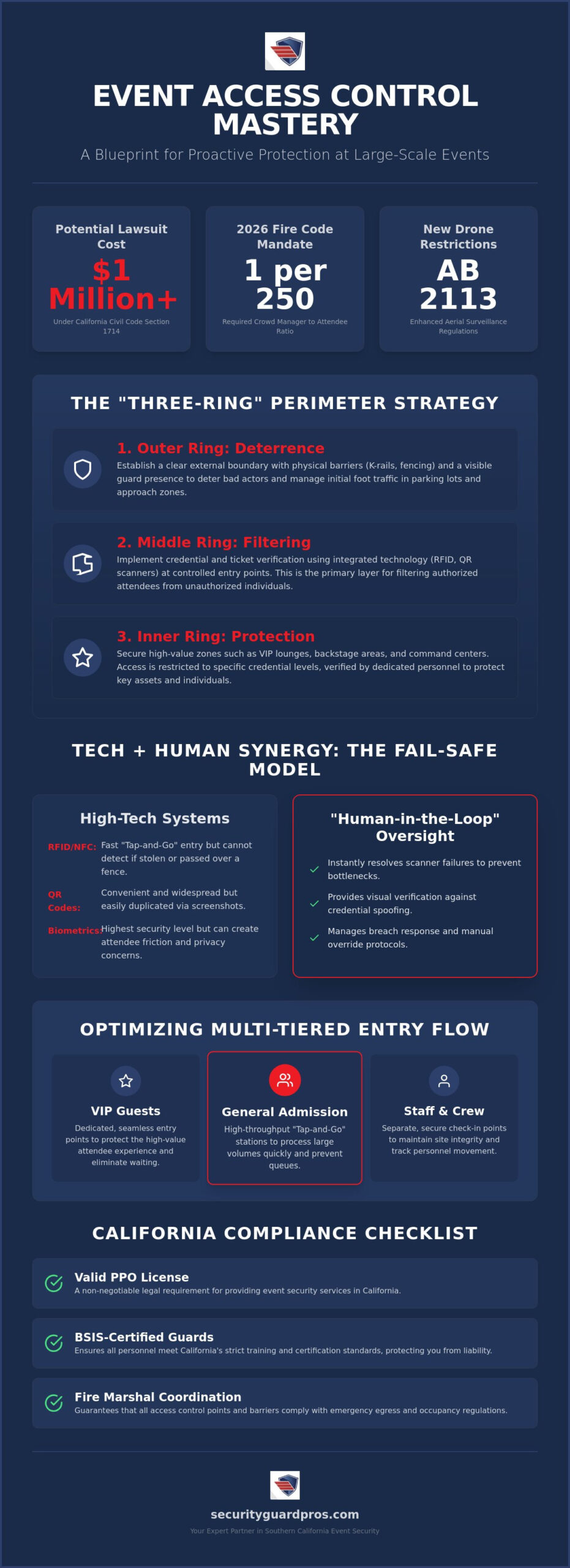
Effective security is a shield, not a suggestion. The Architecture of Event Access Control integrates physical barriers, advanced technology, and disciplined personnel into a single, cohesive unit. When you’re managing access control for a large event, you must implement the “Three-Ring” perimeter strategy. This methodology layers your defenses: an outer ring for initial deterrence, a middle ring for credential filtering, and an inner ring for high-security zone protection. This structured approach ensures that a single point of failure doesn’t lead to a total perimeter breach.
Southern California venues demand logistical precision. Whether you’re operating in Los Angeles, Anaheim, or San Diego, the scale of these environments requires more than just a body in a high-visibility vest. You need a partner holding a valid Private Patrol Operator (PPO) license. This isn’t a mere badge of expertise; it’s a legal requirement for event safety in California. Generic staffing agencies often lack this critical regulatory standing. We provide the professional authority and unwavering reliability that turns a vulnerable venue into a secure fortress.
Outer Perimeter and Pre-Screening Zones
Your security starts long before the ticket scanner. Implement physical barriers like K-rails or interlocking fencing to funnel foot traffic into specific, manageable lanes. A visible, disciplined guard presence at these funnels acts as a stern deterrent to bad actors. Don’t ignore the parking lots. These areas are prime targets for unauthorized credential swaps and tailgating. Our teams maintain vigilance in these secondary zones to identify and neutralize threats before they reach your primary entry points.
Regulatory Compliance and Fire Marshal Standards
Compliance is your best defense against liability and loss. Access control systems must be designed so they don’t impede emergency egress routes. This is a non-negotiable safety standard. We coordinate directly with local Southern California fire marshals to ensure every barrier and gate aligns with current occupancy limits. Every guard we deploy is BSIS-certified. This ensures your event meets the strict legal necessity of California law, protecting you from the massive fines and legal exposure associated with unlicensed security personnel.
By establishing these clear zones and following state-mandated protocols, you create an environment where safety is the baseline. It allows your team to focus on core operations while we maintain the protective shield around your perimeter. This is the difference between an amateur gathering and a professionally secured event.
Integrating High-Tech Systems with Professional Guard Staffing
Technology is a force multiplier, not a standalone solution. Relying solely on automated software creates a single point of failure that sophisticated intruders can exploit. Successfully managing access control for a large event requires a “Human-in-the-Loop” architecture. While biometric systems offer high security, they often create friction and privacy concerns. QR codes are convenient but easily duplicated via screenshots. RFID remains the industry standard for speed, yet it cannot detect if a wristband was stolen or passed over a fence. This is where professional oversight becomes the deciding factor between a secure perimeter and an open door.
Disciplined guards don’t slow down the technology; they ensure it functions under pressure. When a scanner fails or a credential flags as invalid, an untrained volunteer might freeze, causing a massive bottleneck. A professional security officer resolves the conflict instantly. They move the individual to a secondary screening area to keep the main flow moving. This proactive management prevents the “bottleneck myth” from becoming a reality. It’s a balance of technical precision and human intuition that protects your liability.
RFID and NFC Deployment Strategies
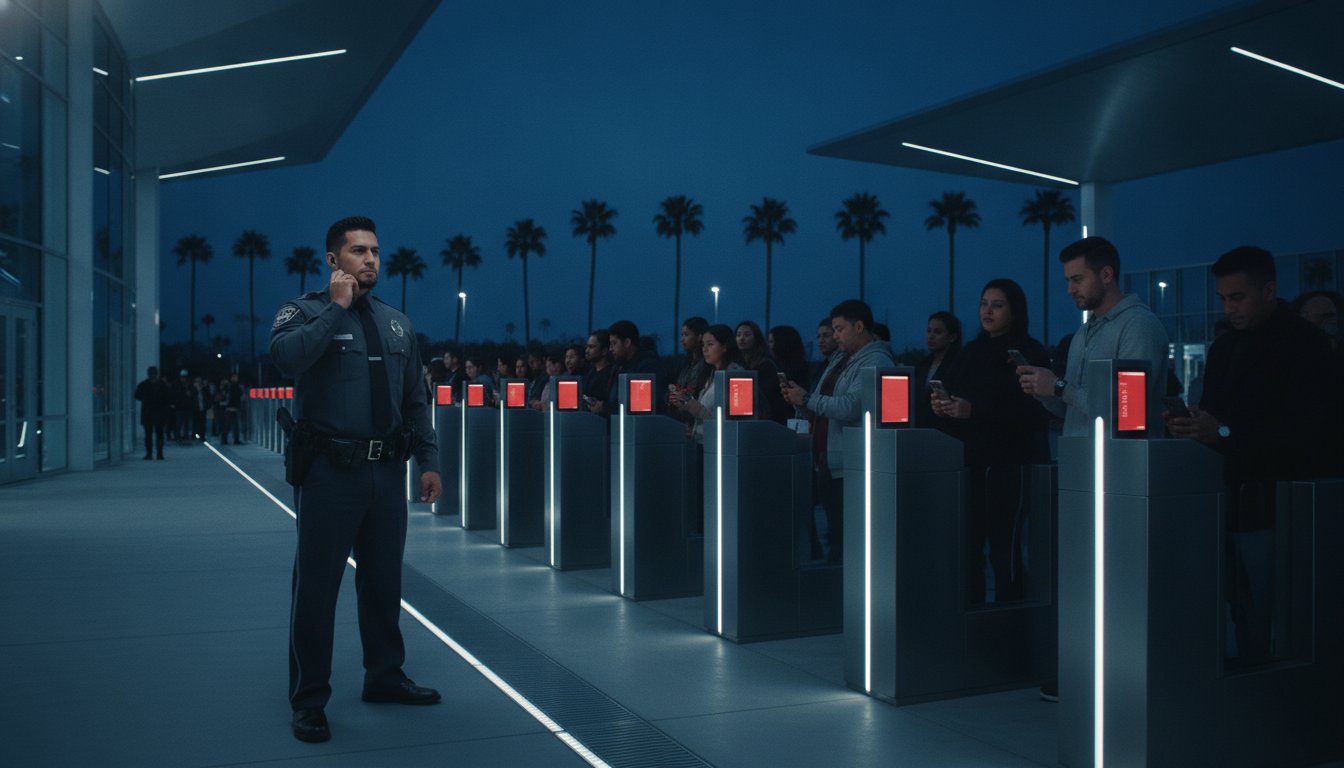
Deploy “Tap-and-Go” stations to facilitate rapid, high-volume entry for General Admission. These systems provide real-time data on venue capacity, allowing command centers to redirect personnel dynamically to crowded zones. When a “red light” scenario occurs, guards must be trained to intervene immediately without halting the entire line. By integrating Special Event Security teams who understand these technical nuances, you ensure that technology serves the mission rather than hindering it.
The Role of Visual Verification
Digital systems can be spoofed, but physical credentials provide a vital secondary layer. Use color-coded badges or holographic wristbands to allow for instant visual verification by staff. Guards must be trained to spot social engineering attempts, such as “piggybacking” through staff entrances or using high-quality counterfeit badges. Tech might miss a duplicated QR code, but a seasoned veteran will notice the wrong texture on a wristband or the suspicious behavior of an unauthorized individual. Between the gates, use vehicle mobile patrols to monitor fence lines and secondary access points where fixed technology may be absent.
This hybrid approach creates a redundant security stack. It allows your event to benefit from the speed of 2026 digital solutions while maintaining the stern deterrent of a visible, professional guard force. Don’t leave your perimeter to chance by trusting software alone. Secure it with the expertise that only comes from decades of field experience.
Managing Multi-Tiered Entry: VIP, GA, and Staff Flow
A single entry point is a single point of failure. When you’re managing access control for a large event, you must implement a sophisticated hierarchy of movement to prevent logistical collapse. Funneling thousands of General Admission (GA) attendees through the same corridors as high-profile speakers or technical staff invites chaos and compromises safety. Strategic separation is the only viable solution. By isolating entry points, you ensure that high-value guests receive the premium experience they expect while the main crowd moves through high-volume screening zones with disciplined efficiency.
Zoning is a method of tiered security that utilizes both physical guards and digital credentials to restrict movement into sensitive areas. This technique prevents “access creep,” where individuals with base-level credentials migrate toward restricted zones like AV booths or command centers. Discipline at these internal checkpoints is just as vital as vigilance at the front gate. Effective zoning ensures that your perimeter remains an active, multi-layered defense system rather than a porous boundary.
Executive Protection and VIP Logistics
High-profile guests and speakers require a specialized security profile that balances safety with discretion. We provide firm but professional Executive Protection Services that blend into the event environment until a threat is detected. Managing private entry routes and secure green room perimeters ensures that talent can move without being swamped by crowds or unauthorized media. This transition from general gate access to internal close-protection requires seamless coordination between perimeter teams and dedicated executive details. It maintains a protective shield that feels like a premium service rather than a restriction.
Back-of-House and Vendor Access
The loading dock is frequently the weakest link in a venue’s perimeter. Securing service elevators and delivery bays against unauthorized entry is a top priority for our Special Event Security teams. We manage the logistical challenge of credentialing temporary staff and third-party contractors using time-bound digital passes. To deter internal theft and credential sharing, our guards conduct randomized bag checks and equipment inspections at all service points. This no-nonsense approach ensures that every individual behind the scenes has been vetted and remains authorized to occupy that space. Managing these layers prevents the “inside threat” of unauthorized persons wandering into high-risk zones, keeping your event compliant and your logistics moving without distraction.
Emergency Protocols and Technology Fail-Safes
Systems fail. Wi-Fi signals drop. Power outages occur at the most critical moments. Managing access control for a large event requires a redundant strategy that doesn’t rely on a digital signal to maintain integrity. When scanners go dark, your guards must pivot immediately to a pre-defined manual override protocol. Every access control plan must include a physical backup, such as a printed manifest, verified by a supervisor. This ensures that the flow of authorized attendees continues while unauthorized individuals remain excluded from the venue.
A perimeter breach or gate-crashing incident demands immediate, disciplined action. If the line is compromised, guards must execute a lockdown and sweep procedure to identify and remove intruders. Communication hierarchies are essential for this transition. Gate guards alert dispatch; dispatch coordinates with event organizers and mobile units to seal the gap. This rhythmic flow of information prevents panic and ensures resources are deployed where the pressure is highest. It turns a potential disaster into a managed incident.
Managing Crowd Surges and Gate Pressure
Peak density moments can turn dangerous if left unmanaged. If the entry zone becomes overcrowded, use a pulse entry technique to pause the flow and allow the interior check-in stations to clear. Implement “Snake” lines using heavy-duty stanchions to break up crowd momentum and prevent a straight-line surge toward the gates. Guards must be trained in de-escalation to handle frustrated attendees who are denied entry or delayed. Calm, firm instructions maintain order when emotions run high, preventing a minor delay from escalating into a crowd safety issue.
Incident Response and Real-Time Reporting
Visibility is key to rapid resolution. Our 24/7 dispatch center allows for the rapid relocation of guards to high-pressure access points as conditions change on the ground. Every denied entry, credential dispute, or security incident is documented through electronic reporting to create a transparent audit trail. This documentation is vital for protecting your organization from liability under California Civil Code Section 1714. For large-scale public festivals, we coordinate directly with local Southern California law enforcement to ensure a unified response to significant threats. Don’t wait for a crisis to test your perimeter. Prepare your venue with Special Event Security that prioritizes fail-safe protocols.
Partnering with Southern California’s Event Security Experts
Experience isn’t just a metric. It’s a history of prevented incidents and managed risks. With over 70 years of collective management expertise, our leadership has navigated the specific logistical hurdles of the Southern California event circuit. Managing access control for a large event in high-traffic hubs like Los Angeles, Anaheim, or San Diego requires more than just a presence. It requires a disciplined strategy that anticipates threats before they manifest. We don’t just staff your gates; we deploy a comprehensive security architecture designed to protect your brand and your bottom line.
Our guards strike a precise balance between a stern deterrent and professional customer service. In the high-stakes environment of a 2026 event, your security team is the first point of contact for high-value attendees. Unprofessionalism at the gate creates friction and damages your reputation. Conversely, a lack of vigilance invites liability. We solve this by training our officers to be “modern guardians” who are polite to guests but immovable to unauthorized intruders. This dual-purpose approach ensures that your perimeter remains secure without compromising the attendee experience.
Customized Security Planning for Your Venue
Every venue has unique vulnerabilities. We don’t believe in one-size-fits-all security. Before the first guest arrives, we conduct a site-specific risk assessment to identify blind spots in your perimeter and potential bottlenecks in your crowd flow. During the event, our 24/7 dispatch center monitors real-time data, allowing us to scale guard presence dynamically as density shifts. This level of agility is why savvy organizers evaluate and hire event security companies that offer full-service, tech-integrated protection. We provide the rapid deployment capabilities necessary for short-term event staffing without sacrificing the quality of the personnel.
Securing Your Next Event with Confidence
Stop managing the anxiety of potential liability and start focusing on your core operations. When you partner with a licensed, insured, and veteran-led guard force, you gain the peace of mind that comes from unwavering reliability. We act as your protective shield, handling the complexities of BSIS compliance, fire marshal standards, and perimeter integrity. Don’t leave your venue’s safety to chance or unprofessional agencies. Secure your perimeter with the seasoned veterans who understand the local landscape. Request a customized event security quote from Security Guard Pros today and ensure your next large-scale gathering is defined by its success, not its security breaches.
Secure Your Perimeter for 2026 and Beyond
Success in the modern event landscape depends on a fusion of digital precision and disciplined physical presence. You’ve seen how a Three-Ring strategy and “human-in-the-loop” oversight prevent the technical failures that lead to perimeter breaches. Managing access control for a large event is a high-stakes operation that demands more than just scanning software; it’s a process that requires the vigilance of seasoned veterans who understand California’s specific regulatory environment. By implementing tiered entry and rigid fail-safe protocols, you protect your organization from the significant legal and financial liabilities of crowd-related incidents.
Security Guard Pros brings over 70 years of collective management experience to every venue we protect. As a licensed and insured California PPO, we provide the professional authority needed to deter threats while offering a reassuring presence to your guests. Our 24/7 dispatch and rapid deployment capabilities ensure that your site stays protected regardless of sudden attendance spikes or technical outages. Secure your next large-scale event with the pros at Security Guard Pros. Focus on your core operations with total confidence while we maintain the protective shield around your perimeter.
Frequently Asked Questions
What is the best way to handle VIP access at a large festival?
Isolate VIP entry points from General Admission to prevent bottlenecks and ensure privacy for high-profile guests. Use dedicated lanes staffed by guards trained in Executive Protection Services who can verify high-level credentials with speed and discretion. This strategic separation allows your team to maintain a premium experience for VIPs while the main crowd moves through high-volume screening zones with disciplined efficiency.
How many security guards do I need per 100 attendees for access control?
Staffing levels depend on the risk profile of your venue, but the California Fire Code mandates at least one trained crowd manager for every 250 occupants. When you are managing access control for a large event, you must also factor in the number of entry points and whether alcohol is served. High-density gatherings often require a more concentrated guard presence to maintain a secure perimeter and manage technical check-in stations effectively.
What happens if the digital ticket scanning system goes offline during the event?
Execute your manual override protocol immediately to prevent a total collapse of the entry flow. Every gate must have a physical backup, such as a printed manifest or offline-capable scanning devices, that can be verified by an on-site supervisor. This redundancy ensures that authorized attendees continue to enter while your technical team resolves the outage, preventing a dangerous buildup of crowd pressure at the gates.
Are armed or unarmed guards better for managing event entry points?
Unarmed guards are the industry standard for front-facing entry points where professional customer service is as vital as security. They provide a reassuring presence while acting as a stern deterrent to unauthorized entry. Armed guards are typically reserved for high-risk zones, cash handling areas, or as a secondary layer of protection to respond to significant threats. A hybrid strategy often provides the most comprehensive shield for large-scale venues.
How do I prevent people from passing wristbands through the fence to unauthorized guests?
Deploy Vehicle Mobile Patrols to monitor the secondary perimeter and fence lines where fixed technology is often absent. Use tamper-evident, holographic wristbands that are destroyed upon removal to prevent credential sharing. Our guards are trained to conduct secondary visual checks at internal “zoning” points to identify loose or taped wristbands that suggest a security breach has occurred.
Does California law require specific licensing for event security guards?
Yes, all event security personnel in California must hold a current Guard Card issued by the Bureau of Security and Investigative Services (BSIS). Furthermore, the agency providing the guards must possess a valid Private Patrol Operator (PPO) license. Utilizing unlicensed staffing exposes event organizers to massive legal liability and ensures that your security plan lacks the professional authority required for state compliance.
What is the role of a mobile patrol in event access control?
Mobile patrols act as a dynamic extension of your fixed gate security by monitoring parking lots and outer perimeter fences. They identify unauthorized gatherings and potential breach points before they escalate into gate-crashing incidents. Their ability to provide rapid deployment and real-time reporting to 24/7 dispatch makes them essential for maintaining the integrity of the “Three-Ring” perimeter strategy.
Can security guards assist with crowd management during a gate surge?
Security guards are the primary line of defense during a surge, using “pulse entry” techniques to slow crowd momentum and prevent injuries. When managing access control for a large event, guards use physical barriers and de-escalation tactics to break up mass movement. This disciplined response protects attendees from the physical dangers of a crush and shields organizers from the liability of a million-dollar crowd injury lawsuit.