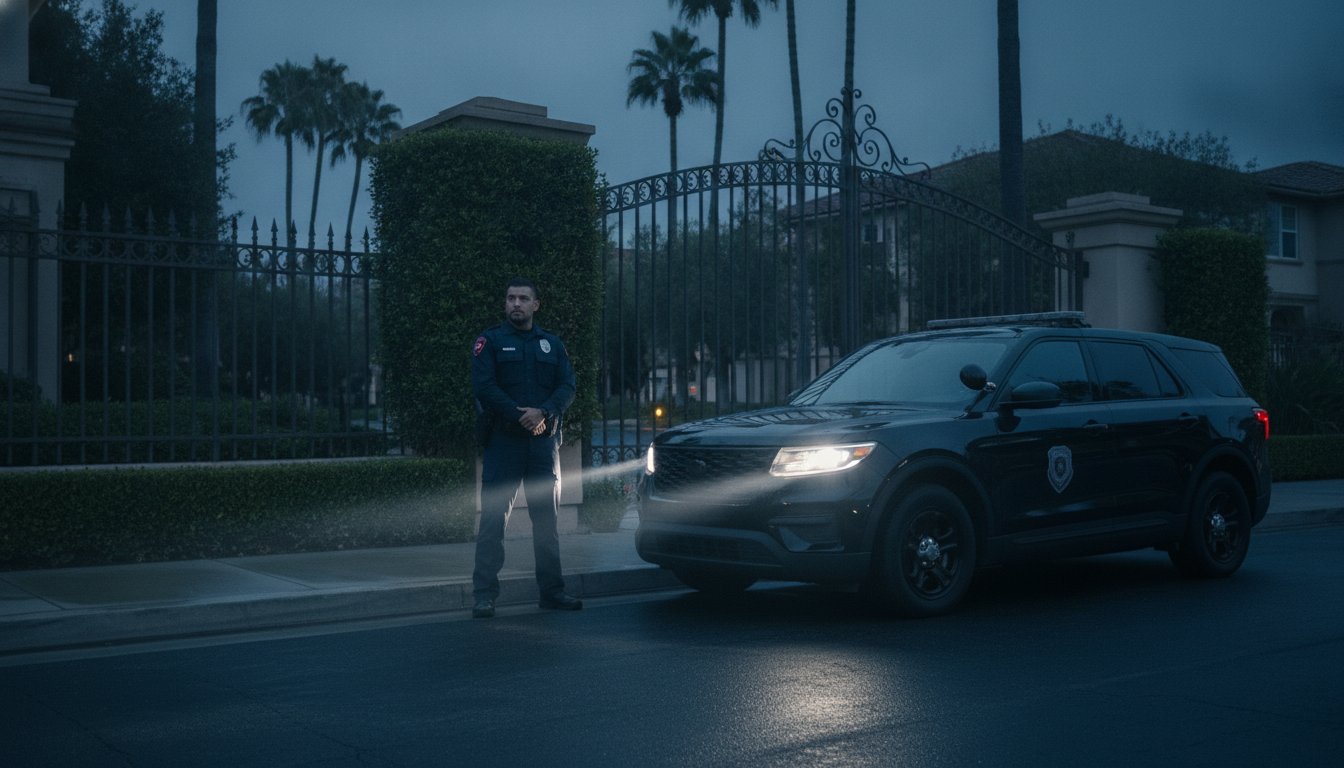
Your security guard contract might be the single greatest liability risk your Southern California community faces this year. While property crime rates across the state saw a 14.3 percent drop in 2025, the anxiety surrounding package theft and vehicle break-ins remains at an all-time high. If your current guards are sleeping on the job or missing shifts, you aren’t just wasting the budget; you’re inviting a negligence claim. Mastering modern hoa security best practices is no longer optional. It’s the only way to build a legal and physical shield that protects both the board and the residents.
You shouldn’t have to choose between astronomical insurance premiums and an unmonitored gate. We know the stress of balancing underfunded reserves with the need for professional protection. This guide provides the essential strategies and vetting processes to shield your HOA from liability while ensuring resident safety in 2026. We’ll examine AI-driven surveillance trends, the impact of the 16.90 dollar minimum wage on contract costs, and the specific criteria required to evaluate vendors with total confidence.
Key Takeaways
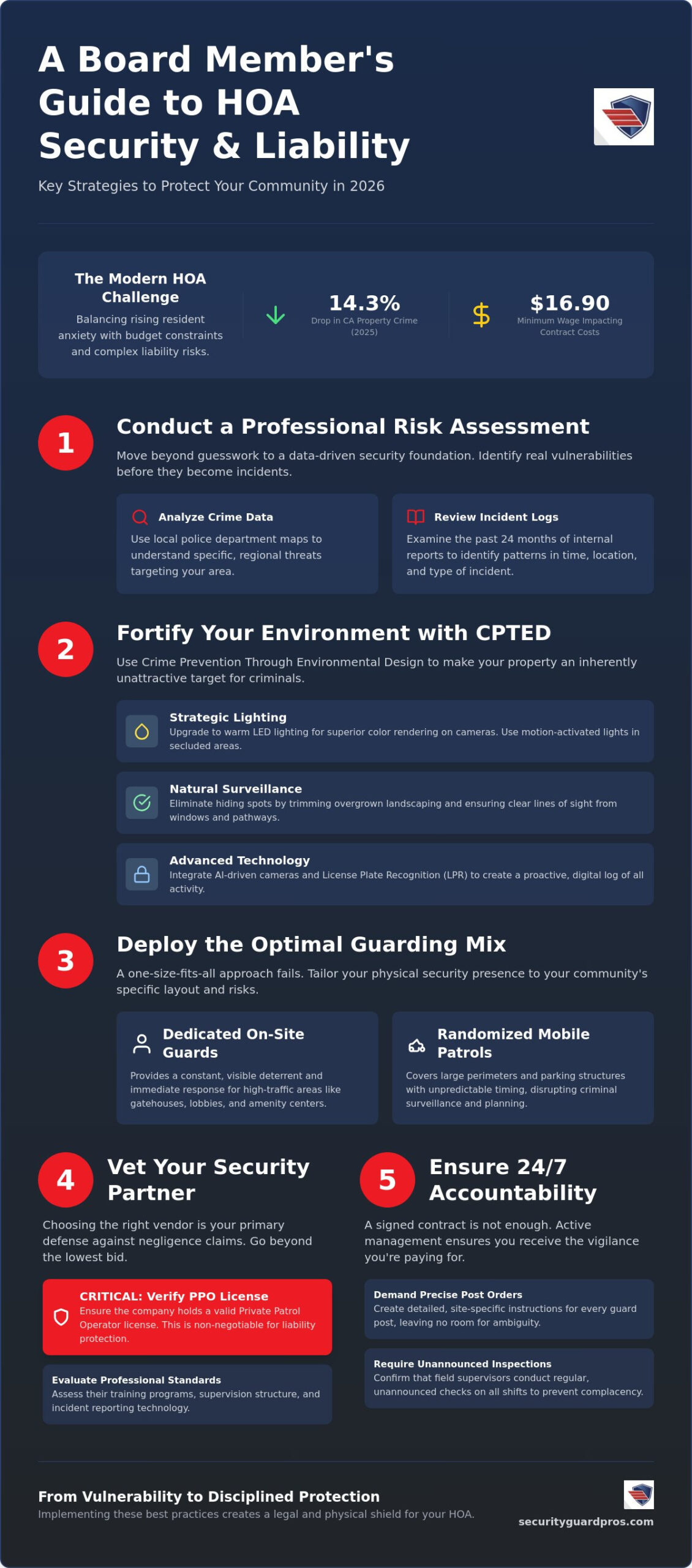
- Identify neighborhood-specific threats by replacing DIY walkthroughs with professional risk assessments and regional crime data analysis.
- Utilize CPTED principles to eliminate hiding spots through strategic landscaping and lighting, creating a natural deterrent to criminal activity.
- Master hoa security best practices by deploying the optimal mix of dedicated gatehouse guards and randomized vehicle mobile patrols.
- Protect the board from legal exposure by verifying PPO licenses and vetting vendors for professional standards rather than just the lowest bid.
- Maintain 24/7 accountability through precise Post Orders and unannounced field supervisor inspections to ensure guards remain vigilant.
The Foundation of HOA Security: Conducting a Professional Risk Assessment
Effective security starts with a cold, hard look at reality. Many HOA boards rely on a casual walkthrough by a volunteer member. This DIY approach often ignores the subtle cues professional criminals exploit. A professional security audit provides a comprehensive map of your community’s exposure. It bridges the gap between what you think is safe and what a seasoned veteran knows is a target. Implementing hoa security best practices requires this data-driven foundation. Ensure your budget is spent on deterrence rather than just reaction.
Analyzing Incident History and Local Crime Trends
Don’t guess where your risks lie. Use local police department crime maps to evaluate the specific threats facing your Southern California neighborhood. While property crime dropped statewide by 14.3 percent in 2025, micro-trends in areas like Los Angeles or San Diego can tell a different story. Review your internal incident logs from the past 24 months. Look for patterns in time and location. If car break-ins consistently happen between 2:00 AM and 4:00 AM near the north perimeter, your current measures are failing. This liability gap is where lawsuits are born.
Identifying Physical Vulnerabilities on the Property
Criminals look for the path of least resistance. Soft targets like mailrooms, pool areas, and clubhouse entries are prime candidates for unauthorized access. The mailroom problem is particularly acute in 2026. Package and identity theft have surged as online commerce continues to grow. Evaluate your perimeter fencing and test gate response times. Integrate principles of Crime Prevention Through Environmental Design (CPTED) to ensure that your physical layout actively discourages intruders. Dark corners in parking garages or overgrown hedges near gym entrances provide the cover criminals need. Shine a light on these vulnerabilities before they become crime scenes.
Establish measurable security goals to track your ROI. Don’t just aim for a vague sense of safety. Set targets for incident reduction and track resident perception through quarterly surveys. A successful strategy balances the stern deterrent of professional Security Guard Services with the reassuring presence residents expect. Refining your hoa security best practices means moving from a state of vulnerability to a state of disciplined protection. This dual approach minimizes liability while maximizing community peace of mind.
Environmental Design and Technology: CPTED Best Practices
Environmental design is the psychological front line of your community. Crime Prevention Through Environmental Design (CPTED) transforms your property into a space that feels inherently protected. It isn’t just about high fences; it’s about natural surveillance. By managing landscaping and lighting, you eliminate the shadows where intruders hide. This approach is a cornerstone of hoa security best practices because it deters crime before it starts. Avoid the Top Ten Security Mistakes HOAs Make by ensuring your physical layout works for you, not against you. Clear lines of sight and defined boundaries tell potential intruders that the community is vigilant and under control.
Lighting Strategies for Safety and Deterrence
Ditch the outdated high-pressure sodium bulbs. In 2026, warm LED lighting is the standard for high-performance security. These LEDs provide superior color rendering, which is vital for modern camera sensors to capture accurate descriptions. You don’t need to flood every square inch with light. Instead, use strategic placement to guide residents along well-lit internal pathways while keeping entryways bright. Motion-activated lighting is an efficient choice for secluded areas, as the sudden illumination often startles intruders. For main thoroughfares, dusk-to-dawn lighting ensures consistent visibility and reinforces the perception of a managed environment.
Surveillance and Access Control Integration
Passive recording is no longer enough to protect a modern HOA. AI-driven cameras are the new benchmark, capable of distinguishing between a resident’s dog and a human intruder in real time. This proactive identification reduces false alarms and allows for immediate response. In gated Southern California communities, License Plate Recognition (LPR) technology has become essential. It creates a digital log of every vehicle entering the property, which can be cross-referenced with law enforcement databases if an incident occurs. Modernizing your fobs and moving to cloud-based access logs also provides a critical paper trail for investigating internal community disputes or unauthorized amenity use.
Balancing resident privacy with high-definition coverage in common areas is a delicate but necessary task. Focus your high-resolution cameras on “soft targets” identified in your risk assessment, such as mailrooms and pool gates. A professional audit of your Gated Community and HOA Security infrastructure can reveal if your current tech is a deterrent or just a decoration. When technology and physical design work in tandem, you create a layered defense that minimizes liability and maximizes peace of mind for every resident. Implementing these hoa security best practices ensures your community remains a hard target for years to come.
Professional Guarding: Dedicated On-Site Guards vs. Mobile Patrols
Physical intervention is the final layer of any defensive strategy. While technology identifies threats, professional guards resolve them. When implementing hoa security best practices, your board must determine if your community requires a static presence or a dynamic patrol. This decision hinges on your specific layout and the volume of visitor traffic at your main access points. A seasoned veteran understands that the presence of a uniformed professional does more than just watch; it communicates control.
The Value of a Visible Security Presence
Uniformed guards serve as a powerful psychological deterrent to opportunistic criminals. Their presence signals that the community is not a “soft target.” However, security in a residential setting requires a nuanced approach. Guards must balance their role as a stern deterrent with excellent resident relations. They are often the first point of contact for homeowners and guests. Accountability is non-negotiable. Demand Daily Activity Reports (DARs) that provide a granular look at every shift. These reports ensure that the “sleeping guard” syndrome common in low-bid agencies never takes root in your community.
Mobile Patrols: Efficiency for Larger Communities
For HOAs with sprawling perimeters or multiple common areas, randomized Vehicle Mobile Patrols offer a high ROI. Criminals often “time” security by watching for predictable patterns. Randomization breaks this cycle. Modern mobile patrols use GPS geofencing to verify that the officer is actually visiting every checkpoint on the property. This technology provides the board with verifiable data rather than empty promises. Beyond deterrence, these units provide “Safe Escort” services for residents walking late at night and assist with consistent parking enforcement in fire lanes and guest zones.
Hybrid models often provide the most cost-effective safety solution. By combining AI-driven surveillance with a rapid-response mobile unit, you create a responsive shield without the overhead of multiple static posts. The choice between armed and unarmed personnel should be based on your neighborhood risk profile. In higher-risk Southern California corridors, the presence of armed professionals may be necessary to match the level of local threats. A professional assessment will clarify which model minimizes your liability while maximizing peace of mind for every resident. This disciplined approach ensures that your security budget is an investment in safety, not just an expense.
Vetting Your Partner: 21 Critical Questions for HOA Boards
Choosing a security vendor based on the lowest hourly rate is a dangerous gamble. In the context of hoa security best practices, the cheapest option often translates to the highest liability. Low-bid agencies frequently cut corners on training, supervision, and insurance coverage. If a guard fails to act during a resident emergency, the board faces the legal fallout. Demand transparency and prioritize professional value over the initial price tag. Your community’s safety is not a commodity to be traded for a few dollars in savings.
In California, your first step is non-negotiable: verify the Private Patrol Operator (PPO) license. This isn’t a suggestion; it’s a legal requirement for any firm providing security services. Probing management depth is equally vital. Look for a partner with 70+ years of collective management experience to ensure they’ve seen and solved the rookie mistakes that plague smaller firms. A seasoned guardian provides a protective shield that allows you to focus on community governance without the distraction of constant safety concerns.
Questions About Accountability and Dispatch
- “Do you have a 24/7 human-led dispatch center or an answering machine?” A rapid response requires immediate human intervention. A voicemail box is a liability in an emergency.
- “How do you handle a guard no-show in the middle of the night?” Reliable agencies maintain a disciplined protocol for emergency staffing and have a deep bench of vetted personnel.
- “What software do you use to provide real-time incident reporting to the board?” You need digital proof of activity and GPS verification, not handwritten notes that can be easily fabricated.
Questions About Recruitment and Training
- “What is your de-escalation training protocol for handling trespassers or residents?” Guards must be firm but professional to avoid escalating a situation into a potential lawsuit.
- “How do you ensure your guards meet Security Guard Services in Los Angeles standards?” Regional expertise is critical for navigating local crime trends and regulatory nuances.
- Verify: Do all guards hold active BSIS guard cards? Never allow an unlicensed individual to patrol your property. This is a primary violation of state law.
Finally, demand proof of high-limit insurance coverage. Your HOA must be listed as “Additionally Insured” on the vendor’s policy. This ensures that if an incident occurs, the security company’s insurance is the first line of financial defense. Without this protection, your community’s reserves and the board members’ personal assets could be at risk. If you are ready to upgrade your community’s defense with a licensed partner, consult with our expert team to secure your HOA today.
Managing the Partnership: Accountability and Liability Reduction
Signing a security contract doesn’t guarantee safety. It only guarantees a presence. True security requires a disciplined partnership built on rigorous accountability. If you treat your security provider like a generic commodity, you’ll receive a generic result. To truly implement hoa security best practices, you must actively manage the relationship through clear documentation and constant verification. This transition from a passive vendor to a strategic partner is what ultimately reduces your board’s legal exposure while maintaining community peace of mind.
Establishing Clear Post Orders
Post orders are the operational foundation of your security program. They define exactly what a guard should and should not do in every conceivable scenario. Be precise. Use “Observe and Report” protocols to clearly define the guard’s role, which helps limit the HOA’s liability during high-stress incidents. Your post orders should include specific community rules regarding pool hours, guest access, and parking enforcement. Don’t let these documents gather dust. Review and update them every six months or immediately following any significant security threat to ensure they reflect the current reality of your Southern California neighborhood.
The Liability Shield: Professional Management
Accountability is the difference between a secure community and a lawsuit waiting to happen. Unannounced field supervisor inspections are vital. These checks ensure guards are alert, in proper uniform, and following post orders to the letter. This level of oversight prevents the “sleeping guard” syndrome that often plagues low-bid agencies. Professional Security Guard Services are an investment in community value, not just a line item in the budget. They provide the professional authority needed to deter threats before they escalate.
Leverage your security logs as a legal defense tool. In 2026, digital logs provide a verifiable paper trail for insurance claims and potential litigation. If a resident claims negligence, your detailed, timestamped reports serve as your primary evidence of due diligence and active monitoring. Our 70+ years of collective management experience ensures that every report and every patrol is executed with military-grade discipline. We don’t just fill shifts; we provide a protective shield for your community’s future. If your current provider relies on answering machines rather than 24/7 human-led dispatch, your community is vulnerable. Get a customized HOA security analysis from Security Guard Pros today.
Take Command of Your Community Safety
Effective HOA security isn’t a one-time project. It’s a continuous cycle of assessment, technology integration, and professional oversight. By prioritizing expert risk audits and the principles of environmental design, you eliminate the shadows where threats reside. Implementing these hoa security best practices ensures that your board isn’t just reacting to incidents but actively preventing them. Your residents deserve a community where safety is a guarantee, not a gamble.
Choosing the right partner is the final step in closing your liability gap. We bring over 70 years of collective security management experience and the legitimacy of a licensed California PPO to your community. Our 24/7 local dispatch center provides the rapid response and accountability necessary for Southern California residential environments. Secure your community with a veteran-led team; get a free HOA security consultation from Security Guard Pros today.
You have the power to transform your neighborhood into a sanctuary. Take the first step toward a safer 2026 and lead your community with confidence.
Frequently Asked Questions
Is an HOA legally responsible for resident safety?
HOAs have a legal duty to exercise reasonable care in protecting residents from foreseeable criminal acts within common areas. This doesn’t mean the board is a guarantor of safety, but it must address known vulnerabilities and previous incidents. Failing to implement hoa security best practices after a surge in crimes can lead to negligence claims. Boards must demonstrate they’ve taken proactive steps to mitigate risks and maintain a secure environment.
What is a PPO number and why must it be on a security company’s website?
A Private Patrol Operator (PPO) number is a license issued by the California Bureau of Security and Investigative Services (BSIS). State law requires all licensed security agencies to display this number on their websites and marketing materials. This identifier proves the company has met state requirements for insurance, experience, and training. Never hire a firm that hides its PPO number, as operating without one is a primary violation of California regulations.
How much does it cost to hire a security guard for an HOA in 2026?
The cost of professional protection varies based on the guard’s experience, the neighborhood’s risk profile, and whether the post is armed or unarmed. Boards should prioritize the total value of the service rather than searching for the lowest hourly rate. Factors like management oversight, 24/7 dispatch capabilities, and high-limit insurance coverage impact the final price. A low bid often indicates a lack of proper training or supervision, which increases your liability.
Can an HOA use cameras instead of physical security guards?
Cameras are effective tools for documentation, but they cannot intervene during a live incident. While modern AI-driven surveillance can identify threats, it requires a human professional to resolve the situation. Most secure communities use cameras to augment physical guards, creating a layered defense. Relying solely on passive recording leaves a gap in response that criminals can easily exploit. A guard provides the immediate intervention that technology lacks.
What are the most common security “red flags” for residential communities?
Common red flags include unmonitored mailrooms, inconsistent patrol patterns, and guards who lack proper uniforms or identification. If your current provider relies on an answering machine instead of a live dispatcher, your community is at risk. High turnover rates and a lack of detailed incident reporting are also warning signs of a failing program. These unprofessional attributes signal to criminals that the property is a soft target for theft or vandalism.
How do we verify if a security company is actually insured in California?
Request a Certificate of Insurance (COI) directly from the security provider’s broker. You must verify that the policy includes general liability, workers’ compensation, and professional liability coverage. Ensure the HOA is named as an “Additionally Insured” party on the document. This status provides a financial shield for the board if an incident occurs. Professional agencies will provide this documentation transparently as a badge of their legitimacy and financial stability.
Should HOA security guards be armed or unarmed?
The choice between armed and unarmed personnel depends on your neighborhood’s specific risk assessment. Unarmed guards are often sufficient for gatehouses and general deterrence in lower-risk areas. Armed guards are necessary for communities facing a high potential for violent confrontation or significant property crime. A veteran-led security firm can conduct a risk audit to determine the appropriate level of force. This ensures your community is protected without creating unnecessary tension among residents.
What is the benefit of a 24/7 dispatch center for an HOA?
A 24/7 human-led dispatch center ensures that every incident receives an immediate response. It serves as a centralized hub for residents to report suspicious activity and allows for real-time monitoring of guard performance. This infrastructure is a core component of hoa security best practices because it eliminates the delays of an answering service. Reliable dispatch ensures that a field supervisor can be deployed instantly if a guard misses a shift or an emergency arises.