Your parking lot camera recorded the entire theft. Too bad it didn’t stop it. That’s the hard truth property managers across Los Angeles are confronting as vehicle-related crime continues to climb throughout Southern California, with catalytic converter theft remaining one of the most persistent and costly threats to any unguarded facility. Effective parking lot security in Los Angeles isn’t about documentation after the fact; it’s about stopping criminal activity before it starts.
You already know the risks. An unprotected parking facility isn’t just a target for theft; it’s a liability lawsuit waiting to happen. One assault, one slip-and-fall, one unauthorized encampment left unchecked can expose your property to consequences that dwarf the cost of professional security. The anxiety is real, and it’s justified.
This guide was built specifically for Los Angeles property managers who are done reacting and ready to take control. Inside, you’ll find actionable strategies to deter criminal activity, reduce your liability exposure, and create a parking environment that tenants and customers actually trust. From mobile patrol deployment to access control best practices, here’s everything you need to protect your asset in 2026.
Key Takeaways
- Effective parking lot security in Los Angeles requires a multi-layered strategy — not just cameras — combining visible deterrence, access control, and professional patrol to stop criminal activity before it occurs.
- Understanding 2026 LA County crime trends, including the continued surge in catalytic converter theft and smash-and-grabs, is essential for building a security plan that addresses real, current threats to your facility.
- Choosing between mobile patrols and on-site guards isn’t one-size-fits-all — your lot’s size, traffic volume, and operating hours determine which deployment model delivers the strongest protection at the right cost.
- Hiring unlicensed security personnel in California isn’t just ineffective — it exposes property managers to serious legal liability that can far exceed the cost of BSIS-compliant professional security.
- Working with a proven security partner backed by over 70 years of collective management experience gives LA property owners a measurable advantage in deterring loss and maintaining tenant trust year-round.
The State of Parking Lot Security in Los Angeles for 2026
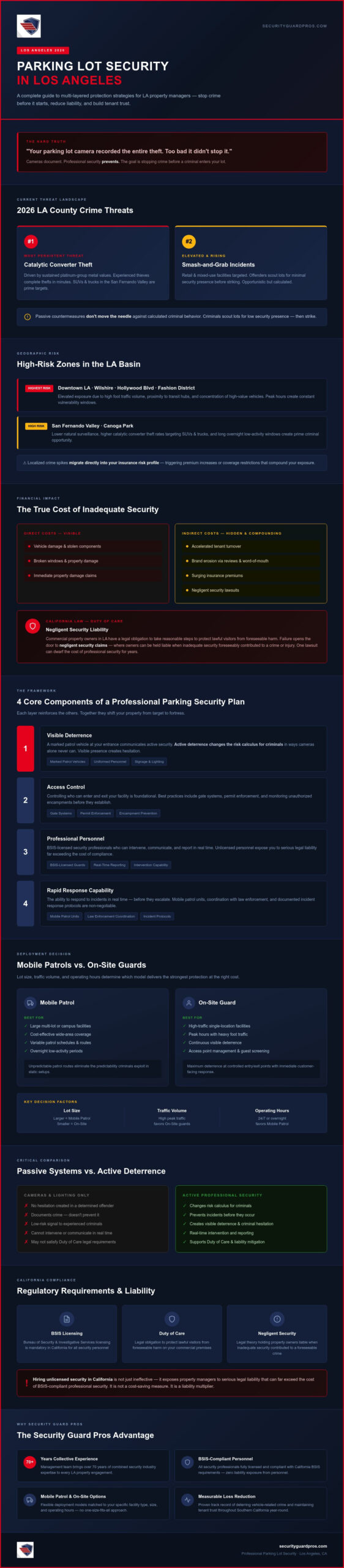
Parking lot security in Los Angeles has never been a passive undertaking, but 2026 has made that reality impossible to ignore. A genuinely effective security posture isn’t a single product or a camera system; it’s a coordinated, multi-layered strategy that combines physical deterrence, access control, professional personnel, and rapid response capability. The goal isn’t to document what happened after the fact. It’s to make your property an unattractive target before a criminal ever enters the lot.
LA County continues to grapple with persistent vehicle-related crime. Catalytic converter theft remains one of the most reported and most costly property crimes affecting commercial facilities, driven by the sustained value of platinum-group metals and the speed at which experienced thieves can complete a theft. Smash-and-grab incidents targeting vehicles in retail and mixed-use parking facilities have similarly remained elevated, with opportunistic offenders often scouting lots for minimal security presence before striking. Passive countermeasures simply don’t move the needle against this type of calculated criminal behavior.
That’s the core problem with relying solely on cameras and lighting. Both serve a purpose, but neither creates hesitation in a determined offender. A well-lit lot with a visible camera tells a thief the risk is low and the reward is documented, not prevented. Active deterrence, meaning a physical presence that can intervene, communicate, and report in real time, is what changes the risk calculus for criminals operating in high-traffic zones.
California law reinforces this point through the legal standard known as Duty of Care. Commercial property owners in Los Angeles have a legal obligation to take reasonable steps to protect lawful visitors from foreseeable harm on their premises. Failing to meet that standard opens the door to negligent security claims, a legal theory under which a property owner can be held liable when inadequate security measures foreseeably contributed to a crime or injury on their property.
High-Risk Zones in the Los Angeles Basin
Not every parking facility carries the same threat profile. Downtown LA and high-density retail corridors along Wilshire, Hollywood Boulevard, and the Fashion District face elevated exposure due to foot traffic volume, proximity to transit hubs, and the concentration of high-value vehicles. In the San Fernando Valley, parking structures in areas like Canoga Park contend with different but equally serious challenges: lower natural surveillance, higher rates of catalytic converter theft targeting SUVs and trucks, and longer periods of low-activity overnight hours that create windows of opportunity for criminal activity. These localized crime spikes don’t stay isolated to incident reports; they migrate directly into your property’s insurance risk profile, often triggering premium increases or coverage restrictions that compound your exposure.
The True Cost of Inadequate Parking Security
The direct costs are visible and immediate: vehicle damage, stolen components, broken windows, and the property damage claims that follow. The indirect costs are where most property managers underestimate their exposure. Tenant turnover accelerates when occupants don’t feel safe using your facility. Brand reputation erodes quietly, through negative reviews, word-of-mouth, and reduced foot traffic, long before a formal complaint is filed. Insurance premiums climb in response to claim history, and once a property is flagged as high-risk, carriers have leverage. Taken together, the financial argument for professional parking lot security in Los Angeles isn’t a close call.
Core Components of a Professional Parking Security Plan
A reactive security posture is a losing strategy. The property managers who successfully reduce criminal activity and limit liability exposure share one thing in common: they’ve built their security plans around prevention, not documentation. Effective parking lot security in Los Angeles depends on four interlocking components, each one reinforcing the others.
Visible Deterrence vs. Stealth Monitoring
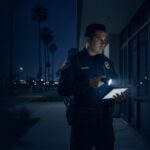
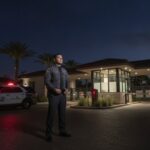
A marked patrol vehicle parked at your facility’s entrance communicates something a hidden camera never can: someone is here, watching, and ready to act. That distinction matters enormously to the criminal calculating risk before entering your lot. Uniformed guards and marked vehicles create what security professionals call a deterrence signal, a clear, immediate message that the cost of criminal activity at this location is higher than elsewhere.
The uniform itself carries weight. High-visibility professional attire doesn’t just deter bad actors; it actively reassures the tenants, customers, and employees who use your facility daily. The goal is a presence that reads as firm and authoritative to a potential offender while remaining approachable and professional to the person walking to their car at 10 PM. Those two qualities aren’t in conflict. They’re the standard every trained security professional should meet.
Access Control and Dynamic Patrol Routes
Managing entry and exit points is foundational. Uncontrolled access means any vehicle, authorized or not, can enter your facility at any time. Gate systems, access credentials, and staffed entry points all reduce the pool of potential offenders who can reach your lot in the first place. But access control alone doesn’t cover what happens once someone is inside.
That’s where patrol strategy becomes critical. Fixed guard posts are predictable. A determined offender will observe the pattern and act during the gap. Randomized, dynamic patrol routes eliminate that gap entirely. When the timing and path of each patrol sweep is unpredictable, there’s no reliable window to exploit. It’s a simple principle with a significant impact on deterrence outcomes.
Technological Integration in 2026
Professional security operations today aren’t running on clipboards and radio calls alone. The strongest programs integrate guard presence with the facility’s existing infrastructure:
- 24/7 dispatch coordination: A centralized dispatch center means any incident reported by a patrol officer triggers an immediate, coordinated response rather than a delayed chain of phone calls.
- Electronic incident reporting: Real-time digital activity logs give property managers a timestamped record of every patrol sweep, observation, and incident. In a negligent security claim, that documentation is your first line of defense.
- System integration: Guard patrols coordinated with gate access systems and lighting schedules create a unified security environment rather than a collection of disconnected tools.
Incident reporting deserves particular emphasis. A handwritten log left in a binder doesn’t hold up the way a geo-tagged, timestamped electronic record does when an attorney starts asking questions. The administrative side of security is where liability is won or lost.
If you’re evaluating whether your current setup covers these components, speaking with a licensed parking security specialist is the fastest way to identify the gaps before an incident forces the issue.
Mobile Patrols vs. On-Site Guards: Choosing Your Defense
There’s no universal answer here. The right deployment model depends on your facility’s size, traffic volume, operating hours, and the specific threat profile of your location. Getting this decision wrong in either direction costs you: over-staff a low-risk lot and you’re burning budget; under-staff a high-volume garage and you’re building a liability case against yourself. Understanding the distinct strengths of each model is where smart parking lot security in Los Angeles planning begins.
When to Deploy Vehicle Mobile Patrols
Mobile patrol works best when coverage needs to span distance. Spread-out commercial plazas, multi-site industrial properties, and HOA communities across the Inland Empire, including Riverside and San Bernardino, are natural fits. A single roving unit can cover multiple properties within a defined geographic zone, delivering professional security presence at a cost structure that a dedicated on-site post simply can’t match for lower-risk environments.
The real power of mobile patrol is unpredictability. Randomized sweep timing and routes eliminate the pattern a determined offender would otherwise exploit. There’s no gap to wait out when the next patrol could arrive in five minutes or forty-five. That uncertainty is the deterrent. For small retail centers and HOAs operating on tighter security budgets, monthly contract models built around mobile patrol offer a practical path to professional coverage without the overhead of a full-time post.
The Case for Dedicated On-Site Protection
Some environments can’t rely on periodic sweeps. Hospitals, hotels, luxury residential complexes, and high-volume parking garages with continuous foot traffic require a permanent, visible presence that can respond immediately, not eventually. When a guest reports aggressive loitering near their vehicle or an unauthorized individual enters a restricted level, the response window is measured in seconds, not the time it takes a patrol unit to complete its route and circle back.
Dedicated on-site guards also carry a dual function that mobile units can’t replicate. They handle parking enforcement, manage guest access, assist with wayfinding, and de-escalate confrontational situations, all simultaneously. That operational versatility makes them essential in environments where the security function overlaps directly with the guest experience.
The armed versus unarmed question follows naturally from this assessment. Unarmed guards are appropriate for most commercial parking environments where the primary threats are property crime and unauthorized access. Armed security guards become necessary when the risk profile includes cash handling, high-value assets, or documented patterns of violent crime at or near the facility. For a detailed breakdown of staffing tiers and how to match guard classification to threat level, this guide to security guard services in Los Angeles covers the full spectrum.
The bottom line: don’t default to the cheapest option or the most familiar one. Match the deployment model to the actual threat environment your facility faces.
Mitigating Liability and Ensuring CA Regulatory Compliance
Security isn’t just a physical problem in California. It’s a legal one. Property managers who focus exclusively on deterrence while ignoring regulatory compliance are building their protection strategy on a foundation that collapses the moment an attorney starts asking questions. For anyone managing parking lot security in Los Angeles, understanding what the law requires isn’t optional background knowledge; it’s the difference between a defensible position and an indefensible one.
California BSIS Standards for 2026
Every security guard deployed on a California property must hold a valid guard card issued by the Bureau of Security and Investigative Services. BSIS regulates licensing for both individual security personnel and the private patrol operator companies that employ them. Any guard carrying a firearm requires an additional, separate BSIS-issued firearms permit. These aren’t administrative formalities. They’re minimum legal thresholds, and verifying them before a single officer sets foot on your property is your responsibility as the contracting party.
Hiring unlicensed individuals to perform a security function doesn’t save money; it transfers the full weight of liability from the offender directly onto you. If an unlicensed “guard” fails to prevent an assault, causes harm, or is involved in any incident on your property, your exposure in litigation is dramatically higher than if no security presence existed at all. The same logic applies to insurance: engaging an uninsured security firm in California is a business-ending risk, because when a claim arises, there’s no coverage to absorb it and your assets become the recovery target.
A licensed private security company carries both professional liability insurance and workers’ compensation coverage for all deployed personnel. That coverage protects you when things go wrong. Don’t accept a contract without confirming both are in place and current.
Liability Protection Through Documentation
Courts evaluating negligent security claims apply a straightforward test: did the property owner take reasonable steps to protect foreseeable visitors from foreseeable harm? Your answer to that question lives or dies in your documentation.
Digital patrol logs with geo-tagged timestamps are your primary evidence of reasonable care. They demonstrate that trained, licensed personnel actively monitored your facility at regular intervals, not that a camera passively recorded what happened. That distinction matters enormously to a jury. A handwritten log doesn’t carry the same evidentiary weight as a timestamped electronic record tied to a specific location and time.
Documentation extends beyond patrol records. Professional security personnel are trained to identify and report physical hazards, broken lighting, oil spills, damaged pavement, and obstructed sightlines, that create independent slip-and-fall exposure. A guard who logs a lighting outage and triggers a maintenance request at 11 PM creates a record that the property owner acted promptly. The absence of that record creates a very different story in court.
Strategic placement of security signage reinforces both legal and physical deterrence. Visible notices that the property is actively monitored by licensed security personnel serve a dual function: they create hesitation in potential offenders and they establish, on the record, that visitors were informed a security program was in place.
If you’re unsure whether your current security vendor meets BSIS requirements or whether your documentation practices would hold up under legal scrutiny, connect with a licensed parking lot security specialist to close those gaps before they become claims.
Why Security Guard Pros is the Shield for LA Parking Facilities
Experience isn’t a marketing claim. It’s the difference between a security partner who anticipates problems and one who reacts to them. Security Guard Pros brings over 70 years of collective management experience to every engagement, built entirely within the Southern California security landscape. That depth of regional knowledge shapes every deployment decision, every patrol strategy, and every customized plan developed for LA property managers who need protection that actually performs.
The approach is deliberate and disciplined. No generic staffing packages. No cookie-cutter patrol schedules applied uniformly regardless of location or threat profile. Every parking facility presents a distinct risk environment, and the security plan built for a high-volume retail garage in Hollywood shouldn’t look identical to the one protecting a mixed-use residential complex in Canoga Park. Security Guard Pros builds from the specific: your lot’s layout, your operating hours, your documented incident history, and the crime patterns active in your immediate area.
Regional Expertise from Canoga Park to San Diego
Understanding local law enforcement dynamics across LA and Orange County isn’t something you develop from a manual. It comes from years of operating within these jurisdictions, coordinating with local agencies, and knowing how response times, patrol coverage gaps, and neighborhood-specific crime patterns interact with your security posture. That operational intelligence gives Security Guard Pros a measurable advantage when structuring coverage for properties across the Southern California corridor.
Rapid deployment capability matters when circumstances change without warning. Emergency fire watch requirements, short-term event needs, or sudden escalations in criminal activity at a facility don’t follow a convenient schedule. Security Guard Pros maintains the dispatch infrastructure to respond to those situations with speed and precision. For developing properties and active construction sites that require parking lot security in Los Angeles during build-out phases, the same expertise that drives their construction site security guard services applies directly to protecting staging areas, equipment, and vehicles on undeveloped lots.
Your Next Steps for a Secure Facility
Getting started doesn’t require a long-term commitment before you understand what you’re getting. The process begins with a site walk-through: a professional assessment of your facility’s physical layout, access control vulnerabilities, lighting gaps, and current coverage deficiencies. From that analysis, a customized deployment plan is developed with transparent pricing structured around ROI and measurable risk reduction, not upsells.
Parking lot security in Los Angeles is too consequential to leave to a vendor who doesn’t know your property or your market. Don’t wait for an incident to force the conversation. Contact Security Guard Pros for a professional parking lot security analysis and get a clear picture of where your facility stands and exactly what it takes to protect it.
Your Parking Lot Deserves More Than a Camera and a Hope
Criminal activity doesn’t pause while you’re evaluating your options. Parking lot security in Los Angeles in 2026 demands a proactive, layered strategy built on licensed personnel, documented patrol activity, and a security partner with the regional expertise to match your facility’s actual threat profile.
The core message throughout this guide is straightforward: passive measures document crime; professional security deters it. Regulatory compliance protects you legally. And the right deployment model, whether mobile patrol or dedicated on-site coverage, depends entirely on your property’s specific needs, not a vendor’s default package.
Security Guard Pros brings over 70 years of collective management experience, full California licensing, and 24/7 rapid deployment capability to every engagement. That’s not a marketing claim; it’s the foundation your tenants, customers, and insurers expect you to stand on.
Don’t let an incident force the decision you could make today. Secure your Los Angeles parking lot with professional guards today and get the protection your property actually deserves.
Frequently Asked Questions About Parking Lot Security in Los Angeles
Is a parking lot owner liable for car break-ins in Los Angeles?
Potentially, yes. California’s Duty of Care standard requires commercial property owners to take reasonable steps to protect lawful visitors from foreseeable harm. If car break-ins are a documented pattern at your facility or in your immediate area, and you haven’t implemented reasonable security measures, a negligent security claim becomes a real exposure. “Foreseeable” is the operative word in court, and local crime history establishes foreseeability quickly.
Liability isn’t automatic after every break-in, but it becomes substantially harder to defend when you can’t demonstrate active, documented security measures were in place. Passive camera footage alone rarely satisfies the reasonable care threshold when a jury is evaluating what a property owner could have done differently.
What is the difference between armed and unarmed parking security?
Unarmed security guards are appropriate for most commercial parking environments where the primary threats are property crime, unauthorized access, and trespassing. They handle deterrence, patrol, enforcement, and incident reporting without a firearm. Armed guards carry a BSIS-issued firearms permit in addition to their guard card, and they’re deployed when the risk profile includes cash handling, high-value assets, or documented patterns of violent crime at or near the facility.
Don’t default to armed security because it sounds more serious. Match the guard classification to your actual threat environment. Over-deploying armed personnel in a low-risk retail lot creates its own liability and operational complications. A professional security assessment will identify which tier your facility actually requires.
How often should mobile patrols visit my parking lot to be effective?
There’s no single correct frequency, but effectiveness depends less on how often patrols occur and more on whether those patrols are unpredictable. A determined offender will observe a fixed, clockwork schedule and act during the gap. Randomized patrol timing eliminates that window entirely. A lot that receives irregular sweeps with no predictable pattern is meaningfully harder to exploit than one patrolled on a rigid schedule, even if total patrol count is similar.
Practical frequency depends on your lot’s size, operating hours, and documented incident history. High-volume facilities with overnight exposure typically require more frequent coverage than a low-traffic suburban retail center. A site assessment from a licensed security professional will produce a defensible patrol cadence built around your specific risk profile rather than a generic template.
Does having a security guard lower my property insurance premiums in California?
It can, though the outcome depends on your carrier and your current claims history. Insurance underwriters assess risk based on documented loss patterns, and a property with a professional security program in place presents a different risk profile than one without. Some California carriers factor active security measures into their premium calculations, particularly for commercial properties in areas with elevated vehicle crime rates.
The more reliable financial argument is claim prevention rather than premium reduction. Fewer incidents mean fewer claims, and claim history is the primary driver of premium increases over time. Professional parking lot security in Los Angeles doesn’t just protect your tenants; it protects your insurability. Contact your carrier directly to understand how documented security measures affect your specific policy.
Can security guards legally tow unauthorized vehicles in LA?
Security guards don’t have independent authority to order tows in California, but they can coordinate with a licensed towing company on behalf of the property owner. California Vehicle Code Section 22658 governs the removal of vehicles from private property and establishes specific requirements: proper signage must be posted, the tow must be authorized by the property owner or their designated agent, and documentation requirements must be met. A security guard acting as the property owner’s authorized agent can initiate that process within those legal parameters.
Getting this wrong creates liability. Improper tows can expose property owners to civil claims. Any security company managing parking enforcement on your behalf should have a clear, documented protocol for vehicle removal that complies with California law. Confirm that protocol before a dispute forces the question.
What should I look for when evaluating security companies in Los Angeles?
Start with licensing. Every guard deployed on your property must hold a valid BSIS guard card, and the company itself must be licensed as a private patrol operator in California. Verify both before signing anything. Next, confirm the company carries professional liability insurance and workers’ compensation coverage for all personnel. An uninsured vendor transfers their liability directly onto you when something goes wrong.
Beyond compliance, look for regional operational experience, not just general security staffing. A company that understands LA County’s specific crime patterns, local law enforcement dynamics, and the distinct threat profiles across different neighborhoods will build a meaningfully stronger deployment plan than one applying a generic template. Ask specifically how they customize patrol strategies and how they document activity in real time.
How does 24/7 dispatch improve parking lot safety?
Centralized 24/7 dispatch eliminates the response gap that exists when a patrol officer has to work through a chain of delayed phone calls after an incident. When something happens, whether it’s a reported trespasser, a vehicle break-in in progress, or a physical altercation, immediate coordination with a live dispatch center means the right response is triggered in seconds rather than minutes. That speed difference is operationally significant in situations where timing determines outcome.
Dispatch capability also supports rapid deployment when circumstances change without warning. An escalation in criminal activity, an emergency fire watch requirement, or an unexpected event at your facility doesn’t follow a convenient schedule. A security operation backed by 24/7 dispatch infrastructure can respond to those situations with precision rather than scrambling to staff up after the fact.
Is security required for parking garages under California law?
California law doesn’t mandate a specific security staffing requirement for most commercial parking garages by name. However, the Duty of Care standard effectively creates a functional obligation when criminal activity is foreseeable at your facility. If your location has a documented history of vehicle crime, or if the surrounding area has elevated incident rates, failing to implement reasonable security measures leaves you legally exposed under negligent security theory regardless of whether a specific statute mandates a guard post.
Certain facility types face additional regulatory considerations. Healthcare facilities, for instance, operate under distinct safety requirements that affect adjacent parking structures. If you’re unsure whether your specific facility type triggers any California security obligations, consult both a licensed security professional and your legal counsel before assuming no requirement applies.