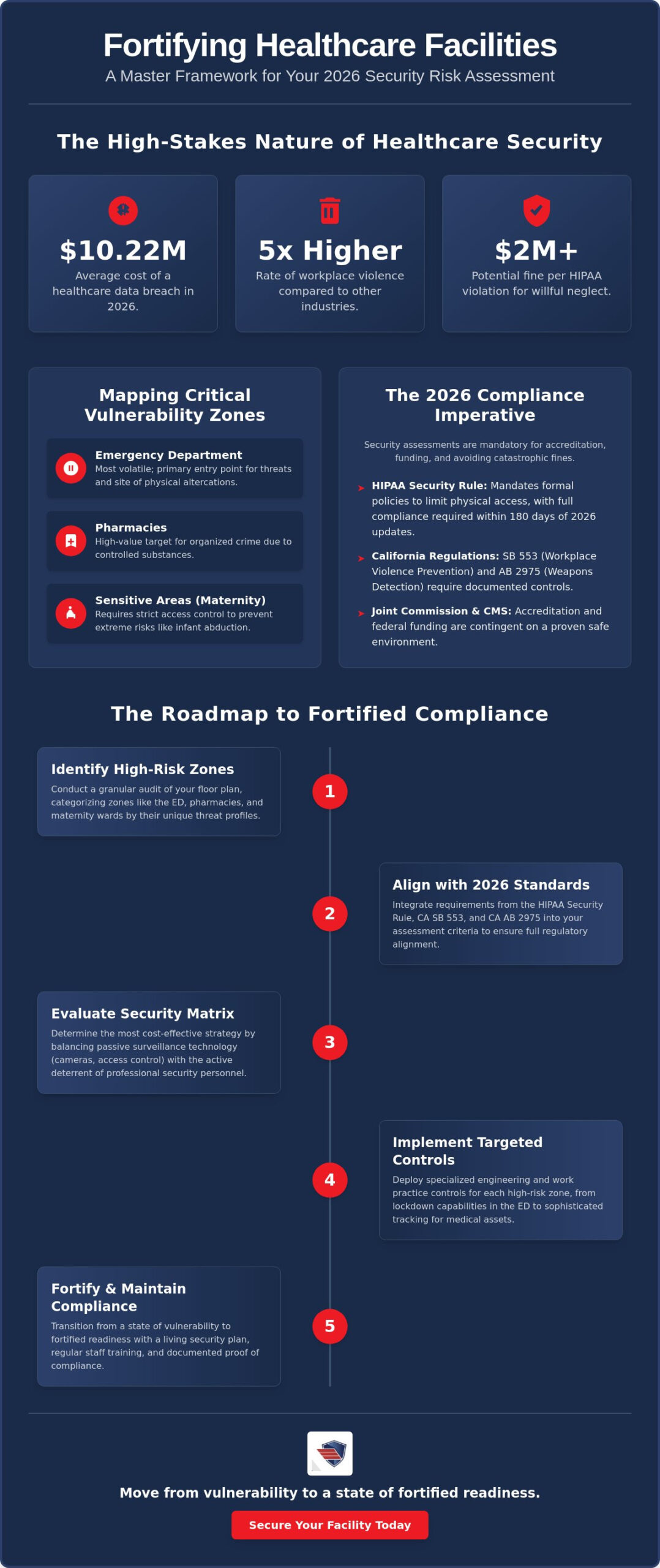
With the average healthcare data breach costing $10.22 million in 2026, treating your healthcare facility security risk assessment as a simple annual checklist is no longer just a risk; it’s a liability. You understand the immense pressure of protecting a vulnerable population while facing workplace violence rates five times higher than other industries. It’s a constant struggle to keep your doors open and welcoming while bracing for the heavy fines associated with the 2026 HIPAA Security Rule updates and California’s AB 2975 weapons detection mandates.
We agree that the traditional approach to safety is often inadequate for today’s sophisticated threats. You need a strategy that satisfies the Joint Commission without turning your medical center into an intimidating fortress. This guide delivers a master framework for identifying hidden vulnerabilities and ensuring total regulatory compliance across your entire footprint. We will outline a clear roadmap for your 2026 evaluation, focusing on reducing insurance premiums and creating a secure environment where your staff can focus on providing elite patient care without distraction.
Key Takeaways
- Learn to identify high-risk zones like the Emergency Department and pharmacies that require specialized protection protocols beyond standard commercial security measures.
- Align your healthcare facility security risk assessment with rigorous 2026 standards, including California SB 553 requirements for documented engineering and work practice controls.
- Evaluate the critical balance between passive surveillance technology and the active deterrent of professional security personnel to determine the most cost-effective protection strategy.
- Master a disciplined, five-step roadmap to transition your medical facility from a state of perceived vulnerability to a position of fortified, long-term compliance.
Understanding the High-Stakes Nature of Healthcare Security Risk Assessments
A healthcare facility security risk assessment is a specialized, technical audit of your physical, procedural, and electronic safeguards. It’s far more complex than a standard risk assessment performed for a typical office or retail space. Medical environments are unique because they never close; they operate 24/7 while housing patients who often cannot protect themselves. This constant accessibility creates a paradox. You must remain open to the public while strictly controlling who enters sensitive areas. By conducting a thorough healthcare facility security risk assessment, you move from a state of vulnerability to a state of fortified readiness.
In 2026, the industry has abandoned the “wait and see” approach. We now focus on proactive threat hunting. This strategy involves identifying vulnerabilities in your perimeter, internal workflows, and staff training before a crisis hits. A robust assessment is your primary defense against institutional liability. It transforms your security from a budget line item into a strategic asset that preserves your reputation and your bottom line. Don’t treat this as a suggestion; treat it as the foundation of your operational survival.
The Evolving Threat Landscape for Medical Facilities
The dangers facing modern hospitals are shifting rapidly. In major urban hubs like Los Angeles, workplace violence has reached a critical point. Healthcare workers are five times more likely to experience violence than those in any other industry. This isn’t just about combative patients; it’s about external threats entering your space. Your facility also houses high-value targets for criminal enterprise. Disciplined oversight is the only way to deter these threats effectively.
- Pharmaceutical Theft: Controlled substances have a massive black-market value, making pharmacies a magnet for organized crime.
- Asset Loss: Specialized medical equipment is expensive and often portable. It requires sophisticated tracking and physical barriers.
- Sensitive Areas: Maternity wards face the nightmare scenario of infant abduction. These zones require a blend of electronic surveillance and disciplined human intervention.
Beyond Physical Safety: The Compliance Imperative
Your security posture is a direct reflection of your regulatory health. A comprehensive assessment is mandatory to satisfy the Centers for Medicare & Medicaid Services (CMS) requirements for a safe environment. It’s also the backbone of Joint Commission accreditation. Without it, you risk losing federal funding and public trust. HIPAA physical safeguard standards mandate that you implement formal policies to limit physical access to systems, especially with the 2026 finalized updates requiring full compliance within a 180-day window. Failing to document these controls can lead to catastrophic fines exceeding $2 million per violation in cases of willful neglect.
Mapping Critical Vulnerability Zones in Your Facility
Effective protection begins with a granular look at your floor plan. Your healthcare facility security risk assessment must categorize zones based on their specific threat profiles. A hospital isn’t a monolithic block; it’s a collection of high-traffic public spaces and highly restricted clinical areas. While an administrative wing might only require basic electronic access control, the Emergency Department (ED) and pharmacy hubs demand a physical, high-visibility presence to deter aggressive behavior and theft.
You must prioritize resources where the stakes are highest. Utilizing a comprehensive HIPAA Security Risk Assessment Checklist ensures that your physical layout doesn’t just stop intruders but also protects sensitive patient data displayed at nursing stations and in public-facing kiosks. By identifying these zones early, you can implement targeted controls that satisfy both safety needs and strict regulatory mandates.
The Emergency Room: The Front Line of Facility Defense
The Emergency Room is your most volatile environment. It serves as the primary entry point for unauthorized individuals and remains the most likely site for physical altercations. In urban centers, the ED often receives gang-related trauma arrivals, which can transform a waiting room into a conflict zone in seconds. You must evaluate your lockdown capabilities and integrate proactive weapons screening at these entrances. The goal is to strike a balance between a welcoming triage experience and a stern deterrent that signals zero tolerance for violence. Staffing these areas with guards who understand the nuance of de-escalation is vital for maintaining order without compromising care.
Securing the Perimeter and Parking Infrastructure
Southern California medical campuses often span several acres with complex, multi-level parking structures. These are notorious blind spots where vehicle burglaries and personal assaults occur. During your assessment, you must analyze lighting standards and verify that emergency call-boxes are functional and visible. Implementing vehicle mobile patrols is a proven method for eliminating these gaps. A visible patrol vehicle doesn’t just respond to incidents; it prevents them by demonstrating constant vigilance across your entire perimeter. This proactive approach alleviates the anxiety patients and staff feel when walking to their cars after dark.
Don’t overlook “soft targets” within the facility. Gift shops, cafeterias, and public waiting areas often have lower security density but high foot traffic. These zones are ideal locations for loitering or the theft of personal assets. Ensure your assessment includes these areas to create a truly comprehensive protective shield. If you want to ensure your facility is fully fortified, consider a professional consultation to align your physical safeguards with modern industry standards.
Navigating the California Regulatory Landscape for 2026
California’s regulatory environment is the most demanding in the nation. As of 2026, California SB 553, the Workplace Violence Prevention Act, has fundamentally changed how you must approach your healthcare facility security risk assessment. This law mandates that every medical facility implement a comprehensive, written workplace violence prevention plan. You can’t rely on generic templates; your plan must be specific to your site’s unique layout and patient population. Your assessment must document specific “engineering controls,” such as physical barriers, badge-access readers, and panic buttons, alongside “work practice controls” like specialized staffing levels and visitor management protocols. Failure to provide these documented justifications leaves your institution open to massive Cal/OSHA penalties and increased liability.
You’re also required to maintain a detailed “Incident Log” as mandated by state law. This log tracks every act of violence, including verbal threats, physical altercations, and unauthorized entries. It’s a critical component of your ongoing risk analysis. By 2026, California has also raised the bar for security guard training in healthcare settings. Guards are now required to possess specific competencies in de-escalation, clinical-environment awareness, and patient privacy. This ensures that the personnel protecting your facility are as disciplined and professional as the medical staff they serve.
Joint Commission and CMS Alignment
Alignment with federal standards is equally vital for your operational survival. The Joint Commission’s “Environment of Care” standards dictate that your assessment frequency must reflect the actual risk level of your facility. In 2026, there’s a heavy focus on Active Shooter preparedness and required annual drills. You must maintain a rigorous documentation trail to prove compliance during unannounced inspections. Your ability to produce a recent, data-driven healthcare facility security risk assessment is the difference between a clean report and a deficiency citation that could threaten your CMS funding.
California-Specific Liability and Tort Law
Beyond compliance, your assessment is your primary shield in California’s litigious environment. Documented risk evaluations mitigate “negligent security” lawsuits by establishing a clear standard of care. In CA courts, the legal distinction between “foreseeable” and “unforeseeable” criminal acts often hinges on whether you identified the risk in a formal report. Utilizing professional security guard services in Los Angeles provides the expert oversight needed to prove you’ve taken reasonable steps to protect patients and staff. This proactive posture transforms your security from a potential vulnerability into a robust legal defense.
Developing a Custom Security Matrix: Technology vs. Personnel
A common mistake in medical management is over-relying on passive surveillance. While high-definition cameras provide evidence after a crime, they rarely stop one in progress. Your healthcare facility security risk assessment should serve as the blueprint for a hybrid strategy where technology acts as the “eyes” and professional personnel act as the “intervention.” Integrating your access control systems with real-time guard notification protocols ensures that a forced door or a tailgating event triggers an immediate physical response rather than just a digital alert. This proactive alignment transforms your security from a recording device into a strategic shield.
The data from your assessment must dictate guard post orders and patrol routes. If your analysis shows a spike in unauthorized access attempts at the pharmacy loading dock between 2:00 AM and 4:00 AM, your matrix should shift resources accordingly. This isn’t just about presence; it’s about precision. The cost-benefit analysis of armed vs. unarmed guards depends entirely on these department-specific profiles. While unarmed guards are often ideal for public lobbies where a helpful, approachable presence is required, high-risk psychiatric units or trauma centers receiving victims of violent crime require a higher tier of protection. In these volatile environments, the presence of armed security guards provides the necessary level of deterrence to prevent a crisis from escalating into a tragedy.
The Role of Professional Security Guards
Professional guards in healthcare must be more than just observers. They require specialized training in the “Management of Aggressive Behavior” (MOAB) and de-escalation techniques. This “Customer Service Security” model ensures that your security team supports the patient-care mission rather than hindering it. They become a disciplined extension of your clinical team, trained to identify early signs of agitation and intervene before physical force becomes necessary. This specialized expertise is a hallmark of elite Hospital and Healthcare Security services that prioritize both safety and the patient experience.
Leveraging Security Technology
Modern technology provides the data that drives human action. AI-driven video analytics can now detect loitering in ER ambulance bays or unusual movement in restricted corridors, alerting staff before an incident occurs. Biometric scanners and RFID tags have become essential safeguards for neonatal units and pharmacies, replacing outdated key systems that are easily compromised. For these tools to be effective, you must maintain 24/7 dispatch communication to bridge the gap between a tech-triggered alarm and a mobile guard on the ground. This integrated approach ensures that no vulnerability remains unaddressed for more than a few seconds.
Executing the Assessment: From Finding to Fortification
Execution is where strategy meets reality. A healthcare facility security risk assessment isn’t a static document; it’s a living cycle of fortification that requires a disciplined, multi-step approach. You can’t rely on a “one-and-done” audit. The landscape changes too fast. To ensure your facility remains a protective shield for patients and staff, follow this rigorous 5-step process:
- Preparation: Define the scope and gather historical incident data from your state-mandated logs.
- On-site Inspection: Conduct a physical walkthrough of the high-risk zones identified in your initial planning.
- Analysis: Cross-reference findings with the 2026 California regulations and your technology-personnel matrix.
- Reporting: Document every vulnerability and recommend specific, actionable engineering and work practice controls.
- Implementation: Deploy resources and update post orders to close identified gaps immediately.
Don’t attempt this process in a vacuum. Assemble a multi-disciplinary team that includes nursing leadership, facilities managers, and professional security consultants. This diversity of perspective ensures that security measures don’t interfere with clinical workflows. Focus your immediate funding on “High Probability/High Impact” risks. By prioritizing these critical vulnerabilities, you maximize your protection while maintaining a pragmatic budget. Review this cycle at least annually to stay ahead of evolving threats and maintain your Joint Commission accreditation.
Selecting a Professional Assessment Partner
Choosing the right partner is a high-stakes decision. Look for a firm that operates a 24/7 dispatch center and possesses deep, verifiable healthcare experience. You need a team with significant management experience; prioritize firms that bring 70+ years of collective expertise to the table. Regional expertise in Orange County or San Diego is critical for local threat modeling, as the security challenges of a coastal medical campus differ fundamentally from those of a high-density urban center. Demand transparency and look for firms that proudly display their regulatory credentials and performance metrics.
Closing the Gaps: Immediate Action Items
If your assessment reveals a critical breach, you must act within the first 48 hours. Secure any compromised access points immediately and update your guard post orders to reflect the new threat level. If electronic fire systems are found deficient during the inspection, you’re legally required to deploy Fire Watch Services to maintain compliance and safety. This proactive response prevents a minor finding from becoming a major liability. For expert guidance in securing your medical environment, Contact Security Guard Pros for a Professional Healthcare Consultation and let our seasoned veterans fortify your facility against the distractions of security concerns.
Fortifying Your Medical Center for a Secure Future
The safety of your patients and staff depends on moving beyond a checkbox mentality. A comprehensive healthcare facility security risk assessment is your primary tool for identifying high-risk zones and ensuring compliance with the demanding 2026 California regulatory landscape. By integrating advanced technology with disciplined personnel, you create a dynamic environment where care remains the focus and threats are neutralized before they escalate. You’ve built a center of healing; now you must ensure it remains a protected sanctuary.
Don’t leave your institutional liability to chance. Our team brings over 70 years of collective management experience to every consultation, offering the peace of mind that comes from working with licensed and insured Southern California security experts. We provide 24/7 dispatch and rapid deployment capabilities to ensure your facility is never left vulnerable to unforeseen threats. Secure Your Facility with a Professional Security Guard Pros Assessment and gain the confidence to lead your organization with unwavering safety. Take the first step toward a fortified future today.
Frequently Asked Questions
How often should a healthcare facility perform a security risk assessment?
Perform a healthcare facility security risk assessment at least once per year or whenever you implement major operational changes. The 2026 HIPAA Security Rule updates require full compliance within a 180-day window from the effective date, making an annual review a legal necessity. Regular updates ensure your protection strategies evolve alongside new threats and changing patient volumes.
Is a security risk assessment required by law for hospitals in California?
Yes, California law mandates these evaluations through several specific statutes. SB 553 requires every medical center to maintain a written workplace violence prevention plan based on a site-specific risk analysis. Additionally, AB 2975 requires weapons detection at specific entrances by approximately June 2027, which necessitates a formal evaluation of your facility’s public access points and traffic flow.
What is the difference between a safety inspection and a security risk assessment?
Safety inspections focus on accidental hazards like fire risks, chemical spills, or slip-and-fall conditions. A security risk assessment evaluates intentional threats like workplace violence, pharmaceutical theft, and unauthorized entry. While both are essential for Joint Commission accreditation, security assessments require a tactical mindset to identify how a motivated intruder might exploit your facility’s physical or procedural gaps.
Can our internal maintenance team perform the security assessment?
Your maintenance team can provide valuable data regarding door hardware and lighting, but they shouldn’t lead the process. Internal teams often suffer from “facility blindness” and lack the specialized tactical training to identify sophisticated vulnerabilities. Hiring an external, licensed security firm provides an objective perspective and creates a vital documentation trail that reduces institutional liability during a lawsuit.
Does the Joint Commission require a specific format for security assessments?
The Joint Commission doesn’t mandate a single template, but it does require that the assessment be comprehensive, data-driven, and documented. It must align with their Environment of Care (EC) standards. Your report should clearly identify specific risks, list your current mitigation strategies, and provide a prioritized plan for addressing any remaining gaps discovered during the inspection.
How do we balance patient privacy with the need for increased video surveillance?
Position your cameras primarily in public-facing areas like lobbies, corridors, and parking structures. Avoid placing surveillance in private treatment rooms unless there’s a documented clinical or safety requirement. Modern AI-driven systems can utilize privacy masking to blur sensitive information automatically, ensuring you maintain HIPAA compliance while still monitoring for combative behavior or unauthorized loitering.
Are armed guards appropriate for a pediatric or maternity ward?
Armed guards are rarely the first choice for pediatric or maternity environments. These sensitive zones benefit more from unarmed guards trained in de-escalation and the Management of Aggressive Behavior (MOAB). Armed personnel are typically reserved for high-risk zones like the Emergency Department or psychiatric units where the threat of deadly force is statistically higher and requires a stern deterrent.
What are the most common security vulnerabilities found in Southern California clinics?
Common gaps include inadequate lighting in multi-level parking structures and “tailgating” at employee-only entrances. Many regional clinics also struggle with “soft targets” like unmonitored gift shops or cafeterias. Addressing these vulnerabilities requires a blend of vehicle mobile patrols and hardened access controls to deter loitering and opportunistic theft in high-traffic urban areas.