A cheap security contract is the most expensive mistake a California business owner can make. You’re likely feeling the pressure to find a budget-friendly solution while staying compliant with complex regulations, such as the latest california fire watch requirements for businesses. It’s a stressful balancing act. If your fire protection systems fail for more than four hours, you’re legally obligated to implement a watch; however, hiring an unlicensed provider to save a few dollars can trigger catastrophic negligent hiring lawsuits that no standard insurance policy will cover.
We understand that navigating Bureau of Security and Investigative Services (BSIS) mandates feels like a full-time job. This guide is your protective shield. You’ll learn how to verify any Private Patrol Operator (PPO) license in under two minutes and understand why the mandatory $1 million per occurrence liability coverage is your primary line of defense. We’ll break down the 2026 standards for training and insurance so you can hire with total confidence and return your focus to your core operations.
Key Takeaways
- Learn how to verify a Private Patrol Operator (PPO) license in under two minutes using the official DCA BreEZe portal to eliminate hiring risks.
- Understand the specific california fire watch requirements for businesses to maintain legal compliance when fire protection systems are inoperable.
- Identify critical red flags during the vetting process, such as cash-only payment requests or a lack of proper uniform identifiers.
- Discover why the BSIS mandates $1 million in general liability insurance and how this protects your company from catastrophic litigation.
- Gain the confidence to select a legitimate Southern California security partner that prioritizes transparency and rigorous training standards.
What is the BSIS and Why Does It Regulate California Security?
The Bureau of Security and Investigative Services (BSIS) isn’t just another government agency. It’s the thin line between a professional protective detail and a massive legal liability for your company. Operating under the California Department of Consumer Affairs (DCA), the BSIS exists to protect the public and business owners by setting the gold standard for private security. They ensure that anyone wearing a uniform on your property has been vetted, trained, and authorized to represent the law. Without this oversight, the private security industry would be a wild west of unvetted actors, leaving your assets vulnerable.
The Role of the Department of Consumer Affairs
Think of the BSIS as the industry’s watchdog. They don’t just issue permits; they enforce a rigorous framework designed to weed out bad actors. Every individual working as one of many Security Guards in the state must pass a mandatory Live Scan background check. This process cross-references fingerprints against DOJ and FBI databases to ensure no violent criminal history exists. If a provider fails to meet these standards, the BSIS uses disciplinary review committees to investigate consumer complaints and revoke licenses when necessary. This accountability is what provides you with peace of mind during a crisis.
Regulated Industries and Mandatory Compliance
Compliance isn’t optional. The BSIS oversees several distinct licenses, including Private Patrol Operators (PPO), Alarm Companies, and Private Investigators. It’s vital to understand the difference between a “Guard Card” and a PPO license. A Guard Card is an individual permit that allows a person to work for a licensed company. However, a Guard Card doesn’t give an individual the right to contract their services directly to you. Only a company holding a valid PPO license can legally provide security services. This rule applies even to temporary needs. For instance, california fire watch requirements for businesses demand that any personnel monitoring your property during a system outage must be employed by a licensed entity. Hiring an “under-the-table” guard is a criminal offense in California and leaves your business exposed to total financial ruin if an incident occurs.
Effective January 1, 2026, Senate Bill 652 has tightened these screws further. All “Power to Arrest and Appropriate Use of Force” training must now be completed within the six months prior to a license application. Additionally, the entire training curriculum must be delivered and certified by a single provider. These 2026 updates, combined with strict california fire watch requirements for businesses, mean that hiring an unverified provider isn’t just risky; it’s a violation of state law. By choosing a BSIS-compliant partner, you’re not just hiring staff; you’re securing a legal shield for your entire operation.
The PPO License: Your Shield Against Liability and Risk
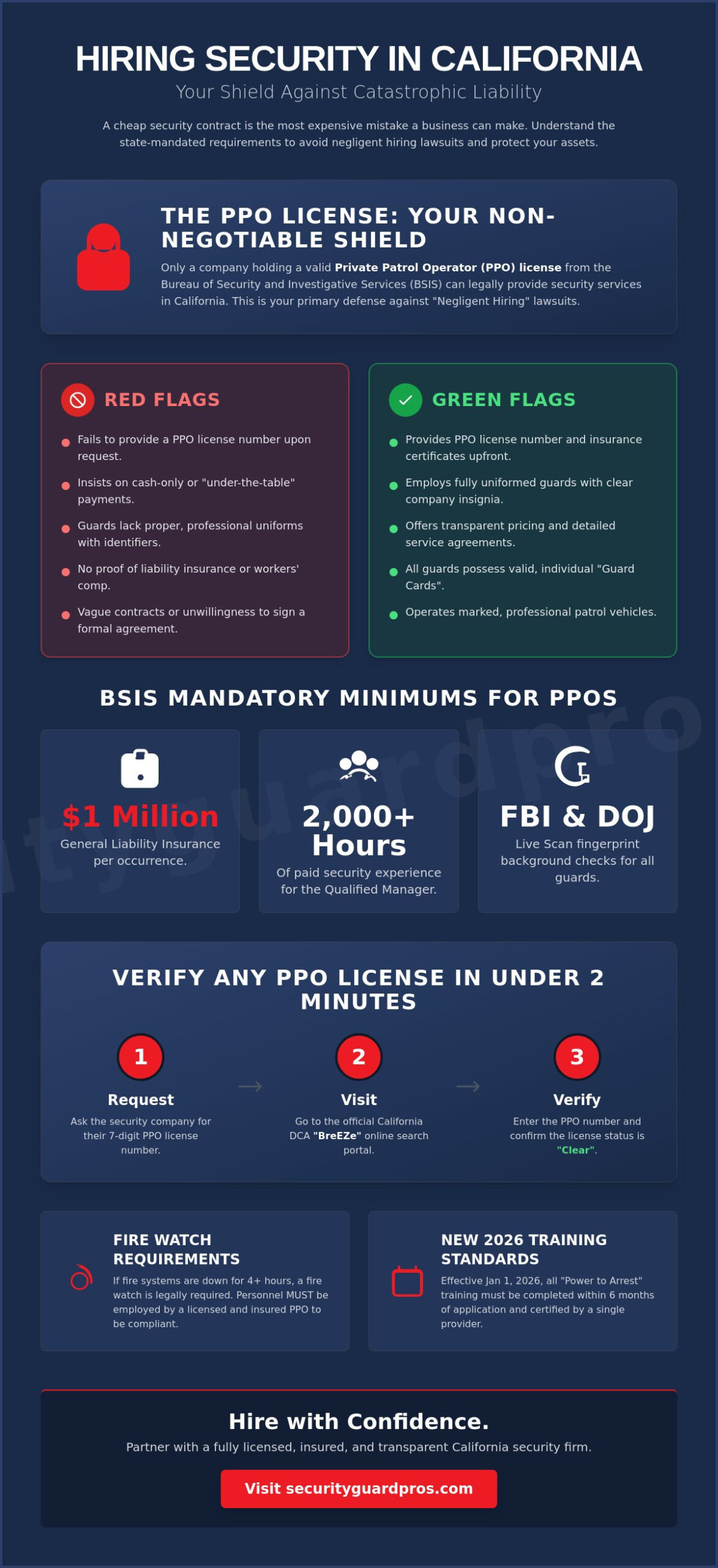
A Private Patrol Operator (PPO) license is the only legal credential that allows a company to provide security services in the state. Think of it as a seal of legitimacy from the Bureau of Security and Investigative Services (BSIS). Without this license, a firm is essentially operating an illegal enterprise. For you, the client, hiring an unlicensed firm isn’t just a compliance error; it’s a direct threat to your bottom line. The PPO license ensures the company has a Qualified Manager who has logged at least 2,000 hours of paid, professional security experience. This person has passed a state-administered examination covering the Business and Professions Code, proving they possess the tactical and legal knowledge required to protect your assets.
Hiring mistakes often stem from the “Negligent Hiring” legal doctrine. If a business contracts an unlicensed security provider and an incident occurs, the court views the business owner as the responsible party. You have a legal duty to vet your vendors. Failing to verify a PPO license before implementing california fire watch requirements for businesses can lead to multi-million dollar judgments. Your corporate insurance provider may even deny your claim, arguing that you knowingly engaged in an illegal contract. This makes the PPO license your primary shield against catastrophic financial loss.
Insurance and Workers’ Compensation Requirements
Legitimate PPO holders must maintain a minimum of $1 million per occurrence and $2 million aggregate in general liability insurance. This isn’t optional. If a guard from an unlicensed firm is injured on your property, you could be held liable for their medical expenses and lost wages. Licensed firms provide a layer of separation between your assets and potential litigation. We recommend you verify insurance certificates directly with the carrier to ensure policies are active and meet the state’s high standards.
Training Standards for Professional Personnel
California doesn’t allow just anyone to put on a badge. Every guard must complete a mandatory 40-hour training curriculum. This starts with an initial 8-hour “Power to Arrest” course before they ever step foot on a job site. Within the first 30 days, they must complete another 16 hours of training, followed by a final 16 hours within their first six months. This rigorous schedule ensures that even when meeting california fire watch requirements for businesses, the personnel on your site are prepared for any emergency. For high-risk environments, armed security guards must undergo additional firearms training and psychological evaluations. Annual continuing education keeps these skills sharp, ensuring your safety partner remains a modern guardian rather than an outdated liability.
Vetting Your Security Provider: Red Flags vs. Green Flags
Selecting a security partner is a high stakes exercise in risk management. You aren’t just buying hours of labor; you’re investing in a liability shield. Professionalism starts with transparency. A Green Flag provider proactively offers their PPO license number and provides verifiable insurance certificates without hesitation. They maintain a physical, local presence in Southern California, which ensures accountability and rapid response times. In contrast, Red Flags are often easy to spot if you know where to look. Be wary of companies requesting cash only payments or those whose guards lack proper uniform patches. A refusal to provide a license number is an immediate deal breaker.
Low cost bids should trigger an internal alarm. California’s regulatory environment, including the strict california fire watch requirements for businesses, carries high overhead costs for training and insurance. If a quote is significantly lower than the market average, that company is likely cutting corners. They might be skipping mandatory workers’ compensation or ignoring the 2026 BSIS training standards. Saving a few hundred dollars on a contract can cost you millions in a single lawsuit. A disciplined provider understands that safety cannot be a bargain basement commodity.
The Dangers of ‘1099’ Security Guards
Legitimate security firms hire guards as W-2 employees. Some low tier providers attempt to classify guards as 1099 independent contractors to avoid taxes and insurance premiums. This practice is a major legal risk for you. Under California law, security guards must generally be employees of a licensed Private Patrol Operator. If you hire a firm using contractors, the IRS or the state may view those individuals as your employees. This leaves you responsible for unpaid payroll taxes, disability claims, and workplace injuries. Always demand proof of W-2 status to protect your corporate assets.
Evaluating Management and Dispatch Capabilities
Experience is the ultimate deterrent. When a site crisis occurs, you need a leadership team that has seen it all. Management with 70 plus years of combined experience provides the seasoned judgment required for complex security implementation. This expertise is backed by 24/7 local dispatch for security guard services. Real-time communication ensures that your property is never left vulnerable. Before signing a contract, verify the Qualified Manager listed on the state’s PPO license through the BreEZe portal. This confirms the person overseeing your safety has the requisite 2,000 hours of professional experience. A modern guardian provides transparency, not excuses.
How to Verify a California Security Company License in 3 Steps
Verification is your most powerful tool against litigation. Don’t take a sales representative’s word for their legal standing. You must perform your own due diligence to ensure your vendor is authorized to operate. Adhering to california fire watch requirements for businesses demands more than just posting a guard; it requires verifying that the guard is backed by a legitimate, insured entity. Follow this three step process to confirm a provider’s credentials before you sign any contract.
- Step 1: Request the PPO License Number. Every legitimate firm will have a Private Patrol Operator (PPO) number. This should be prominently displayed on their website, business cards, and marketing materials. If a representative hesitates to provide this number, terminate the meeting.
- Step 2: Access the DCA BreEZe Portal. Navigate to the official California Department of Consumer Affairs (DCA) BreEZe License Verification system. This is the state’s central database and the only source of truth for licensing status.
- Step 3: Confirm ‘Active’ Status. Enter the PPO number and search. The status must read “Active.” Look closely at the disciplinary history section. A professional firm will have a clean record, free from major BSIS sanctions or license suspensions.
If your search returns “No Results,” the company may be operating under a “Doing Business As” (DBA) name that isn’t registered with the BSIS. Ask for the exact legal name used on their license. If the status is “Expired,” “Revoked,” or “Suspended,” the company is operating illegally. Hiring them would be a violation of state law and a massive liability for your property. To avoid these risks, always partner with a fully licensed Southern California firm that maintains transparent records.
Navigating the BreEZe Search Tool
The BreEZe portal allows you to search by business name or license number. Searching by number is more accurate. If you search by name, ensure the address on the license matches the company’s local office. Some fraudulent actors attempt to use the license numbers of defunct companies. Always verify that the “Qualified Manager” listed on the license is an actual employee of the firm. Status indicators like “Canceled” mean the license is no longer valid, while “Suspended” indicates a legal or regulatory failure that prohibits the company from providing security services.
Requesting a Certificate of Insurance (COI)
A license is only half of the equation. You must also verify that the firm carries the mandatory $1 million per occurrence and $2 million aggregate general liability insurance. Request a Certificate of Insurance (COI) that names your business as “Additionally Insured.” This ensures that the security firm’s policy protects you directly in the event of an incident. Check the policy expiration dates and the carrier’s rating; a professional BSIS-licensed firm will provide these documents immediately upon request. When fire systems fail, meeting california fire watch requirements for businesses is only possible if your security partner has the financial backing to handle the risk.
Partnering with a Vetted Southern California Security Firm
Security Guard Pros stands as a premier BSIS-licensed Private Patrol Operator, serving as a disciplined guardian for Southern California’s commercial sector. We don’t provide generic staffing; we deliver a protective shield built on transparency and regulatory excellence. Our operations span from the high-density corridors of Los Angeles to the industrial hubs of San Diego. By maintaining a localized command structure, we ensure that every client receives a security plan tailored to their specific site vulnerabilities rather than a one-size-fits-all commodity.
Compliance is our baseline. Safety is our deliverable. Our deep understanding of california fire watch requirements for businesses allows us to deploy certified personnel within hours of a system failure, preventing the catastrophic liability discussed earlier in this guide. We bridge the gap between traditional security values and modern technological oversight, providing you with the peace of mind required to focus on your core operations. We take our responsibilities with extreme seriousness, ensuring your business remains a hard target for threats.
Regional Expertise: From Canoga Park to San Diego
Operating security guard services los angeles requires more than just a presence; it requires a deep understanding of urban risk management. Our deployment capabilities extend through Anaheim, Riverside, and the Inland Empire, ensuring rapid response times for mobile patrols and emergency details. Local geographic knowledge isn’t a luxury; it’s a tactical necessity. Whether you’re managing a corporate high-rise in Canoga Park or a logistics center in San Diego, our dispatchers coordinate with guards who know the terrain, the local law enforcement protocols, and the specific environmental risks of your neighborhood. This localized expertise translates to faster intervention and superior asset protection.
Comprehensive Solutions for Every Industry
Every sector demands a unique defensive posture. We provide specialized construction site security guards who are trained to mitigate theft and vandalism on high-value jobsites. These same rigorous BSIS standards are applied across our retail, industrial, and residential portfolios. We ensure that every guard on your property is a W-2 employee backed by comprehensive liability and workers’ compensation insurance. This protects you from the ‘negligent hiring’ pitfalls common with low-cost, unvetted agencies. Don’t leave your assets to chance. Contact our 24/7 dispatch center today for a professional security consultation. Secure your property with a partner that treats california fire watch requirements for businesses as a critical mandate, not an afterthought.
Secure Your Corporate Future with Regulatory Excellence
Choosing a security partner is a definitive statement about your commitment to asset protection and legal compliance. You now possess the tools to navigate the BSIS BreEZe portal and identify the green flags of a legitimate Private Patrol Operator. Remember that a valid PPO license and a minimum of $1 million in liability insurance aren’t just bureaucratic checkboxes; they’re your primary defense against the doctrine of negligent hiring. When your property faces immediate risks or must meet strict california fire watch requirements for businesses, there is no substitute for a vetted, professional guardian.
Don’t leave your liability to chance or settle for unvetted providers who cut corners. Our team brings a fully BSIS licensed PPO status and over 70 years of combined management experience to every site we protect. With 24/7 local dispatch and rapid deployment capabilities across Southern California, we’re ready to act as your protective shield. Get a Free Security Consultation from Our Licensed Experts and replace your anxiety with the calm confidence of professional protection. Your business deserves the vigilance of a seasoned veteran.
Frequently Asked Questions
What is the difference between a Guard Card and a PPO license?
A Guard Card is an individual registration that allows a person to work as a security employee in California. In contrast, a Private Patrol Operator (PPO) license is the mandatory business credential required for a company to contract security services to the public. You cannot legally hire an individual who only possesses a Guard Card; they must be employed by a licensed PPO firm to provide services on your property.
Can I hire an off-duty police officer for security without a BSIS license?
No, off-duty police officers cannot provide private security services directly to your business unless they hold their own PPO license or work for a licensed security firm. While they have law enforcement experience, they are subject to the same BSIS regulations as any other provider when working in a private capacity. Hiring them outside this framework creates significant liability gaps and violates state labor laws regarding private security contracting.
How often do California security guards need to renew their BSIS registration?
California security guards must renew their BSIS registration every two years. It is critical for the guard to submit their renewal application and pay the state fee before the expiration date to remain eligible for work. As a property manager, you should verify the expiration dates of all personnel on your site. This ensures your security team remains compliant with current state background checks and training standards.
Is fire watch required to be BSIS-licensed in California?
Yes, any third-party firm providing personnel to meet california fire watch requirements for businesses must hold a valid BSIS Private Patrol Operator license. While the fire code dictates when a watch is necessary, the personnel performing those patrols fall under the state’s definition of private security. Hiring an unlicensed “fire watch” company leaves your business vulnerable to state fines and can lead to a total denial of insurance claims.
What insurance should a California security company carry?
A professional California security company must carry a minimum of $1 million per occurrence and $2 million aggregate in general liability insurance. They are also legally required to maintain active workers’ compensation insurance for all guards. These policies act as a shield for your assets if an incident or injury occurs on your site. Always demand a Certificate of Insurance that names your business as additionally insured before work begins.
How do I report an unlicensed security company to the BSIS?
You can report unlicensed activity through the California Department of Consumer Affairs online complaint portal. Provide specific details, such as the company name, contact information, and any marketing materials or contracts they provided. The BSIS investigates these claims to remove bad actors from the market. This process protects business owners from the dangers of unvetted and uninsured operations that undermine the safety of the industry.
Does a BSIS license cover both armed and unarmed security services?
A PPO license allows a company to offer both armed and unarmed services, but individual guards must hold the correct permits. Unarmed guards require a standard Guard Card, while armed guards must also possess a valid BSIS Firearms Permit. The company must also maintain specific insurance endorsements to deploy armed personnel. Always verify that both the firm and the individual guards have the specific credentials for the level of protection you require.
What happens if I hire a security company with an expired PPO license?
Hiring a company with an expired license exposes your business to catastrophic legal and financial risks. Your corporate insurance carrier will likely void your coverage for any incidents involving the unlicensed guards. You also face “negligent hiring” lawsuits and potential state penalties. Failing to ensure california fire watch requirements for businesses are met by a currently licensed firm is a major compliance failure that no professional manager should overlook.