
What if the legal document meant to shield your business is actually the very thing that leaves you exposed during a crisis? For many California business owners, the fine print remains a source of deep anxiety; they fear hidden costs or being held liable for an incident because of a misunderstood clause. Truly understanding your security guard service agreement is not just a legal hurdle. It’s a strategic move to ensure your provider acts as a reliable partner rather than a liability.
You deserve a protective shield that allows you to focus on operations without the distraction of security concerns. In this guide, we’ll master the critical terms that define a modern guard contract in 2026. We’ll demystify industry jargon and verify compliance with the latest BSIS regulations, including the training mandates of SB 652. By the end, you’ll have a clear checklist for negotiating better terms and the confidence that your assets are under the watch of a disciplined, professional force. Transition from a state of perceived vulnerability to a position of absolute security.
Key Takeaways
- Replace handshake deals with a comprehensive performance framework to eliminate legal vulnerability and ensure accountability.
- Simplify the process of understanding your security guard service agreement by identifying critical “Hold Harmless” clauses and mandatory insurance requirements.
- Prevent service failures by establishing a precise Scope of Work that distinguishes between static posts and vehicle mobile patrols.
- Protect your bottom line from unexpected billing surprises by mastering the nuances of holiday pay, overtime, and cancellation terms.
- Verify that your provider maintains strict BSIS compliance and PPO transparency to shield your organization from regulatory liability.
The Foundation of Professional Protection: Why Your Agreement Matters
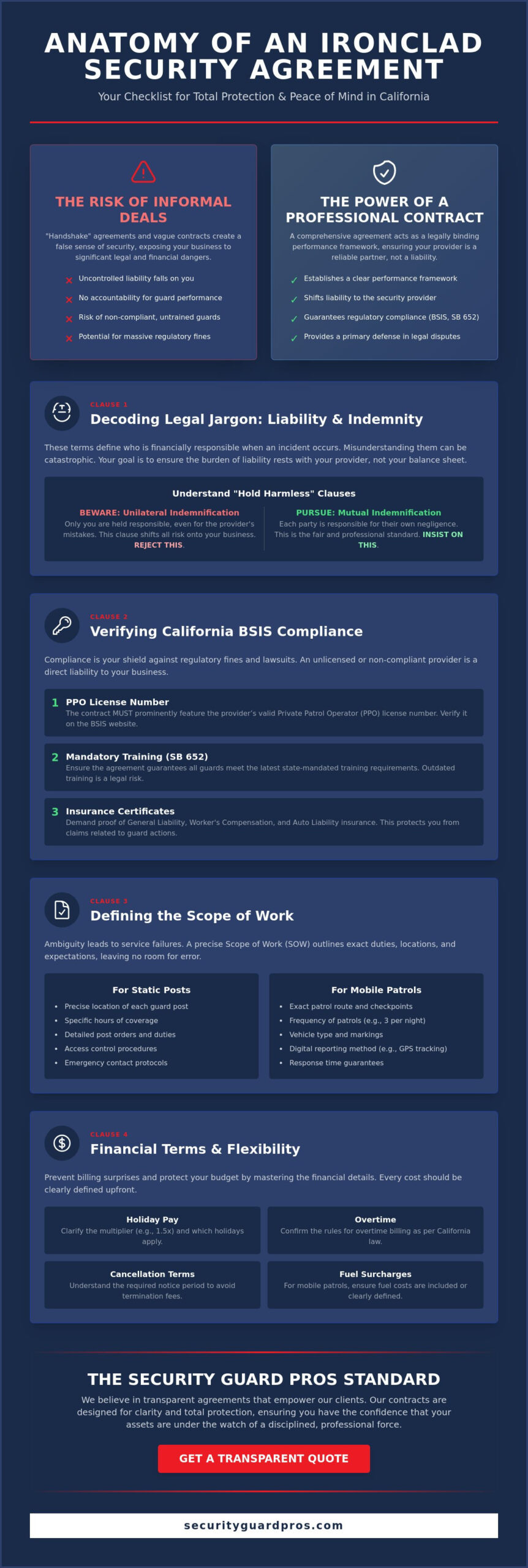
A security guard service agreement is far more than a routine administrative task. It functions as a legally binding performance framework that dictates exactly how your assets are protected. In the modern private security industry, this document establishes the precise boundaries of duty and the exact standards of conduct required on your property. Without a written contract, you aren’t just hiring a guard; you’re inviting uncontrolled risk. Understanding your security guard service agreement is the first step in transforming a potential liability into a robust protective shield.
Professionalism is defined by transparency. While “fly-by-night” operations might offer lower rates through informal handshake deals, these arrangements lack any formal documentation or accountability. They offer a false sense of security that crumbles the moment an incident occurs. In contrast, a comprehensive agreement provides the calm confidence you need to focus on your core business operations. It replaces ambiguity with a disciplined roadmap for safety. It’s the difference between hoping for the best and planning for total protection.
The Role of California Regulatory Compliance
In California, the Bureau of Security and Investigative Services (BSIS) sets the gold standard for industry oversight. Every legitimate contract must prominently feature the provider’s Private Patrol Operator (PPO) license number. This isn’t just a formality; it’s a badge of legitimacy. If your contract doesn’t reference a valid PPO license, the provider isn’t legally authorized to operate. Additionally, Southern California business owners must account for local ordinances in cities like Los Angeles that may impose specific reporting or equipment requirements. Ensure your agreement acknowledges these regional mandates to maintain full legal compliance and avoid regulatory fines.
Contract vs. Handshake: The Risk of Informal Staffing
Choosing “under-the-table” or unlicensed guard services is a massive liability. If a guard card is expired or training is non-compliant with SB 652 standards, the legal consequences fall directly on the property owner. You become the primary target for lawsuits if an incident happens under the watch of an undocumented worker. A detailed, written agreement serves as your primary defense in court. It proves you performed due diligence by hiring a regulated firm. Don’t settle for verbal promises. Demand a contract that outlines every operational detail. This is how you secure true peace of mind and ensure your provider is a modern guardian rather than a legal burden.
Decoding the Legal Jargon: Indemnity, Liability, and Insurance
Legal jargon often feels like a barrier designed to obscure reality. In the context of a security contract, however, these terms are your primary financial defense. Misinterpreting a single clause can lead to catastrophic losses that exceed the cost of the service itself. Truly understanding your security guard service agreement requires you to look past the technical vocabulary and focus on where the financial risk resides. You must ensure that the burden of liability stays with the provider, not your balance sheet.
Negotiating these terms is about more than just checking boxes. It’s about establishing a relationship based on accountability. By aligning your contract with international standards for security providers, you confirm that your partner adheres to high-level due diligence and ethical operations. This proactive approach eliminates the anxiety of the unknown and replaces it with the calm confidence of a secured operation.
Understanding Indemnification and Hold Harmless
Indemnification is the shifting of financial risk from one party to another. In a security agreement, this usually appears as a “Hold Harmless” clause. You should generally pursue mutual indemnification. This means the security firm protects you from losses caused by their negligence, and you protect them from issues arising from your specific site hazards. Beware of unilateral indemnification, where only you are held responsible regardless of who is at fault. If a guard is injured due to their own lack of training, the provider’s insurance should cover it. If a guard causes property damage, their firm must be the one to pay. Reviewing these details with an expert at Security Guard Pros can clarify how these protections apply to your specific site.
Insurance Requirements: More Than Just a Certificate
Never accept a verbal assurance of coverage. In California, a Private Patrol Operator (PPO) is legally required to carry a minimum of $1,000,000 in general liability insurance. However, high-value sites often require much more. Demand to see General Liability, Professional Liability, and Workers’ Comp policies. You must also insist on being named as an “Additional Insured” on their policy. This ensures that their insurance company defends you directly if a lawsuit is filed. Additionally, request a “Waiver of Subrogation.” This prevents the security firm’s insurance company from coming after you to recoup costs they paid out for a claim. Verify all coverage by contacting their insurance broker directly; a disciplined provider will welcome this transparency as a sign of your professional standards.
Finally, address the limitations of liability. Many firms try to cap their total financial responsibility at the value of the contract. This is often insufficient for major incidents. Negotiate fair caps that reflect the actual risk levels of your facility. A professional agreement balances the provider’s need to manage risk with your need for total protection. This is the foundation of a reliable partnership.
Defining the Scope of Work: From Guard Posts to Mobile Patrols
A vague Scope of Work (SOW) is the primary driver of service failure in the security industry. When an agreement merely states that guards will “perform duties as assigned,” it creates a vacuum of accountability. Truly understanding your security guard service agreement requires a granular look at exactly what your guards do during every hour of their shift. Without specific performance metrics, you have no recourse when service falls short. Professionalism demands a document that leaves no room for interpretation.
Your agreement must clearly distinguish between various deployment models. For instance, dedicated post standing involves a guard remaining at a fixed location, such as a lobby or gatehouse. In contrast, vehicle mobile patrols provide a broader range of coverage, utilizing marked units to deter threats across large industrial or residential complexes. These differences aren’t just operational; they impact response times and liability. According to Security Officer Contract Essentials, well-defined staffing considerations are vital for maintaining quality and consistent protection.
Modern security is intelligence-led. Your contract should codify the use of advanced technological solutions like GPS tracking and digital reporting. These tools provide transparent, real-time data that traditional paper logs cannot match. Ensure that emergency response times are explicitly stated in the agreement. Whether it’s a fire watch incident or a breach of a perimeter, your provider must be contractually obligated to respond within a specific window. For security guard services in Los Angeles, this includes ensuring guards receive site-specific training that addresses the unique risks of the local urban environment.
Site-Specific Post Orders and Accountability
Detailed “Post Orders” are the tactical manual for your security team. These must include patrol routes, access control logs, and specific incident reporting protocols tailored to your facility. A professional agreement also mandates 24/7 dispatch communication, ensuring guards are never isolated. Implementing digital “Guard Tour” systems serves as undeniable proof of service. These systems record every checkpoint visited, providing you with a rhythmic, data-driven report of your site’s safety status. It’s the difference between guessing and knowing your property is secure.
Armed vs. Unarmed Service Specifications
The choice between armed and unarmed guards significantly alters your risk profile and insurance requirements. Your agreement must use precise contractual language when deploying armed personnel. This includes listing mandatory BSIS firearms permits and periodic requalification requirements as part of the service standard. Allocation of risk must be clearly defined based on the level of force authorized in the SOW. By understanding your security guard service agreement force protocols, you ensure that your provider operates within strict legal boundaries, protecting your business from the fallout of unauthorized actions.
Financial Terms and Flexibility: Rates, Overtime, and Cancellation
Financial transparency is the bedrock of a professional security partnership. Hidden costs and vague billing structures don’t just hurt your bottom line; they erode the trust required to maintain a safe environment. A disciplined security firm provides a clear fee schedule that accounts for every contingency. Understanding your security guard service agreement allows you to budget with precision and avoid the “billing creep” common in less professional agencies. You should expect a straightforward breakdown of costs before any guard sets foot on your property.
Most agreements utilize hourly billing for static posts, while vehicle mobile patrols often operate on flat-rate monthly contracts. Each model has its merits depending on your site’s risk profile. For high-stakes environments, such as those requiring construction site security guards, rapid deployment terms are essential. These terms ensure that protection is available immediately when assets are most vulnerable, without the delay of lengthy administrative hurdles. Secure a transparent quote from Security Guard Pros to see how we eliminate billing ambiguity through expert-led consultations.
Navigating Billing Structures and Hidden Fees
Unprofessional firms often bury extra charges in the fine print. Watch for line items like uniform fees, equipment rentals, or fuel surcharges that can inflate your invoice by 10% or more. Your agreement should also explicitly define “holiday pay” and “overtime” rates to prevent surprises during peak seasons. When structuring rates for short-term emergency fire watch, ensure the contract specifies a minimum shift length and a clear “all-in” hourly rate. Transparent billing should include detailed time-stamped logs for every hour invoiced. This level of accountability ensures you only pay for the protection you actually receive.
Cancellation and Performance Clauses
Flexibility is just as important as the service itself. You must distinguish between “Termination for Convenience” and “Termination for Cause.” A “Termination for Convenience” clause typically requires a 30-day notice period, which is standard in the Southern California market. However, a “Termination for Cause” clause allows you to end the relationship immediately if the firm fails to meet BSIS compliance or performance standards. Beware of “Auto-Renewal” or evergreen clauses that lock you into long-term commitments without your active consent. Your agreement must also include the right to audit, giving you the power to review guard logs and payroll records. This ensures your provider is paying their staff in accordance with California labor laws, shielding you from secondary liability. Understanding your security guard service agreement performance metrics gives you the leverage to demand excellence every single day.
The Security Guard Pros Standard: Transparent Agreements for CA
A contract is only as strong as the company that stands behind it. At Security Guard Pros, we view the document as a promise of performance rather than a mere legal formality. With over 70 years of combined management experience, our leadership understands that understanding your security guard service agreement is the key to a successful, long-term partnership. We don’t just act as a staffing agency; we position ourselves as a protective shield for your assets. Our commitment to BSIS compliance and PPO transparency is absolute. We prominently display our regulatory credentials to provide the calm confidence you need to focus on your core business operations without the distraction of safety concerns.
Reliability requires localized expertise and rapid response capabilities. We maintain a robust presence throughout Los Angeles and Orange County, backed by a 24/7 dispatch center that ensures constant communication. This infrastructure allows us to offer rapid deployment for emerging threats or urgent fire watch needs. By choosing a partner that respects traditional security values while embracing contemporary digital tools, you transition from a state of vulnerability to a state of total security. We replace the ambiguity of unprofessional vendors with the disciplined, vigilant service of a seasoned veteran.
Customizing Your Protection Plan
Generic, one-size-fits-all contracts often leave critical gaps in coverage. We tailor every agreement to the specific demands of your industry, whether you manage a high-traffic retail center, a sprawling industrial complex, or a gated HOA community. Our process integrates advanced technological solutions, such as GPS-verified patrols and digital incident reporting, directly into the scope of work. This ensures that human intelligence is always supported by verifiable data. Our “No-Nonsense” approach to documentation means you receive clear, comprehensive insurance and liability paperwork upfront. We eliminate the anxiety of hidden costs by providing a transparent roadmap for your site’s protection.
Next Steps: Requesting a Contract Review
Don’t sign a document that leaves your business exposed. A professional security consultation is the most effective way to identify hidden liabilities before they become expensive problems. If you are currently struggling with a provider that lacks accountability or fails to meet California’s strict training standards, the transition to a professional service is simpler than you think. We specialize in audit-ready agreements that stand up to legal scrutiny and operational reality. Take control of your site’s safety today. Contact Security Guard Pros for a transparent, professional service agreement quote today.
Elevate Your Operational Security Standards
A well-structured contract is more than a legal requirement; it’s a strategic asset that transforms your security posture from reactive to proactive. By prioritizing clarity in your scope of work and demanding rigorous insurance standards, you eliminate the ambiguity that unprofessional vendors rely on. Truly understanding your security guard service agreement empowers you to hold your provider accountable to the highest levels of performance. You transition from a state of perceived vulnerability to a position of absolute control.
Don’t leave your assets to chance with a generic, high-risk arrangement. Security Guard Pros brings a seasoned veteran’s perspective to every partnership, backed by a licensed PPO status and over 70 years of management experience. We ensure your site remains protected through comprehensive insurance, full BSIS compliance, and a 24/7 dispatch infrastructure capable of rapid deployment across Southern California. Our approach replaces anxiety with the calm confidence of a secured operation.
Secure Your Business with a Professional Agreement – Get a Quote from Security Guard Pros
Take the first step toward absolute peace of mind. Your business deserves a modern guardian that values transparency and disciplined execution above all else. Secure your future with a partner who takes your safety as seriously as you do.
Frequently Asked Questions
What is the most important clause in a security guard contract?
The Scope of Work is the most critical clause because it establishes the performance standards and accountability metrics. It dictates exactly what guards must do, from patrol routes to emergency response protocols. Without a detailed scope, you lack the contractual leverage to address service failures or negligence. A professional agreement replaces vague promises with a disciplined roadmap for safety.
Do I need to be listed as an “Additional Insured” on the security company’s policy?
Yes, you must insist on being named as an “Additional Insured” on the provider’s general liability policy. This status ensures the insurance carrier defends your business directly in the event of a lawsuit involving the security team. It provides a protective layer that keeps your own insurance premiums from rising due to the provider’s actions. Never accept a contract that leaves this protection out.
Can I cancel a security guard agreement if the guards are unprofessional?
You can cancel an agreement for unprofessionalism if your contract includes a “Termination for Cause” provision. This clause allows for immediate dissolution of the partnership if the firm fails to meet performance standards or BSIS compliance. Understanding your security guard service agreement cancellation rights ensures you aren’t locked into a relationship with a low-performing vendor. Professionalism isn’t optional; it’s a contractual requirement.
What is the difference between a PPO license and a standard business license?
A Private Patrol Operator (PPO) license is a specialized credential issued by the BSIS that authorizes a firm to provide security services in California. A standard business license only permits general commercial activity within a specific city. Hiring a company without a valid PPO license is illegal. It places all liability for guard actions directly on your property’s balance sheet.
How much notice is typically required to terminate a security contract in California?
In the Southern California market, a 30-day notice period is standard for termination for convenience. This allows both parties to wind down operations professionally and ensures a smooth handoff to a new provider. However, termination for cause should always be structured as an immediate right if the firm commits a material breach of contract or fails to maintain mandatory insurance coverage.
Are security companies liable for thefts that occur on my property?
Security companies are generally not liable for theft unless you can prove the incident resulted from their direct negligence or a breach of the agreed-upon Scope of Work. Most contracts include a limitation of liability clause to protect the firm’s financial stability. A disciplined provider focuses on deterrence to prevent these incidents from occurring, rather than just reacting after the loss has happened.
What should be included in the “Scope of Work” section?
The Scope of Work section must include specific patrol frequencies, post orders, access control procedures, and reporting requirements. It should also mandate the use of digital guard tour systems and GPS tracking for vehicle mobile patrols. This level of detail eliminates ambiguity. It ensures every guard understands their role as a modern guardian of your assets and follows your site-specific safety plan.
How do I verify if a security guard company is legally compliant in Los Angeles?
Verify compliance by searching the BSIS license database for a valid PPO license and checking for a clear status. For operations in Los Angeles, ensure the provider also holds a local business tax registration and complies with specific city ordinances. Understanding your security guard service agreement compliance markers is the only way to confirm you are hiring a legitimate professional partner rather than a liability.