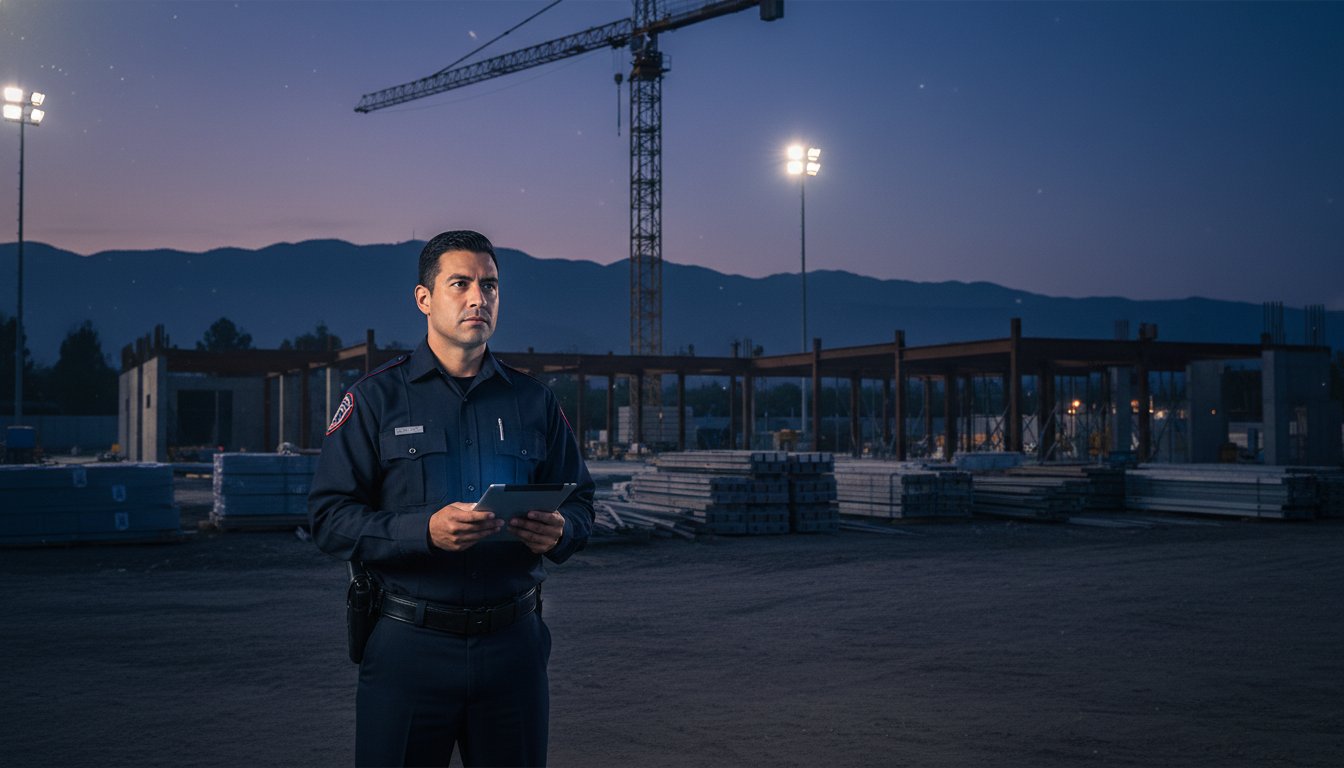
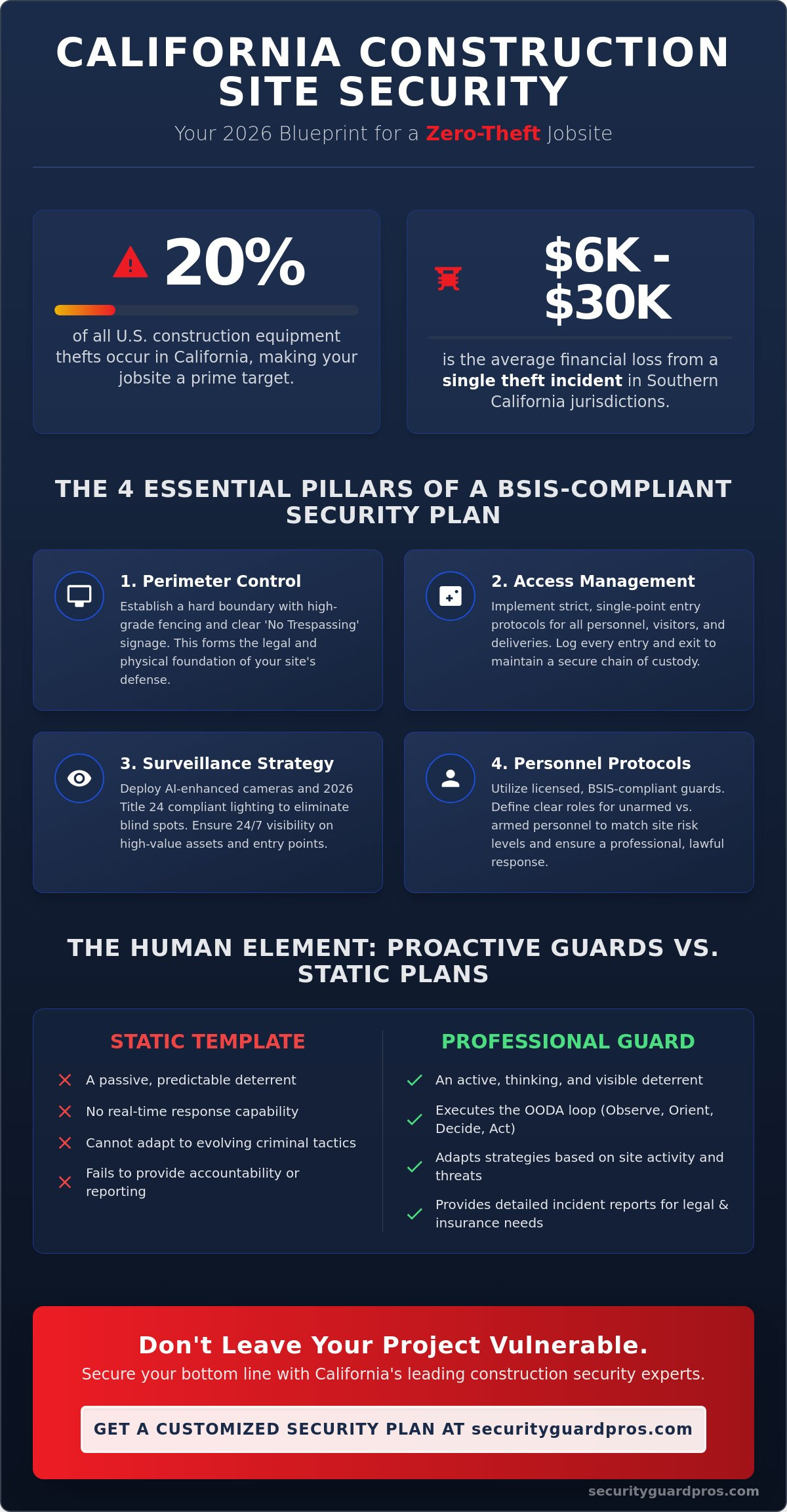
California accounts for 20% of all construction equipment thefts in the United States, making your jobsite a primary target for organized crime rings. In high-risk hubs like Los Angeles and San Diego, the average loss from a single equipment theft incident now ranges between $6,000 and $30,000. You aren’t just fighting thieves; you’re battling the 2026 Title 24 building standards and spiking insurance premiums that penalize poor oversight. Securing your perimeter requires more than a chain-link fence and a padlock. You need a rigorous construction site security plan template california professionals use to satisfy BSIS regulations and protect their bottom line.
You likely feel the pressure of rising operational costs, especially with the 2026 state minimum wage increase and new Cal/OSHA confined space requirements. It’s frustrating to watch your project’s profit margin erode due to preventable liability or stolen copper. This guide provides the exact framework you need to stabilize your site and deter professional threats. We’ll break down the mandatory 2026 regulatory updates, including SB 440 change order protocols and the latest fire safety mandates. By following this roadmap, you’ll gain the tools to reduce insurance liability and maintain a zero-theft environment throughout your project’s lifecycle.
Key Takeaways
- Discover how a documented security strategy directly reduces Builders Risk Insurance premiums by mitigating aggressive 2026 theft trends.
- Access a comprehensive construction site security plan template california developers use to satisfy Title 24 lighting standards and BSIS compliance.
- Learn why professional security guards provide a proactive deterrent that static templates cannot match through the OODA loop of situational response.
- Identify the site-specific risk assessment steps necessary to harden high-theft zones in Southern California jurisdictions like Los Angeles and San Diego.
- Streamline your site logistics by integrating perimeter control and access management into a single, cohesive protective shield for your project.
Why Every California Jobsite Needs a Formal Security Plan in 2026
In 2026, a construction site security plan template california developers rely on isn’t just a suggestion; it’s a defensive barrier against financial ruin. Organized theft rings in Los Angeles and San Diego have become increasingly surgical, targeting high-value copper and heavy machinery with precision. Relying on a generic, outdated checklist leaves your project vulnerable to both sophisticated criminals and aggressive insurance adjusters. A documented plan serves as your primary evidence of due diligence, directly influencing Builders Risk Insurance premiums by proving your site isn’t an easy target. When you demonstrate a structured approach to risk, you shift from being a liability to a controlled asset in the eyes of your provider.
A compliant security framework differs from a simple deterrent because it accounts for the legalities of the California Business and Professions Code. It doesn’t just hope to stop a thief; it establishes a chain of accountability. Secure your perimeter with a strategy that respects the fundamental principles of physical security, ensuring every gate, camera, and patrol is part of a cohesive shield. This proactive stance allows you to focus on project milestones while we handle the complexities of site protection.
The Cost of Inaction: Theft and Liability Stats
The financial impact of theft in Southern California is staggering. With the average loss per incident in Los Angeles County reaching between $6,000 and $30,000, a single breach can derail your project’s timeline and profitability. Beyond equipment loss, California’s “attractive nuisance” doctrine places the burden of safety squarely on the property owner. If a trespasser is injured on your site due to inadequate fencing or lighting, you face massive legal exposure. Your formal security plan acts as a “reasonable care” defense, providing documented proof that you took every necessary step to secure the site and mitigate foreseeable risks.
Meeting California BSIS Standards
Compliance starts with the Bureau of Security and Investigative Services (BSIS). Under the Private Security Services Act, any personnel providing protection must be properly licensed and registered. Hiring unlicensed “watchmen” or off-book labor creates a liability nightmare that can void your insurance coverage and lead to heavy state fines. Your construction site security plan template california documentation must integrate professional construction site security guards who are trained in modern de-escalation and reporting. This ensures your framework meets state law while providing a stern, visible deterrent to unauthorized entry. Don’t gamble your project’s future on unverified personnel; demand the accountability that only licensed professionals provide.
The 5 Essential Pillars of a Construction Site Security Plan Template
A high-performance construction site security plan template california developers utilize must go beyond basic compliance. It needs to be a tactical blueprint that evolves with your project. To achieve zero theft incidents, you must build your strategy upon five non-negotiable pillars. These pillars transform your jobsite from a vulnerable target into a hardened facility where every asset is accounted for and every entry is scrutinized. It’s about creating a protective shield that allows you to focus on your core operations without the distraction of security concerns.
- Perimeter Control: Install high-grade fencing and clear “No Trespassing” signage. This isn’t just about physical barriers; it’s about establishing the legal grounds for prosecution under California law.
- Access Management: Control the flow of subcontractors, deliveries, and visitors. Every individual on site must have a verified reason for being there.
- Surveillance Strategy: Deploy AI-enhanced cameras in high-blind-spot areas. Pair these with lighting plans that meet 2026 Title 24 standards to eliminate shadows where criminals hide.
- Personnel Protocols: Define exactly when to use armed vs. unarmed guards. While unarmed personnel are excellent for access control, high-risk sites in Los Angeles often require the stern deterrent of armed professionals.
- Incident Response: Establish immediate protocols for theft, fire, or injury. Confusion during a crisis leads to liability. Your plan must dictate who calls the authorities and how evidence is preserved.
Access Control and Logistical Security
Paper logs are obsolete. Modern California jobsites require digital sign-in systems to track every person who enters the gates. This data is vital for both security and labor disputes. Implementing RFID or biometric scanning ensures that only authorized tradespeople access the site after hours. If your project requires specialized overnight work, construction site security services can manage these logistical handoffs, ensuring no unauthorized personnel slip through the cracks during shift changes. This disciplined approach eliminates the “open door” policy that many unprofessional sites inadvertently adopt.
The Lifecycle of Security: From Grading to Handover
Your security needs change as the project matures. A static plan fails because it doesn’t account for the shifting risk profile of a rising structure. Divide your strategy into three distinct phases to maintain maximum protection.
Phase 1: Grading and Excavation. During this stage, your primary focus is perimeter integrity. Secure the boundaries to prevent illegal dumping and equipment theft while the site is still an open field. Phase 2: The Lock-up Stage. As high-value materials like copper and lumber arrive, internal security becomes paramount. This is when theft rings are most likely to strike. Phase 3: Final Finish. Once appliances and smart-home technology are installed, the site faces its highest financial risk. Your construction site security plan template california must pivot to protecting these finished assets until the final handover to the owner. Vigilance at this final stage is the difference between a profitable project and a liability-ridden handoff.
Integrating Human Intelligence: Why Guards Outperform Static Templates
A construction site security plan template california provides the structural framework for your defense, but human intelligence provides the execution. Criminals don’t fear a piece of paper; they fear a disciplined, visible presence that can react in seconds. While cameras record a crime for the police to review later, human intelligence stops the crime before it escalates. This is the OODA Loop in action: Observe, Orient, Decide, and Act. A static camera can observe, but it cannot decide or act. Our personnel are trained to process environmental changes instantly, providing a level of situational awareness that no algorithm can replicate.
Static systems often suffer from “blind spot” syndrome. Professional thieves are experts at identifying camera angles and staying out of sight. Human guards eliminate these vulnerabilities by moving through the site and investigating suspicious activity in real-time. For high-risk projects in Southern California, integrating armed security guards with mobile patrol technology creates a multi-layered defense. This combination ensures that technology identifies the threat while human experts neutralize it, closing the gap between detection and resolution.
Active Deterrence vs. Passive Recording
Uniformed guards provide a psychological deterrent that passive recording devices lack. When an opportunistic vandal sees a professional guard, the perceived risk of capture becomes too high to proceed. Beyond theft prevention, guards perform critical safety roles that tech cannot touch. If a site’s sprinkler or alarm system fails, our team steps in to provide professional Fire Watch services, keeping your project compliant with local fire codes and preventing costly shutdowns. When determining your needs, consult our security guard services guide to establish the correct staffing ratios for your specific site acreage and risk profile.
Mobile Patrols: Cost-Effective Coverage for Large Sites
Large-scale developments often have too much ground for a single stationary guard to cover effectively. Randomized patrol patterns are the solution to this logistical challenge. By varying the timing and route of each circuit, our guards prevent criminals from “timing” the security or finding predictable gaps in coverage. We use GPS-tracked reporting to provide real-time accountability, ensuring you have a digital breadcrumb trail of every inspection. Mobile patrols bridge the gap between technology and personnel by providing a physical response to electronic alerts in real-time. This approach ensures maximum coverage and rapid response without the overhead of a massive stationary team.
Customizing Your Template for Southern California Jurisdictions
Southern California isn’t a monolith. A strategy that works for a gated development in Irvine will fail a high-rise project in Downtown Los Angeles. Your construction site security plan template california must account for the granular differences between local jurisdictions to remain effective and compliant. Generic plans ignore the specific municipal codes and law enforcement protocols that vary from city to city. To harden your site, you must move beyond broad strokes and implement a localized, tactical approach that addresses the unique threats of your specific geographic area.
- Step 1: Conduct a site-specific risk assessment. Evaluate the crime statistics for your specific neighborhood in Los Angeles, San Diego, or Anaheim. High-density urban zones require different deterrents than sprawling sites in the Inland Empire.
- Step 2: Align with Title 24 Standards. Ensure your lighting plan complies with the 2025 California Building Standards Code (Title 24), effective January 1, 2026. Proper illumination is a legal requirement and your first line of defense against nighttime intruders.
- Step 3: Coordinate with local law enforcement. Establish “Private Property” authorization with local precincts. This allows officers to trespass unauthorized individuals without waiting for a site manager to arrive.
- Step 4: Establish a 24/7 dispatch chain. Seconds matter during a breach. Your plan must include a direct line to a professional dispatch center that can coordinate with both on-site guards and local emergency services.
- Step 5: Review milestones monthly. As your project evolves from grading to finish work, your risk profile shifts. Update your plan every 30 days to reflect the current value of materials on site.
Los Angeles and Orange County Specifics
Navigating the LAPD “Commercial Burglary” prevention guidelines is essential for any project within city limits. These guidelines often dictate specific fencing heights and gate configurations. In Riverside and San Bernardino counties, environmental risks like illegal dumping and “flash theft” in open spaces require more aggressive vehicle mobile patrols. Additionally, be aware of local ordinances regarding armed guard deployment. Some residential zones in Orange County have noise and visibility restrictions that might influence your choice between stationary posts and randomized patrols. Don’t let regulatory gaps expose you to liability. Review our security guard services in Los Angeles to ensure your jobsite meets every municipal requirement.
Compliance with Fire Watch Regulations
The Fire Marshal can shut down your project instantly if your fire suppression systems are offline or not yet installed. When these systems are compromised, California law typically requires a 24/7 fire watch. Your security plan must document every fire watch round with precision to avoid massive municipal fines. Our personnel don’t just walk the site; they provide a disciplined, documented presence that satisfies the most stringent marshal inspections. This proactive oversight prevents the catastrophic losses associated with jobsite fires while keeping your compliance record spotless.
Executing Your Plan with Security Guard Pros
A construction site security plan template california is only as strong as the team executing it. A document sitting in a trailer won’t stop a coordinated breach; only a disciplined, professional force can do that. At Security Guard Pros, we transform your written strategy into a proactive shield. Our collective management team brings over 70 years of experience to your project, ensuring every vulnerability is addressed before the first shovel hits the ground. We don’t believe in generic solutions. We customize your template to fit the specific topography and budget of your jobsite, providing a surgical level of protection that generic agencies simply can’t match.
Speed is a critical component of site safety. We offer a zero-hassle deployment process that moves from initial consultation to on-site protection in as little as 24 hours. Once our guards are on-site, we maintain absolute accountability through GPS-verified electronic reporting and a 24/7 dispatch communication chain. This transparency ensures you aren’t just paying for a presence; you’re investing in a documented, high-performance security operation. You can focus on your milestones while we maintain a stern deterrent against those who would disrupt your progress.
The Security Guard Pros Advantage
Our commitment to BSIS compliance is unwavering. Every guard we deploy undergoes rigorous training to handle the specific pressures of a California construction environment. We don’t just work alongside your management; we integrate with your team to become a seamless part of your operational flow. This synergy was proven in Canoga Park, where our vigilant patrol team identified and neutralized an attempted $50,000 copper theft. By following the protocols established in the construction site security plan template california, our guards secured the perimeter and coordinated with local authorities to prevent a catastrophic financial loss for the developer.
Next Steps: Get Your Custom Site Analysis
Securing your project begins with a professional assessment. Schedule a walkthrough with a Southern California security expert to identify the specific high-risk zones of your layout. We’ll help you finalize your written security plan for insurance submission, ensuring you meet every regulatory hurdle for 2026. Don’t wait for a breach to realize your site is vulnerable. Secure your construction site with a professional plan today and gain the peace of mind that comes from working with a seasoned industry veteran. Our team is ready to provide the unwavering reliability your jobsite demands.
Secure Your Project’s Future Today
Your jobsite is more than a construction project; it’s a high-value asset that requires a sophisticated shield. We have explored how a robust construction site security plan template california professionals trust must integrate 2026 Title 24 standards and BSIS compliance to remain valid. Static cameras alone cannot stop a determined theft ring. True site hardening requires the OODA loop of human intelligence and the localized expertise of a team that understands the specific risks of Southern California’s urban hubs.
Don’t leave your profit margins to chance or settle for unverified watchmen who increase your liability. As a Licensed California Private Security Agency with over 70 years of management expertise, we offer 24/7 rapid deployment across Southern California to secure your perimeter immediately. Take control of your site’s safety and eliminate the anxiety of potential loss. Request a Professional Site Risk Assessment & Custom Security Plan today. You have built the project; now let us build the protection that ensures its successful completion.
Frequently Asked Questions
Is a written security plan legally required for California construction sites?
California state law doesn’t mandate a written plan for every project, but local municipal codes and insurance providers typically require one for permit approval and coverage. A construction site security plan template california developers use ensures you meet these external mandates while establishing a legal defense of “reasonable care.” Without this documentation, you risk being held liable for “attractive nuisance” incidents or facing denied insurance claims following a theft.
What are the BSIS requirements for hiring guards on a jobsite?
All security personnel in California must be registered with the Bureau of Security and Investigative Services (BSIS) and possess a valid Guard Card. Additionally, any agency providing these guards must hold a valid Private Patrol Operator (PPO) license. Hiring unlicensed individuals or “watchmen” is a violation of the Private Security Services Act and creates significant legal and financial exposure for your company.
How do I calculate how many security guards my project needs?
Staffing levels depend on your site’s specific risk profile, including total acreage, the number of entry points, and the current value of materials on-site. A small urban site might only require one guard at the main gate, while a sprawling multi-acre development often needs vehicle mobile patrols to cover blind spots. Conduct a professional risk assessment to determine the precise ratio of personnel to square footage.
Can I use remote video monitoring instead of a physical security plan?
Remote video monitoring is a valuable surveillance tool, but it is not a replacement for a comprehensive security strategy. Cameras can record a crime, but they cannot physically intervene or perform Fire Watch duties. A complete construction site security plan template california integrates technology with human intelligence to provide a proactive deterrent that can react to threats in real-time.
What should I do if my site experiences a security breach?
Immediately secure the perimeter to prevent further loss and notify local law enforcement to file an official report. You must document the breach in detail, including what was taken and how the entry occurred. Following the incident, review your existing security plan with a professional to identify and close the vulnerabilities that allowed the breach to happen.
Does insurance cover theft if I don’t have a documented security plan?
Insurance carriers often require proof of “reasonable care” before honoring a theft claim. If you don’t have a documented security plan, your provider may argue that you were negligent in protecting the assets, leading to a denied claim or a massive increase in future premiums. A formal plan serves as your primary evidence that you took disciplined steps to mitigate foreseeable risks.
How often should a construction security plan be updated?
Update your security plan at every major project milestone or at least once per month. As your project moves from the grading phase to the lock-up stage, the value of materials on-site increases significantly, requiring a shift in security tactics. Regular reviews ensure your protective shield evolves alongside the rising risks of the construction lifecycle.
What is the difference between armed and unarmed guards for construction security?
Unarmed guards are ideal for access control, fire watch, and general patrols in lower-risk environments. Armed guards are deployed as a stern deterrent in high-crime areas or when protecting extremely high-value assets. The choice depends on your site’s specific threat level; armed personnel provide the necessary authority to handle aggressive intruders where unarmed presence might be insufficient.