Manufacturing operations now represent the single most targeted sector for high-stakes security breaches, with the average cost of a ransomware incident climbing to $8.7 million. You know that protecting your inventory from Southern California cargo theft and meeting the July 2026 OSHA workplace program deadlines requires a rigorous manufacturing plant security assessment checklist to ensure survival. Liability concerns and inventory shrinkage shouldn’t keep you up at night when professional solutions exist.
Harden your facility and protect your bottom line with our comprehensive, expert-led guide. You’ll gain a clear roadmap to identify vulnerabilities, satisfy C-TPAT standards, and potentially reduce your insurance premiums through proven security measures. This guide explores a three-layer defense strategy focusing on perimeter, process, and personnel. We’ll show you how to transform your plant into a secure fortress that allows you to focus on production without the constant distraction of safety risks. Secure your perimeter and protect your people today.
Key Takeaways
- Identify hidden vulnerabilities through a systematic evaluation of physical and procedural defenses to eliminate operational blind spots.
- Implement a comprehensive manufacturing plant security assessment checklist to harden your perimeter using rigorous audits of fencing and lighting.
- Audit internal logistics by examining biometric access controls and securing high-value inventory zones against shrinkage.
- Evaluate the human layer of your defense by distinguishing between passive security presence and disciplined, active guard tours.
- Master the “Risk vs. Cost” matrix to prioritize facility upgrades and justify the budget for industrial-grade security services.
What is a Manufacturing Plant Security Assessment?
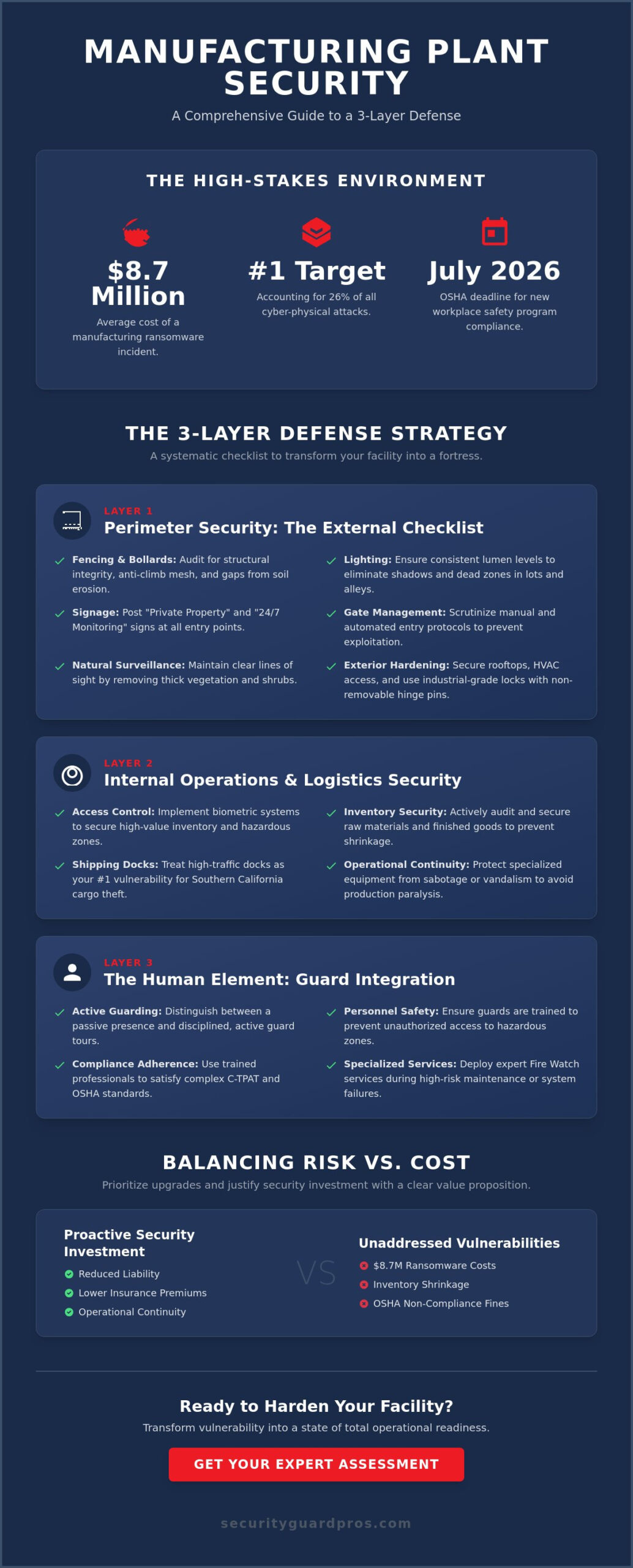
A manufacturing plant security assessment isn’t a mere walkthrough. It’s a systematic, deep-dive evaluation of your facility’s physical, technical, and procedural defenses. By utilizing a rigorous manufacturing plant security assessment checklist, you identify the “blind spots” that invite theft, industrial espionage, or catastrophic safety violations. In 2026, the strategy has moved past reactive monitoring. You need proactive deterrence to stay ahead of threats. This evolution is necessary because manufacturing remains the most targeted industry for cyber-physical attacks, accounting for 26% of all documented ransomware incidents according to recent industry data.
The financial stakes are higher than ever. With the average cost of a ransomware incident in manufacturing hitting $8.7 million in 2024, a breach is often a terminal event for a business. A professional audit reduces your liability and can lower insurance costs by demonstrating a commitment to proven security measures. It’s about replacing vulnerability with a state of total operational readiness. In California’s complex regulatory environment, staying ahead of compliance isn’t just a safety choice; it’s a financial necessity that protects your bottom line.
The Core Objectives of an Industrial Audit
Your audit must focus on three critical pillars. First, you must protect high-value raw materials and finished inventory from internal and external theft. Second, you need to ensure personnel safety. This includes preventing unauthorized access to hazardous zones, which is essential for meeting the July 20, 2026, OSHA workplace program deadlines. Finally, you must maintain operational continuity. A single act of equipment sabotage or vandalism can paralyze your production line for weeks. A thorough manufacturing plant security assessment checklist ensures no corner of your facility is left exposed.
Why Manufacturing Plants are Unique Targets
Manufacturing facilities are inherently difficult to secure compared to standard commercial real estate. They feature complex layouts with multiple entry and exit points designed for logistics and high-volume staff turnover. You aren’t just protecting a building; you’re protecting specialized Physical security systems and sensitive intellectual property. Shipping docks remain your number one vulnerability. These high-traffic areas are magnets for cargo theft, especially in hubs like Southern California. If your primary suppression systems fail or during periods of high-risk maintenance, specialized fire watch services become the only line of defense between your assets and a total loss. You need a partner who understands that industrial security is a specialized discipline, not a generic service.
Perimeter Security: The External Checklist
Your perimeter serves as the first and most critical deterrent against external threats. While some technology providers suggest that AI analytics can replace physical barriers, a seasoned security professional knows that hardware still dictates the terms of engagement. A comprehensive manufacturing plant security assessment checklist must begin at the property line. Evaluate your fencing for structural integrity, focusing on anti-climb mesh and strategically placed bollards to prevent vehicle ramming. These aren’t just suggestions. They’re the foundations of a site that signals strength to any potential intruder.
Audit your lighting standards with precision. Dead zones in parking lots or alleys are invitations for criminal activity. You need consistent lumen levels that eliminate shadows where intruders can hide. Signage acts as a psychological barrier that reinforces your physical defenses. “Private Property” and “24/7 Monitoring” signs should be visible at every entry point to establish a clear boundary. Gate management requires a similar level of scrutiny. Audit your manual and automated gate entry protocols to ensure manual overrides aren’t easily exploited by unauthorized personnel. Finally, practice natural surveillance by clearing thick vegetation. High shrubs provide cover; maintaining clear lines of sight ensures that threats are spotted long before they reach your doors.
Hardening the Facility Exterior
Inspect your boundary for “fence creep” or gaps where soil erosion has created openings. Verify that all exterior doors utilize high-grade industrial locks and non-removable hinge pins to prevent forced entry. Don’t overlook your rooftop access points. HVAC ventilation shafts and roof hatches are frequently the weakest links in an otherwise secure perimeter. Hardening these points is essential to prevent sophisticated break-ins that bypass ground-level sensors.
Parking Lot and Employee Access
Keep employee parking a safe distance from sensitive production areas to reduce the risk of internal shrinkage. Audit the lighting quality in parking structures to prevent vehicle break-ins and ensure worker safety during shift changes. For expansive industrial sites, randomized vehicle mobile patrols provide a level of vigilance that static cameras simply cannot match. Seeing a marked unit move through the lot provides immediate peace of mind for your staff and a stern warning to outsiders. If you’re unsure about your current exterior vulnerabilities, consider a professional industrial security consultation to identify high-risk zones.
Internal Operations and Logistics Security
Securing the perimeter is only the first step. The true test of your facility’s resilience lies within its daily operational flow. Internal security failures often stem from a lack of procedural discipline rather than a lack of technology. Use your manufacturing plant security assessment checklist to scrutinize how people and products move through your space. Start with your access control systems. Audit badge readers and biometric scanners to ensure they aren’t just functional, but restricted to the correct personnel. Permission levels must be dynamic; if an employee changes roles or leaves the company, their access must be revoked immediately to prevent internal shrinkage or industrial espionage.
Inventory control requires more than just a locked room. High-value cages and sensitive storage areas need dedicated surveillance and secondary authentication layers. Strategic camera placement is vital. Focus on loading bays, tool cribs, and even breakrooms. These aren’t just for monitoring theft; they provide an essential record for liability concerns and worker safety. In an era where 22% of organizations report cybersecurity incidents affecting OT systems, your internal physical security must act as a fail-safe for your digital assets. Demand accountability at every internal touchpoint.
Securing the Loading Dock
The shipping and receiving area is your facility’s most vulnerable transition point. Implement a strict “two-person rule” for all high-value shipments leaving the plant to eliminate the opportunity for collusion. Audit your driver check-in procedures with zero tolerance for shortcuts. You must verify government-issued IDs against the Bill of Lading (BOL) before any cargo moves. Never allow dock doors to be propped open during shift changes or for ventilation. This common lapse creates an unmonitored entry point that bypasses every other security layer you’ve installed.
Visitor and Contractor Management
Non-employees represent a unique risk to your intellectual property and physical safety. Evaluate your escort policy for every contractor or visitor entering the production floor. A digital check-in system is superior to a paper logbook because it provides a timestamped, unalterable record of who was on-site and for how long. Ensure that contractors are issued geofenced access cards that limit their movement to specific authorized zones. If you manage a high-traffic facility, integrating professional Logistics and Distribution Security specialists ensures these protocols are followed without exception, allowing your floor managers to stay focused on production targets.
The Human Element: Guard Integration and Compliance
Technology provides the data, but human intervention provides the resolution. If your security guards are merely sitting at a desk, they’re a liability rather than an asset. Your manufacturing plant security assessment checklist must include a rigorous evaluation of guard post orders to ensure active engagement. Passive monitoring is a relic of the past; 2026 demands active, randomized tours that are digitally logged and verified. These patrols ensure that every “blind spot” identified in your initial audit is physically inspected, creating a visible deterrent that cameras alone cannot achieve.
Speed is the only metric that matters during a system failure. If your fire suppression or alarm systems go offline, you need immediate fire watch services to maintain compliance with local California fire marshal regulations. Waiting for a technician while your facility is unprotected is a gamble you won’t win. Compliance also extends to international standards like C-TPAT, which requires a documented and tested security plan. Regular drills for active intruder scenarios or perimeter breaches ensure your staff doesn’t freeze when the stakes are highest. Demand accountability from your security provider and never settle for unverified performance.
Armed vs. Unarmed Guards for Manufacturing
The decision to deploy armed security guards depends on your specific risk profile. If your facility houses high-value materials like precious metals, specialized semiconductors, or pharmaceuticals, the presence of an armed deterrent is often a necessity. You must assess the liability and insurance implications of different guard tiers with your provider. High-value inventory mandates a higher level of protection to mitigate the extreme financial impact of a successful breach. It’s about matching the level of force to the level of the threat.
Regulatory Compliance in Southern California
Navigating California’s regulatory environment requires geographic expertise. You must review California Title 24 requirements to ensure your commercial building safety protocols are current. Furthermore, ensure that any construction site security guards working on facility expansions are BSIS licensed and fully compliant with state mandates. Under California law, plant owners possess a non-delegable duty of care to maintain a safe environment and implement reasonable security measures to protect individuals from foreseeable criminal harm. Contact our team to schedule your Manufacturing and Industrial Security consultation and bridge the gap between vulnerability and compliance.
Executing the Plan: From Assessment to Implementation
Completing your manufacturing plant security assessment checklist is a significant milestone, but data without action leaves your facility vulnerable. You must now transition from identification to execution. Start by prioritizing your findings using a “Risk vs. Cost” matrix. This tool allows you to categorize vulnerabilities based on the severity of the threat and the resources required to neutralize it. Focus your immediate attention on high-risk, low-cost fixes, such as repairing perimeter gaps or updating gate protocols, before moving toward long-term capital investments like advanced biometric integration.
Budgeting for security requires a shift in perspective for many stakeholders. You aren’t just buying a service; you’re protecting your operation from the $8.7 million average cost of an industrial breach. Frame the cost of professional Security Guard Services as a strategic investment in operational continuity and a method for reducing insurance premiums. Proactive deterrence is always more cost-effective than reactive recovery. While competitors suggest annual reviews, the 2026 landscape demands quarterly audits to adapt to rapidly evolving crime trends and new Southern California cargo theft tactics. Vigilance isn’t a one-time event; it’s a permanent operational standard.
Selecting a Security Partner in SoCal
Localized expertise is your greatest asset when securing a facility in the Los Angeles basin. National agencies often lack the granular understanding of regional crime patterns that a dedicated Southern California partner provides. Look for a firm that maintains a robust local headquarters and offers rapid deployment capabilities across the region. Your partner must demonstrate specific experience in Logistics and Distribution Security to handle the unique pressures of high-traffic shipping docks. Demand accountability by reviewing a sample Daily Activity Report (DAR). This document should provide a transparent, timestamped record of every patrol and incident, ensuring your guards are meeting the high standards of a modern guardian.
Next Steps for Your Facility
Take decisive action to secure your facility today. Follow this three-step protocol to move from vulnerability to a state of calm confidence:
- Step 1: Perform a comprehensive walk-through of your facility using the manufacturing plant security assessment checklist provided in this guide.
- Step 2: Identify your top three “Critical Vulnerabilities,” such as a compromised fence line, inadequate parking lot lighting, or unverified driver check-in procedures.
- Step 3: Contact Security Guard Pros to schedule a professional on-site consultation.
Our team provides the disciplined, veteran-led protection your business deserves. We bridge the gap between perceived safety and actual security, allowing you to focus on your core manufacturing operations without the distraction of liability or loss. Secure your future with a partner who takes your protection as seriously as you do.
Harden Your Facility Against Modern Threats
Effective industrial protection requires a relentless focus on the three pillars of defense: perimeter integrity, internal procedural discipline, and professional guard integration. By utilizing a comprehensive manufacturing plant security assessment checklist, you’ve taken the first step toward eliminating the blind spots that lead to liability and loss. In a state as complex as California, relying on generic security measures is a risk your operation can’t afford. You need a partner who understands that true safety is found in the intersection of advanced technology and disciplined human vigilance.
Security Guard Pros brings over 70 years of collective management experience to every facility we protect. We’re fully licensed, bonded, and insured in California, offering 24/7 rapid deployment across Southern California to address your most urgent security needs. Stop guessing about your vulnerabilities and start securing your assets today. Secure Your Facility with a Professional Assessment from Security Guard Pros now. Our veteran-led approach provides the protective shield your business needs to thrive in 2026 and beyond. Your peace of mind is our mission.
Frequently Asked Questions
How often should a manufacturing plant conduct a security assessment?
Conduct a formal assessment at least quarterly to stay ahead of rapidly evolving industrial threats. While annual reviews were once the standard, the rise in sophisticated cargo theft and new OSHA deadlines in 2026 makes frequent audits a necessity. Use your manufacturing plant security assessment checklist to identify new “blind spots” created by staff turnover or changes in facility layout. Regularity ensures your defense remains a stern deterrent rather than a reactive measure.
What are the most common security vulnerabilities in industrial facilities?
Unsecured shipping docks and inadequate perimeter lighting represent the most frequent points of failure. Intruders exploit “dead zones” in parking lots and alleys where surveillance is absent. Additionally, propped-open loading doors during shift changes create unmonitored entry points that bypass your entire defense system. Address these physical gaps immediately to prevent inventory shrinkage and unauthorized access to hazardous production zones.
Is an armed guard necessary for a manufacturing plant?
Armed guards are necessary if your facility houses high-value raw materials, specialized electronics, or pharmaceuticals that carry a high risk of violent theft. The decision depends entirely on your specific risk profile and the nature of your inventory. Armed protection serves as a powerful deterrent to professional criminal syndicates. Evaluate your facility’s “target value” to determine if this higher tier of protection is required to mitigate catastrophic financial loss.
How does a security assessment help with insurance premiums?
A documented security assessment demonstrates to insurers that you’ve proactively mitigated foreseeable risks. By identifying and fixing vulnerabilities, you reduce the likelihood of claims related to theft or worker injury. Many California insurers reward this commitment to safety with lower premiums or better coverage terms. A professional audit provides the quantitative data needed to prove your facility is a low-risk environment for liability and loss.
What is C-TPAT and does my security checklist need to include it?
C-TPAT is the Customs-Trade Partnership Against Terrorism, a voluntary program focused on strengthening international supply chains. If your plant handles international shipments, your manufacturing plant security assessment checklist must align with C-TPAT standards to avoid costly border delays. Compliance requires rigorous driver identification and manifest verification protocols. This ensures your facility is recognized as a secure link in the global logistics chain.
Can security cameras replace physical security guards in a warehouse?
Cameras cannot replace physical guards because technology is passive and cannot intervene during a breach. While cameras provide a record of events, they can’t perform a physical arrest, clear a blocked fire exit, or conduct a manual fire watch. You need a human presence to interpret data and provide an immediate response to threats. Relying solely on tech creates a false sense of security that professional criminals easily exploit.
What should be included in a fire watch checklist for a factory?
Your fire watch checklist must prioritize the continuous monitoring of hot work areas and the verification of all fire suppression systems. Guards should inspect every fire extinguisher for current tags and ensure that all emergency exits remain unobstructed. During system failures, the checklist requires timestamped rounds through all production zones to detect smoke or heat. This disciplined approach satisfies local fire marshal rules and prevents catastrophic operational downtime.
How do I secure a loading dock against internal theft?
Secure your loading dock by implementing a strict “two-person rule” for all high-value shipments and verifying every driver’s ID against the Bill of Lading. Use internal surveillance to monitor the specific transition points where cargo is moved from the floor to the trailer. Restrict access to the dock area to essential personnel only. These procedural barriers eliminate the opportunity for collusion and ensure that every item leaving your facility is accounted for.