If your current security plan relies on the same protocols used three years ago, you aren’t just behind the curve; you’re actively inviting liability. Managing a commercial asset in Southern California’s urban centers now requires a sophisticated response to rising vandalism and unauthorized access. You likely feel the pressure of tenant anxiety regarding workplace violence and the burden of escalating insurance premiums. Implementing robust corporate office building security procedures is no longer optional for those who value asset protection and legal compliance.
This guide provides a professional framework to harden your perimeter, reduce incidents, and align your operations with the 2026 California security mandates. We will examine the transition from reactive guarding to proactive protection. You’ll learn how to integrate AI-powered surveillance, which has been shown to cut incident response times by 60 percent, with disciplined human vigilance. This approach creates a secure environment where your tenants can focus on their work without distraction. It’s time to replace vulnerability with unwavering reliability.
Key Takeaways
- Implement a multi-layered defense strategy that integrates physical barriers with advanced surveillance to eliminate single points of failure.
- Establish rigorous corporate office building security procedures that mandate tiered access control for the perimeter, lobby, and individual tenant suites.
- Deploy uniformed security professionals to provide a visible deterrent and bridge the gap between automated technology and human intelligence.
- Standardize daily operations with clear visitor badging protocols and tenant safety policies to minimize unauthorized access and liability risks.
- Partner with licensed experts who understand the unique regulatory landscape and urban risks specific to Southern California.
The Foundation of Corporate Office Building Security Procedures
Effective corporate office building security procedures represent the operational blueprint for your facility’s survival. These aren’t merely suggestions. They’re the rigid set of rules that dictate how your staff grants access, how your systems monitor movement, and how your team responds to a breach. In 2026, the industry standard has shifted toward a layered defense model. This strategy ensures that your protection doesn’t rely on a single gate or camera. Instead, it utilizes Physical security measures across multiple, interdependent rings of defense. If one layer is bypassed, the next is already waiting to neutralize the threat.
Prevention is always more cost-effective than recovery. The financial impact of a single theft or violent incident far outweighs the investment in a disciplined security framework. Central to this framework is a formal Security Standard Operating Procedure (SOP) manual. This document serves as the primary source of truth for every guard and property manager on site. It eliminates guesswork during a crisis. Without a written SOP, your security is reactive, inconsistent, and ultimately vulnerable to the first person who decides to test your perimeter.
Identifying Southern California-Specific Office Threats
Office buildings in Los Angeles, Orange County, and San Diego face a unique set of environmental risks. High-traffic urban zones often experience elevated rates of property vandalism and unauthorized loitering. Beyond external threats, industrial espionage remains a concern for high-value corporate tenants. Your corporate office building security procedures must account for the specific geography of your building. A facility near a major transit hub in San Diego requires a different intensity of lobby screening than a suburban office park in Irvine. We analyze these local factors to ensure your protocols act as a precise deterrent rather than a generic, ineffective solution.
The Value of Proactive Liability Management
Property managers have a legal Duty of Care to provide a safe environment for tenants and guests. Rigorous, documented procedures are your primary defense against negligence claims. When you can prove a history of consistent patrols and audited access logs, you significantly reduce your legal exposure. This proactive stance often leads to more favorable insurance premiums because it demonstrates a commitment to risk mitigation. Professional security audits are the first step in this process. They uncover hidden vulnerabilities, such as unmonitored service entrances or outdated badge systems, before they become a liability that costs you your reputation.
Tiered Access Control and Surveillance Protocols
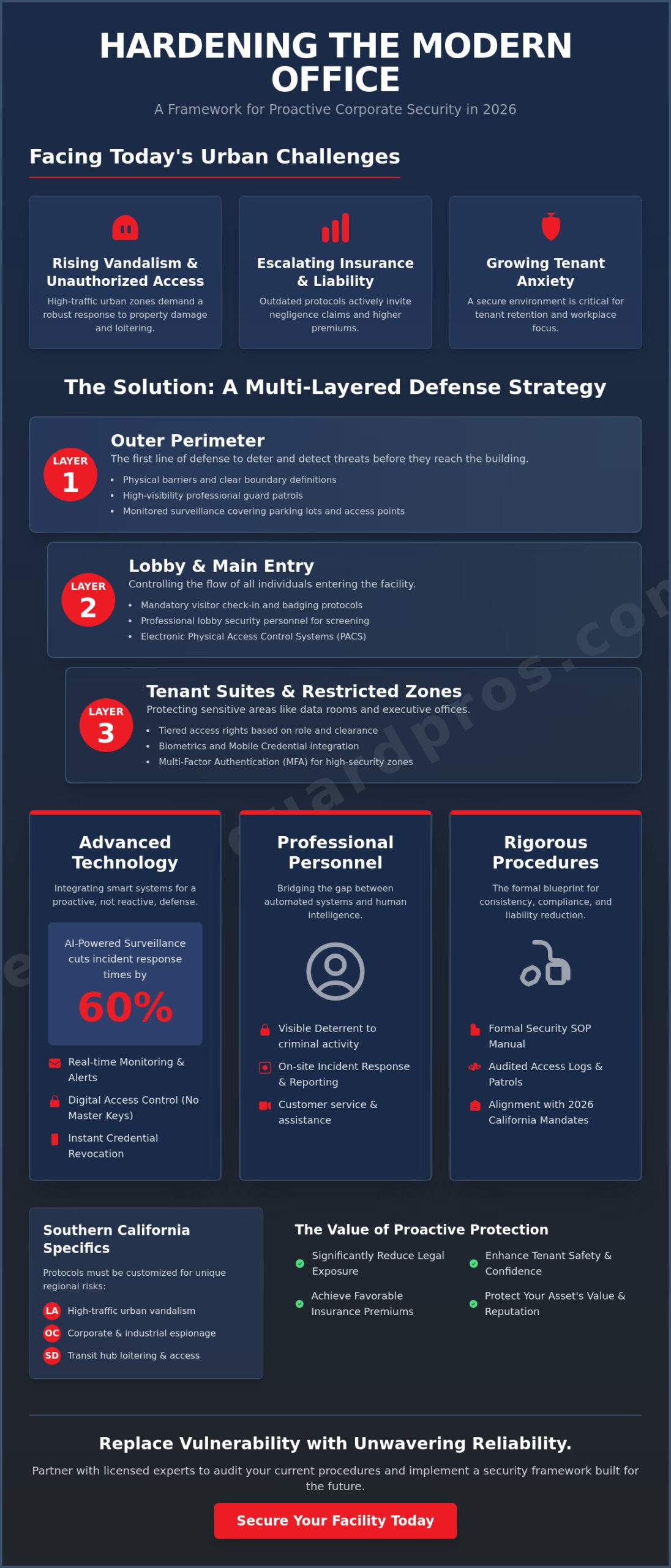
Visualize your facility as a fortress protected by three distinct rings of defense. The outer perimeter, the primary building entry, and the restricted internal suites form a hierarchy of safety. Modern corporate office building security procedures must prioritize these layers to ensure no single breach compromises your entire operation. In 2026, relying on a single locked door is a failure of strategy. You need a system where each layer validates the last. This tiered approach creates the friction necessary to slow down intruders while maintaining a seamless flow for authorized personnel.
Technology has moved beyond the easily duplicated plastic badge. Professional protection now mandates the integration of biometrics and mobile credentials. These tools link access rights directly to an individual’s physical presence or encrypted device. When an employee leaves the company or a contractor completes their project, your protocol must include instantaneous credential revocation. A delay of even an hour creates a window of vulnerability. Implementing best practices for tenant safety requires this level of digital discipline. You can connect with Corporate Office Security specialists to audit your current hardware and identify these critical gaps.
Electronic Physical Access Control Systems (PACS)
Ditch the physical master keys. They’re a liability that’s impossible to track. Encrypted digital access allows you to monitor every movement within the building in real-time. For high-security zones like data rooms or executive suites, mandate multi-factor authentication (MFA). This ensures that a stolen phone or badge isn’t enough to grant entry. Your corporate office building security procedures should also include a strict visitor management protocol. Use temporary digital tokens for vendors that expire automatically, removing the human error associated with manual logbooks.
Video Monitoring and AI-Driven Analytics
Passive recording is a hallmark of unprofessionalism. It only provides a video of your loss after the damage is done. Modern surveillance utilizes AI-powered motion detection to identify suspicious behavior before an incident occurs. These systems distinguish between a delivery driver and an unauthorized loiterer, triggering immediate alerts to on-site guards. In California, you must ensure your video storage protocols comply with state privacy regulations and data retention laws. Transitioning to active, AI-driven monitoring can improve incident response times by 60 percent, transforming your cameras from silent witnesses into proactive deterrents.
The Strategic Role of Professional Guards in Office Security
Technology provides the data, but professional guards provide the decision-making. Automated systems can alert you to a door being propped open, but they can’t assess the intent of the person standing beside it. Integrating human intelligence into your corporate office building security procedures ensures that every anomaly is met with a reasoned, tactical response. A uniformed presence in your lobby isn’t just about optics. It’s a stern deterrent that signals a controlled environment to potential intruders while offering a sense of calm confidence to your tenants. This human element is the only layer of your defense capable of real-time de-escalation.
Effective protection requires more than just a warm body in a chair. It demands a specialized understanding of the local environment. When you secure security guard services in Los Angeles, you’re investing in personnel who understand the specific vagrancy and vandalism trends of the region. These professionals act as the customer service face of your building. They balance the need for strict access control with the hospitality expected in a high-end corporate environment. They don’t just watch; they manage the flow of the building, ensuring that security remains a seamless part of the tenant experience rather than a hurdle.
Armed vs. Unarmed Presence in Lobby Management
Lobby security requires a nuanced approach to risk. For high-profile corporate headquarters or facilities housing sensitive financial data, an armed presence provides the ultimate deterrent against workplace violence. These elite guards must meet the 2026 California standards, including the 40-hour training requirement and the “Power to Arrest” certification mandated by Senate Bill 652. For standard commercial assets, unarmed guards often strike the right balance. They provide vigilant monitoring and visitor screening without the aggressive profile of a weapon, maintaining an atmosphere of professional hospitality while enforcing strict entry protocols.
Mobile Patrols for Perimeter and Parking Security
Predictability is the enemy of safety. If an intruder can time your security rounds, your building is vulnerable. Randomized vehicle mobile patrols break these patterns, creating a constant state of uncertainty for anyone casing your property. These patrols are essential for securing sprawling parking garages and loading docks, where lighting and blind spots often invite criminal activity. By utilizing mobile units, you extend your corporate office building security procedures beyond the lobby, ensuring that the very first point of contact for your tenants—the parking lot—is as secure as the executive suite.
Standard Operating Procedures (SOPs) for Daily Operations
Discipline is the difference between a secure facility and a legal liability. Your corporate office building security procedures must be codified in a living SOP manual that every team member follows without deviation. Central to this accountability is the Daily Activity Report (DAR). Unlike vague verbal updates, a professional DAR provides property managers with a chronological, audited log of every patrol, incident, and maintenance check. This transparency ensures that the security you pay for is the security you receive. It eliminates guesswork and provides the data necessary for long-term risk assessment.
Security is a partnership with your tenants. Implement “Clear Desk” and “Locked Door” policies to protect sensitive information and physical assets. A clear desk policy mandates that all proprietary data and hardware are secured at the end of the day, reducing the risk of internal theft or corporate espionage. Similarly, a locked door policy ensures that internal suites remain inaccessible to unauthorized wanderers. These simple habits harden your building against opportunistic threats that technology alone cannot stop. It’s about creating a culture of vigilance that extends from the lobby to the individual workstation.
Visitor Management and Delivery Protocols
Replace outdated paper sign-in sheets with encrypted digital logs. This transition allows for instant background verification of unexpected visitors or couriers. Every guest must receive a time-expiring badge and be subject to an “escort only” policy in restricted zones. For after-hours deliveries, your security team should manage the loading dock and freight elevators, ensuring that maintenance staff or vendors only access the specific areas required for their task. If your current protocol feels loose, it’s time to hire Corporate Office Security experts to tighten these gaps.
Emergency Response and Crisis Communication
Crisis management requires a dispatch-led response coordinated with local Southern California law enforcement. Your SOPs must detail specific actions for fire, medical emergencies, and active shooter scenarios. Professional guards act as the primary incident commanders during evacuations, guiding tenants to safety while providing real-time intelligence to arriving first responders. This synchronization between private security and public agencies like the LAPD or Orange County Sheriff’s Department is vital. It ensures that when minutes matter, your building’s response is immediate, disciplined, and effective.
Customizing Your Security Plan with Southern California Experts
A generic security template is a liability. In the dense urban corridors of Los Angeles and San Diego, a one-size-fits-all approach fails because it ignores the granular risks of specific neighborhoods. Your corporate office building security procedures must be as dynamic as the environment they protect. This requires a partner that understands the difference between a high-rise in Downtown LA and a sprawling campus in Orange County. We provide tailored solutions that account for local crime data, pedestrian traffic patterns, and the specific needs of your tenant base. It’s about replacing a passive presence with a strategic deterrent.
Legitimacy in the security industry is defined by regulatory compliance. In California, this means verifying that your provider holds valid Bureau of Security and Investigative Services (BSIS) licensing and Private Patrol Operator (PPO) credentials. These aren’t just bureaucratic markers. They’re your assurance that the guards on your property are vetted, trained, and legally authorized to protect your assets. Security Guard Pros maintains these high standards, ensuring that our team operates with the discipline of seasoned veterans. We prioritize peace of mind by adhering to every state mandate, protecting you from the liability of unprofessional staffing.
Accountability is non-negotiable. We utilize advanced electronic reporting and GPS tracking to provide real-time visibility into guard activity. This technology replaces the “trust me” model of traditional security with hard data. You can verify every patrol and every checkpoint scan, ensuring that your SOPs are being executed with precision. This level of transparency is what distinguishes an elite guardian from a generic staffing agency. It allows you to maintain safety without the distraction of managing your security team’s every move.
Why Local Expertise Matters for California Compliance
Navigating California’s labor and security regulations requires specialized knowledge. From mandatory use-of-force training under Senate Bill 652 to complex wage and hour laws, your security partner must be an expert in state-specific compliance. Local expertise also allows for better guard placement. We select personnel who are familiar with the specific challenges of your zip code, ensuring they can anticipate threats before they escalate. This regional focus ensures that your building remains a safe, productive environment for all occupants. It’s a professional shield designed for the California market.
Getting Started with a Professional Security Audit
The transition to professional protection begins with a comprehensive site vulnerability assessment. We analyze every entry point, lighting blind spot, and access protocol to identify where your current plan is failing. Transitioning from an existing provider doesn’t have to be a source of anxiety. We manage the process with a steady, efficient pace, replacing unprofessionalism with unwavering reliability. Your assets deserve a protective shield that allows you to focus on your core business operations. Stop settling for a generic service and start investing in a professional partnership.
Contact Security Guard Pros for a customized office security consultation to secure your facility today.
Harden Your Perimeter with Expert Protection
Securing a commercial asset in 2026 requires more than just cameras and locks. It demands a disciplined integration of advanced surveillance technology and elite human vigilance. By establishing rigorous corporate office building security procedures, you eliminate the gaps that invite vandalism and unauthorized access. You’ve learned how tiered access control and standardized daily operations reduce liability while providing your tenants with the peace of mind they expect. Don’t leave your property’s safety to chance or unprofessional staffing.
Security Guard Pros brings over 70 years of collective management experience to every site we protect. As a licensed and insured PPO with a dedicated 24/7 dispatch center, we provide the unwavering reliability your business needs. We specialize in customized security plans for Los Angeles, Orange County, and San Diego, ensuring your protocols meet every California regulatory requirement. Transition from a state of vulnerability to a position of strength today. Secure Your Office with Professional Southern California Guards and ensure your facility remains a safe, productive hub for your staff and assets.
Frequently Asked Questions
What are the most common security threats to office buildings in 2026?
Unauthorized access, property vandalism in urban centers, and workplace violence are the primary threats facing commercial assets today. These risks are particularly prevalent in high-traffic zones like Los Angeles and San Diego where loitering and property crimes have seen recent increases. Identifying these specific environmental threats allows property managers to transition from a reactive posture to a proactive defense that neutralizes risks before they escalate.
How do I create a security policy for a multi-tenant corporate office?
Establish a unified framework that balances individual suite privacy with building-wide safety protocols. This policy must include standardized visitor management and shared responsibility for entry-point integrity among all occupants. Coordinating these corporate office building security procedures across every tenant ensures that a single weak link doesn’t compromise the entire asset, creating a cohesive protective shield for the whole facility.
What is the difference between physical security and building security?
Physical security refers to the tactical measures like barriers, locks, and guards used to protect people and assets, while building security is the broader operational management of the facility’s safety. Building security encompasses the overall strategy and compliance, whereas physical security provides the tangible tools to execute that plan. Both elements must work in tandem to eliminate vulnerability and maintain unwavering reliability.
How often should corporate security procedures be audited and updated?
Audit your security protocols at least annually or immediately following any significant facility change, tenant turnover, or security incident. Regular assessments identify hardware failures and procedural drift before they become legal liabilities. Continuous monitoring ensures that your Standard Operating Procedures (SOPs) remain effective against evolving regional threats and stay compliant with the latest California state regulations.
Are armed guards necessary for a standard corporate office building?
Armed guards are recommended for high-profile assets or facilities housing sensitive financial data and executive protection teams. While unarmed guards are highly effective for standard lobby management and hospitality-focused roles, an armed presence provides a stern deterrent against severe threats like workplace violence. The decision depends entirely on your specific risk profile and the anxiety levels of your tenant base.
How can technology and guards work together for better security?
Technology provides the data alerts while professional guards provide the tactical response and human judgment. AI-driven surveillance identifies suspicious motion in real-time, allowing on-site guards to intervene before a crime occurs. This integration has been shown to improve incident response times by 60 percent, transforming your security from a passive recording system into an active, modern guardian.
What are the legal requirements for security guards in California?
California law requires all guards to possess a valid BSIS Guard Card and complete 40 hours of mandatory training. Under Senate Bill 652, effective January 2026, the initial “Power to Arrest and Appropriate Use of Force” training must be completed within six months before submitting an application. Ensuring your provider meets these regulatory identifiers is a badge of legitimacy that protects you from liability.
How do security procedures impact tenant retention and property value?
Robust corporate office building security procedures directly increase property value by reducing insurance premiums and mitigating costly legal exposure. Tenants are significantly more likely to renew leases in buildings where they feel a sense of calm confidence and personal safety. Professional protection is not just a staffing cost; it’s a strategic investment in the long-term financial viability of your commercial asset.