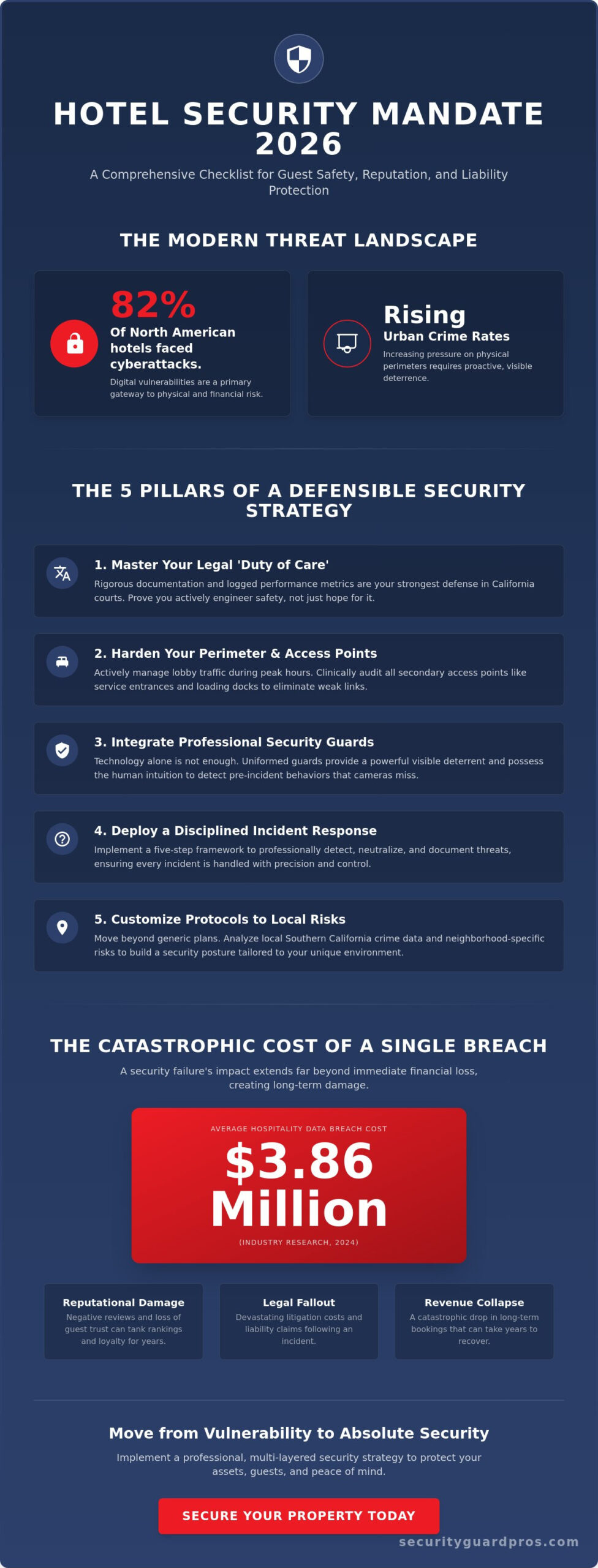
Did you know that 82% of North American hotels faced cyberattacks in late 2025, while urban crime rates continue to pressure physical perimeters? You’ve likely felt the anxiety of rising insurance premiums or the frustration of a negative review where a guest felt unsafe in your lobby. It’s a heavy burden to balance five-star hospitality with the constant threat of liability. This guide provides a comprehensive hotel security checklist for guest safety that transforms your facility from a vulnerable target into a hardened, professional environment. You’ll master the essential protocols and human-led strategies required to protect your guests, preserve your reputation, and minimize legal exposure. We will examine the specific 2026 regulatory mandates, including the Los Angeles County Hotel Worker Protection Ordinance, and outline a daily protocol for your staff. By the end of this guide, you’ll have the tools to act as a modern guardian for your property. Secure your perimeter and regain the peace of mind needed to focus on your core operations. Let’s move from a state of perceived vulnerability to a state of absolute security.
Key Takeaways
- Understand the legal ‘Duty of Care’ standard to ensure your documentation serves as a robust defense in California courts.
- Audit your property’s secondary access points and manage high-traffic lobby flow to eliminate vulnerabilities during peak hours.
- Implement a comprehensive hotel security checklist for guest safety that integrates professional security guards to provide a visible deterrent and catch threats cameras miss.
- Deploy a disciplined five-step incident response framework to detect, neutralize, and document threats with professional precision.
- Move beyond generic safety plans by customizing your protocols based on local Southern California crime data and neighborhood-specific risks.
Why Every Hotel Needs a Rigorous Guest Safety Checklist in 2026
Security is not a luxury. It is a 24/7 proactive shield that protects your guests, your staff, and your physical assets. In 2026, the hospitality industry faces a volatile environment where cyber threats and physical risks intersect with increasing frequency. A hotel security checklist for guest safety is no longer just a piece of paper in a manager’s desk; it is a living document that defines your property’s resilience. Transitioning from reactive monitoring to proactive deterrence is the only way to survive in a market where a single lapse can destroy decades of brand equity. You must view security as an active operational pillar rather than a passive expense.
The legal standard of “Duty of Care” in California has never been more demanding. Courts increasingly look for documented evidence of professional oversight to determine if a property met the “reasonable security” standard. Without a rigorous checklist and logged performance metrics, your defense in a liability suit becomes remarkably fragile. Documentation is your best shield against the rising tide of litigation. It proves you didn’t just hope for safety, but actively engineered it through disciplined protocols. This level of transparency alleviates the anxiety of ownership and positions your hotel as a responsible, professional entity.
Safety directly impacts your Revenue Per Available Room (RevPAR). Guests in 2026 are highly sensitive to “feeling unsafe,” and their feedback spreads instantly across digital platforms. A secure environment supports your reputation in several ways:
- Review Integrity: Prevents negative mentions of loitering or unauthorized access that tank your ranking.
- Guest Loyalty: Peace of mind encourages repeat bookings from high-value corporate travelers.
- Insurance Optimization: Documented safety protocols help mitigate the high premiums caused by perceived liability risks.
The Cost of a Security Breach
A single high-profile incident can trigger a catastrophic drop in long-term bookings that lasts for years. Beyond the immediate loss of revenue, the legal fallout is often devastating. While specific litigation costs vary by case complexity, industry research confirms that the average cost of a data breach in the hospitality industry reached $3.86 million in 2024, signaling the massive financial stakes of any security failure. You cannot afford to treat security as a secondary concern when the survival of your business is on the line.
Digital vs. Physical Security Intersections
Smart locks, AI-powered surveillance, and contactless check-ins are powerful tools, but they are only half of the equation. Technology can fail, be bypassed, or suffer from the cyberattacks that hit 82% of North American hotels in 2025. The human element remains the most critical component of any hotel security checklist for guest safety. The Role of Security Guards in 2026 involves a sophisticated understanding of pre-incident behaviors that cameras simply cannot catch. Integrating your digital tools with professional security guard services ensures that human intuition and rapid physical response back up your technological investments. This creates a multi-layered defense that modern threats cannot easily penetrate.
Access Control and Perimeter Security: Your First Line of Defense
Secure your perimeter with unwavering discipline. The “Golden Hour” of access occurs during peak check-in and check-out windows when the lobby is flooded with guests and luggage. This chaos provides the perfect cover for unauthorized individuals to slip past your front desk unnoticed. Your hotel security checklist for guest safety must mandate active lobby management during these high-traffic periods. Don’t allow hospitality to become a vulnerability. Keep your staff vigilant and your entry points controlled at all times.
Audit every secondary access point with clinical precision. Service entrances, loading docks, and employee exits are often the weakest links in your defense. These doors are frequently left propped open for convenience, creating an invitation for intruders. Establish a rigorous schedule to verify that every non-guest entrance remains locked and alarmed when not in active use. Reviewing the U.S. Department of State Lodging Safety Tips helps align your standards with international safety expectations, ensuring your property meets the highest benchmarks for traveler protection.
Maintain strict key card hygiene to prevent internal breaches. Audit master key logs daily and deactivate lost cards immediately. Lighting also serves as a critical deterrent. Your checklist should include nightly inspections of exterior perimeters and stairwells. High-intensity illumination eliminates the shadows where threats hide. A well-lit property sends a clear message to potential criminals that your facility is under constant, disciplined watch.
Guest Room Access Protocols
Verify the functionality of automatic door closers and deadbolts during every room turnover. A door that doesn’t latch completely is a liability waiting to happen. Implement a mandatory “knock and announce” policy for all housekeeping and maintenance staff to respect guest privacy and safety. Additionally, schedule regular audits for electronic lock battery levels and access logs. This data-driven approach allows you to identify unauthorized entries before they escalate into incidents. These small, mechanical checks form the backbone of a reliable safety environment.
Parking Lot and Garage Safety
The parking structure is statistically the #1 site for hotel-related crime. It’s often isolated and poorly monitored, making it a prime target for vehicle break-ins and physical altercations. Deploy randomized vehicle mobile patrols to create a visible, unpredictable deterrent that discourages criminal activity. Your checklist must also include a verification of clear lines of sight, functioning emergency call boxes, and highly visible safety signage. Integrating these steps into a comprehensive hotel security checklist for guest safety ensures your parking facilities are as secure as your guest rooms. Consider a consultation with a professional security partner at securityguardpros.com to harden your facility against these common threats.
The Proactive Advantage: Integrating Professional Security Guards
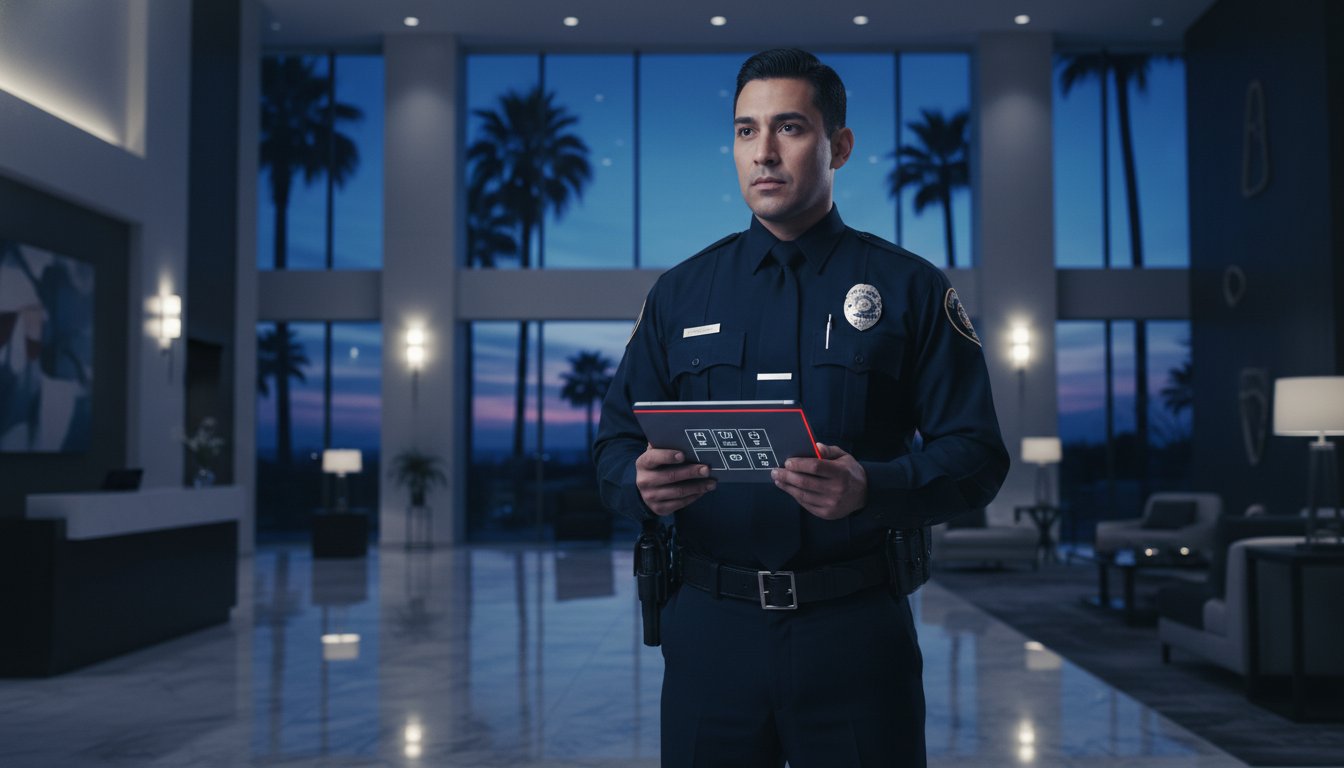
Technology records crime, but disciplined human presence prevents it. While cameras provide valuable post-incident evidence, they lack the ability to intervene in real time. A uniformed professional acts as a powerful psychological deterrent, signaling to potential bad actors that your property is a hard target. This human element is the most critical component of a hotel security checklist for guest safety. It bridges the gap between passive monitoring and active protection. You don’t just need eyes on the property; you need a trained responder capable of neutralizing threats before they escalate.
Observational excellence is what distinguishes a veteran guard from a standard lobby attendant. Professional guards utilize specific checklists to identify “pre-incident” behaviors that digital sensors often miss. They look for subtle cues like loitering in non-public areas, nervous body language near service entrances, or individuals “testing” door locks. By integrating guard tours with your property management system, you gain real-time reporting and verifiable data on every patrol. This transparency ensures that your security plan is being executed with the precision your reputation demands. There is a fundamental difference between hospitality-focused staff and licensed security guards in Los Angeles who are trained to manage high-stress physical confrontations.
Armed vs. Unarmed Personnel for Hospitality
Assessing your hotel’s risk profile is essential for determining the appropriate level of force. Standard hospitality environments often benefit from the approachable yet firm presence of unarmed guards. However, high-profile corporate events or properties located in high-risk urban zones may require armed personnel to ensure absolute guest safety. Use the following comparison to understand why human guarding is the superior choice for active defense.
| Security Capability | Passive CCTV Systems | Professional Guarding |
|---|---|---|
| Immediate Intervention | None | High |
| Threat De-escalation | None | High |
| Physical Deterrent | Low | High |
| Post-Incident Evidence | High | High |
Nighttime Security and Fire Watch
The darkness of night brings unique vulnerabilities. Your hotel security checklist for guest safety must prioritize floor audits during “Quiet Hours” to prevent unauthorized “tailgating” into guest elevators. Guards provide the physical barrier necessary to ensure only registered guests access residential floors. Additionally, if your automated fire suppression systems undergo maintenance, you are legally required to implement an emergency fire watch. Trained guards conduct continuous patrols to detect smoke or heat, providing the rapid response needed to protect lives and maintain compliance with California fire codes. This vigilant oversight allows your guests to sleep with total peace of mind.
Emergency Preparedness and Incident Response Protocols
Chaos is the enemy of safety. When an emergency occurs, your staff must rely on a disciplined, 5-step incident response framework: Detect, Report, Respond, Neutralize, and Document. This systematic approach ensures that threats are identified early and resolved with professional efficiency. Your hotel security checklist for guest safety should explicitly detail who is responsible for each phase of this cycle. Without a clear chain of command, a minor medical issue or a localized fire can quickly spiral into a property-wide crisis. Preparation is the only antidote to panic. Integrating these response steps into your hotel security checklist for guest safety minimizes the risk of human error during a crisis.
Evacuation routes must remain clear of all obstructions at all times. Verify that exit signs are illuminated and that staff muster points are clearly defined and known to every employee. Medical emergencies require immediate action; your checklist must include weekly audits of Automated External Defibrillator (AED) locations and expiration dates on pads. Ensure that your staff’s CPR certifications are current through regular training audits. For high-stakes scenarios, the 2026 hospitality standard for active threat response remains the Run-Hide-Fight protocol. This training empowers your team to make life-saving decisions under extreme pressure.
Fire Safety and Compliance
Perform monthly inspections of all fire extinguishers, sprinkler heads, and smoke detectors to maintain peak operational status. Compliance with local Southern California fire marshal requirements is non-negotiable and provides a critical layer of legal protection. Under the California Fire Code, hotel employers must conduct fire drills for all staff members at least once every quarter to ensure everyone is prepared for an emergency. These drills transform theoretical knowledge into muscle memory, reducing response times when seconds matter most.
Incident Documentation and Reporting
Adhere to the professional standard: if it isn’t written, it didn’t happen. Accurate security logs are your primary defense against future liability claims. When an event occurs, your team must capture detailed witness statements and preserve relevant CCTV footage before it is overwritten. Professional security supervisors play a vital role here by reviewing daily incident reports to identify patterns of vulnerability. This level of accountability ensures your safety measures are constantly evolving. If you need expert oversight to manage these complex protocols, consider hiring professional security guard services to harden your property’s defenses.
Customizing Your Hotel Security in Southern California
Southern California is a diverse landscape where a one-size-fits-all approach to safety inevitably fails. A hotel security checklist for guest safety designed for a quiet coastal resort in Orange County will not address the specific threats faced by a high-rise in downtown Los Angeles. You must adapt your protocols to the unique rhythm of your neighborhood. This requires a disciplined analysis of local crime data to inform your patrol frequency and staffing levels. If local data shows a spike in vehicle-related crimes, your checklist must pivot to prioritize more frequent parking structure audits. Do not rely on generic templates that ignore the geographic realities of your property. Precision in your security plan is the only way to ensure unwavering reliability.
Conventions and high-profile bookings introduce another layer of complexity. These events attract large crowds and increase the risk of unauthorized access to guest floors. Hiring a firm with specialized event security experience is essential for these scenarios. Professional guards manage the delicate balance between maintaining a welcoming atmosphere and enforcing strict access control. They act as a protective shield, allowing your event staff to focus on guest satisfaction without the distraction of safety concerns. Security Guard Pros tailors every checklist to the specific property type, whether you manage a boutique motel or a sprawling corporate hotel.
The Security Guard Pros Advantage
We leverage 70 years of collective management experience to provide a level of protection that goes beyond simple observation. Our leadership team understands the technical and legal nuances of the California hospitality market. We offer rapid deployment capabilities for critical needs such as emergency fire watch or filling sudden staffing gaps. This agility ensures your property is never left vulnerable to liability or loss. Our customized security plans are designed to be a stern deterrent to threats while remaining a reassuring presence for your guests. We respect traditional security values while utilizing contemporary reporting tools to give you total transparency into our operations.
Getting Started with a Professional Audit
Move beyond the limitations of a static paper checklist. A truly effective hotel security checklist for guest safety must be dynamic and informed by professional expertise. Request a site-specific vulnerability assessment to identify the hidden gaps in your current perimeter and internal protocols. This assessment serves as the foundation for a professional security partnership that evolves with the 2026 threat landscape. It’s time to replace perceived vulnerability with calm confidence. Secure your hotel with Southern California’s trusted professionals and reclaim the peace of mind your business deserves.
Secure Your Hospitality Legacy in 2026
The 2026 landscape of hospitality demands a shift from passive observation to disciplined, proactive defense. You’ve learned that a robust hotel security checklist for guest safety is the foundation of this strategy, but its success relies on professional execution. By integrating human intuition with advanced access control and maintaining meticulous incident documentation, you protect more than just your lobby; you safeguard your brand’s future. Don’t let your property become a statistic in an increasingly volatile market. Transitioning from perceived vulnerability to absolute security is a choice that defines your leadership.
Security Guard Pros stands ready as your protective shield. As a licensed and insured California private security firm with over 70 years of collective management experience, we understand the specific regulatory and physical threats facing Southern California hotels. We provide 24/7 rapid response dispatch to ensure your facility remains a hard target against crime and liability. Take the first step toward total peace of mind today by partnering with a modern guardian that respects traditional security values.
Request Your Free Hotel Security Vulnerability Assessment
Your guests deserve the highest standard of safety, and your business deserves the freedom to thrive without the distraction of security concerns. Let’s build a safer environment together.
Frequently Asked Questions
What are the most common security issues in hotels in 2026?
Common issues in 2026 include sophisticated cyberattacks, “tailgating” into guest elevators, and organized theft in hotel parking structures. Statistics from 2025 show that 82% of North American hotels were hit by cyber threats, emphasizing the need for digital vigilance. Physical security remains equally vital as urban crime rates put pressure on perimeter controls. Balancing high-tech room access with disciplined human monitoring is the only way to mitigate these evolving risks effectively.
Is a security camera system enough to protect my hotel guests?
No, a camera system is a reactive tool that provides evidence after an incident has occurred. It cannot physically intervene to stop an assault or prevent a trespasser from entering a restricted area. Professional security guards provide the proactive deterrence and immediate physical response necessary to protect lives in real time. Integrating human oversight with your surveillance ensures that threats are neutralized before they escalate into costly liability claims.
How often should a hotel conduct a full security audit?
You should conduct a comprehensive security audit at least once per year. However, properties in high-traffic urban zones or those subject to the 2026 Los Angeles County Hotel Worker Protection Ordinance should move to a quarterly schedule. Regular audits ensure that your physical defenses, staff training, and digital protocols remain compliant with the latest California safety regulations. Frequent reviews allow you to identify and close vulnerabilities before criminals exploit them.
What is the difference between a hotel security guard and a lobby attendant?
The primary difference lies in licensing, training, and the legal authority to intervene. Lobby attendants are hospitality-focused staff who manage guest needs and luggage. In contrast, licensed security guards in California possess BSIS credentials and specific training in de-escalation, physical defense, and emergency response. Guards provide a stern deterrent to crime that attendants cannot offer, making them essential for high-risk periods or properties with significant foot traffic.
Can a hotel be held liable for a guest’s stolen property?
A hotel can be held liable if it’s found that management failed to meet the “Duty of Care” legal standard. Courts look for evidence of “reasonable security” measures, such as functioning locks, adequate lighting, and professional patrols. Maintaining a consistent hotel security checklist for guest safety provides the documentation needed to prove your property took proactive steps to prevent crime. Without this documented oversight, your defense against liability claims becomes significantly weaker.
What should be included in a daily hotel security patrol checklist?
Your daily hotel security checklist for guest safety must include a rigorous sweep of all perimeter doors, stairwell lighting audits, and randomized parking structure patrols. Staff should verify that automatic door closers are functioning and that secondary service entrances remain locked. Additionally, check the operational status of all emergency call boxes and ensure that guest floor access is restricted to key card holders. These repetitive, disciplined checks form your property’s first line of defense.
How do professional guards handle ‘unruly’ guests while maintaining hospitality standards?
Professional guards utilize verbal de-escalation and “calm confidence” to manage difficult individuals without escalating the situation. They’re trained to identify the early signs of agitation and intervene before a guest’s behavior impacts the experience of others. This approach maintains a high standard of hospitality while ensuring that safety protocols are strictly enforced. By acting as a quiet but firm presence, guards protect the property’s reputation while neutralizing potential disruptions.
What are the California requirements for hotel fire watch services?
California requires a dedicated fire watch whenever a hotel’s fire alarm or sprinkler system is out of service for more than four hours. You must deploy personnel to conduct continuous, recorded patrols of all areas of the building to detect smoke or fire. These guards must stay in constant communication with a central dispatch and keep a detailed log for inspection by the local fire marshal. This ensures life safety compliance and prevents costly fines.