California accounted for 36% of all U.S. cargo theft incidents in the first quarter of 2026, with 277 reported cases. You’ve likely felt the mounting pressure of these rising statistics, especially as organized crime groups shift from opportunistic looting to sophisticated fictitious pickup schemes. It’s frustrating to watch insurance deductibles climb while your client trust hangs in the balance. Implementing robust logistics security to prevent cargo theft is no longer optional for SoCal businesses; it’s a requirement for survival. Stop reacting to losses and start deterring them with a partner that acts as a protective shield rather than a passive observer.
Discover how to protect your supply chain from evolving cargo theft tactics with expert-led physical security and logistical deterrents. We’ll show you why professional guards are the critical link in breaking the cycle of fraud and opportunity. This guide provides a clear path to achieving zero loss incidents, lowering your insurance premiums, and ensuring your security measures integrate seamlessly into your existing logistics workflows.
Key Takeaways
- Identify the 2026 trends driving the need for multi-layered logistics security to prevent cargo theft in Southern California.
- Learn to spot the difference between traditional physical heists and the rising threat of strategic fictitious pickup schemes.
- Discover why the active presence of professional guards provides a stronger deterrent than passive GPS or camera systems alone.
- Implement a disciplined security framework using comprehensive risk assessments and strict gate control protocols.
- Leverage regional expertise and specialized Logistics and Distribution Security to maintain seamless, loss-free operations.
The Rising Crisis: Cargo Theft Trends in 2026
Logistics security to prevent cargo theft is no longer a simple matter of padlocks and perimeter fences. It’s a multi-layered defense system designed to protect high-value assets across every stage of storage and transit. In 2026, the reality is stark. Cargo theft has matured into a sophisticated, multi-billion dollar criminal industry where transnational organized crime groups operate with the precision of a Fortune 500 company. They don’t just steal goods; they exploit systemic weaknesses in your supply chain.
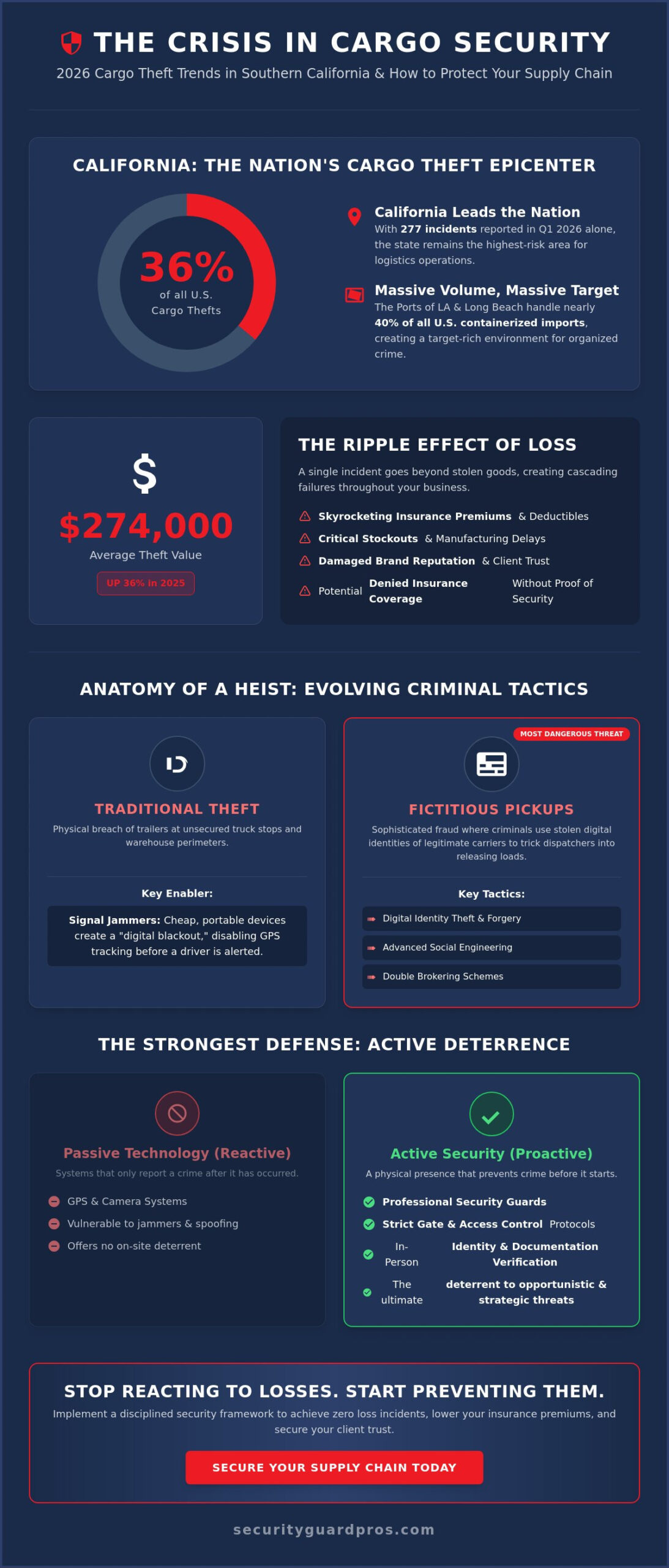
The statistics for the first quarter of 2026 confirm a troubling trend for California businesses. While some regions saw slight decreases, California recorded 277 incidents, accounting for 36% of all U.S. cargo thefts. This represents a definitive shift from the “smash and grab” tactics of the past to high-tech fraud, GPS spoofing, and insider collusion. Criminals are now using AI-powered social engineering to infiltrate supply chains, making a foundational understanding cargo and package theft essential for any commercial manager looking to harden their facility against modern threats.
Why Southern California is the Epicenter of Cargo Theft
The Port of Los Angeles and the Port of Long Beach handle nearly 40% of all U.S. containerized imports. This massive volume creates a target-rich environment for organized syndicates that monitor these gates around the clock. Drivers face the highest risk within the “red zone,” which is the first 200 miles after leaving the port or a distribution hub. Thieves frequently follow trucks from these high-traffic areas, waiting for a single moment of driver fatigue or an unsecured stop. The Inland Empire logistics corridor serves as the primary artery for these goods, yet its vast warehouse clusters and high traffic volume make it the most concentrated zone for cargo crime in the nation.
The Financial and Operational Impact of Loss
The cost of a single theft incident extends far beyond the immediate value of the stolen goods. With the average theft value climbing 36% in 2025 to nearly $274,000, the financial shock can be devastating to a company’s bottom line. Insurers are responding to this volatility by tightening requirements and spiking premiums for businesses that lack documented, professional security protocols. If you can’t prove you’ve taken active steps to secure your freight, you’ll likely pay the price through higher deductibles or denied coverage.
The ripple effect is even more damaging to your long-term growth. A stolen shipment of pharmaceuticals or electronics leads to immediate stockouts, manufacturing delays, and a significant blow to your brand reputation. When a client’s critical inventory vanishes, their trust in your logistics workflow vanishes with it. In 2026, relying on “adequate” security is a liability. You need a proactive shield that prevents the crime before it starts, ensuring your operations remain seamless and your client relationships remain secure.
Anatomy of a Heist: How Modern Cargo Thieves Operate
Criminals don’t just work harder; they work smarter. While traditional physical breaches still occur, the modern heist is often a calculated operation involving digital deception and specialized hardware. Understanding these methods is the first step in building effective logistics security to prevent cargo theft. You can’t defend against a threat you don’t fully comprehend.
Straight theft remains a constant threat at unsecured truck stops and warehouse perimeters. Thieves now use signal jammers to create a “digital blackout” around a trailer, effectively disabling GPS tracking devices before the driver even realizes the seal is broken. This technology is cheap, portable, and extremely effective against companies that rely solely on passive tracking. If your security plan starts and ends with a dashboard, you’re already behind the curve.
Fictitious Pickups: The Most Dangerous Threat
Strategic theft has surpassed physical break-ins as the most lucrative method for organized crime. Criminals steal the digital identities of legitimate, high-rated trucking companies to trick dispatchers into releasing high-value loads. They often use “double brokering” schemes to further mask their trail, making it nearly impossible to recover goods once they leave the yard. By the time the real carrier arrives, the cargo is already being dismantled in a “cross-dock” facility miles away.
Data from the latest cargo theft trends shows that digital-only verification is no longer a sufficient defense. Sophisticated social engineering can bypass even the most expensive software. This is where human-centric Logistics and Distribution Security becomes your primary line of defense, providing the physical verification and driver credentialing that automated systems lack.
Warehouse and Yard Vulnerabilities
Your facility is most vulnerable when it’s quiet. The “weekend threat” is a well-documented pattern where thieves strike between Friday night and Monday morning, knowing that response times are slower and yards are often at their fullest. Unsecured perimeter fencing and poorly monitored dock doors are invitations for organized groups to move in with heavy equipment. They look for the path of least resistance, and an unstaffed gate is exactly that.
Pilferage, while smaller in scale per incident, serves as a warning sign for your entire operation. Frequent, small-scale losses usually indicate a larger systemic failure or a lapse in gate control. Insider collusion facilitates over 50% of major cargo heists by providing criminals with gate codes, schedule details, and inventory manifests. Secure your perimeter. Tighten your protocols. Don’t let your facility become a soft target for a disciplined criminal enterprise.
Beyond GPS: Why Physical Security is Your Strongest Deterrent
Technology alone is a passive observer. While GPS tracking and CCTV provide valuable data, they don’t stop a crime in progress. A camera records your loss; a professional guard prevents it. In the high-stakes environment of Southern California, logistics security to prevent cargo theft requires more than just digital breadcrumbs. The human element remains your most effective deterrent. Criminal syndicates are risk-averse and look for “soft targets” where they can operate without immediate physical confrontation. When a uniformed guard is present at your gate or patrolling your yard, the risk-reward calculation changes for the thief. The potential for immediate detection forces them to bypass your facility in favor of an easier mark.
Don’t let the fear of operational slowdowns prevent you from implementing a physical presence. Modern security personnel act as logistical partners who streamline gate workflows rather than hindering them. They manage entry logs, verify load manifests, and ensure that only authorized carriers access your yard. This proactive approach eliminates the friction of unauthorized entry while hardening your facility against the threats outlined in FBI Cargo Theft Prevention guidelines. By integrating professional guards, you transform your security from a cost center into a protective shield that ensures business continuity.
The Human Element in Fraud Prevention
Digital verification systems are vulnerable to social engineering and stolen credentials. A physical guard provides a layer of authentication that software cannot replicate. By conducting face-to-face interactions, guards verify driver licenses and match truck DOT markings against Bill of Lading data in real time. They’re trained to identify red flags that automated kiosks miss, such as a driver’s nervous behavior or mismatched paperwork. This physical checkpoint is the only way to effectively kill a fictitious pickup attempt before the trailer leaves your property. It’s about stopping the fraud at the source, not tracking the loss after the fact.
Mobile Patrols and Perimeter Defense
Static security is predictable. For large distribution hubs in the Inland Empire or Los Angeles, randomized Vehicle Mobile Patrols break the patterns that thieves use to plan their heists. These patrols provide a constant, visible presence across the entire perimeter, ensuring that fences remain intact and dock doors are secure during high-risk hours.
Integrating these patrols with your existing CCTV creates a comprehensive “eyes-on” strategy. Guards perform manual seal checks during shift changes, recording every number to ensure the chain of custody remains unbroken. If a seal is compromised, the discovery happens immediately, not days later when the client opens an empty container. This level of vigilance provides the peace of mind that allows you to focus on your core business while we maintain the shield around your inventory.
Implementing a Logistics Security Plan to Prevent Cargo Loss
Execution is the difference between a secure supply chain and a series of expensive insurance claims. Transitioning from theory to a functional logistics security plan to prevent cargo loss requires a disciplined, process-driven framework. It isn’t enough to have a general idea of safety; you need a documented set of protocols that every employee and contractor follows without exception. Start by conducting a comprehensive site and supply chain risk assessment. Identify where your perimeter is weak and where your digital handoffs are vulnerable. This analysis should cover everything from physical fencing to the software used for carrier vetting.
Once you’ve identified the gaps, establish strict gate control protocols. This is your primary filter. Every movement must be authorized, recorded, and verified. Implement a “No Unattended Loaded Trailers” policy, especially in the high-risk “red zones” identified earlier. If a load is ready, it must be moving or under active guard supervision. Train your staff to recognize social engineering attempts. Criminals often test your front-line workers with small requests or fake emergencies before launching a full-scale theft. Finally, partner with a licensed security firm that understands the specific demands of the logistics industry. A generic guard service won’t have the training to manage complex distribution workflows.
Gate Security and Seal Management
Effective gate security relies on the meticulous documentation of the “In-and-Out” log. Every driver must present a valid ID, and every trailer must be inspected for structural integrity. Use high-security ISO 17712 bolt seals for all loads; these are the industry standard for a reason. Physical inspection is mandatory because a visual check from a distance won’t catch a tampered or “glued” seal. Security personnel must physically pull on the bolt seal to verify its integrity before allowing any vehicle to exit the property. This simple physical check is your last line of defense against internal collusion and seal manipulation.
Southern California Compliance and Standards
Operating in the Los Angeles basin requires adherence to specific regulatory standards. Ensure your security partner meets all CA BSIS licensing requirements to avoid liability and ensure professional conduct. Aligning your internal security plans with C-TPAT (Customs-Trade Partnership Against Terrorism) standards not only hardens your facility but also speeds up your customs processing. For businesses looking to hire, consult the Security Guard Services in Los Angeles: The 2026 Professional Protection Guide to understand local hiring standards and compliance needs.
Establishing robust logistics security to prevent cargo theft is a multi-step process that demands constant vigilance. If you’re ready to secure your facility with a modern guardian that understands the regional landscape, contact Security Guard Pros for a comprehensive logistics security analysis.
Securing the Supply Chain with Security Guard Pros
Experience isn’t just a prestige metric; it’s the foundation of your protection. Security Guard Pros brings over 70 years of collective management experience to the Southern California logistics sector. We understand that your facility isn’t just a building; it’s a critical node in a global supply chain that cannot afford downtime or inventory loss. Our leadership team has spent decades hardening regional hubs against the exact threats described in this guide. We don’t offer generic staffing. We provide a specialized Logistics and Distribution Security service designed to meet the rigorous demands of 2026’s high-risk environment.
Effective logistics security to prevent cargo theft requires a partner that can scale with your operations. Whether you’re managing a sudden surge in seasonal inventory or facing an immediate threat from local criminal syndicates, our 24/7 dispatch and rapid deployment capabilities ensure you’re never left vulnerable. We build custom security plans tailored to your specific commodity risks and facility layouts. A warehouse storing high-value electronics requires a different defensive posture than one handling perishable food items, and our experts analyze these nuances to create a shield that fits your business perfectly.
Our Approach to Logistics Protection
We believe in the “Modern Guardian” philosophy. This means combining traditional, disciplined vigilance with contemporary electronic reporting and communication tools. Our clients receive real-time updates and digital logs that provide total transparency into gate activities and patrol rounds. We offer a strategic blend of armed or unarmed guards and randomized Vehicle Mobile Patrols to ensure your perimeter is never predictable.
Our success is documented through our work across the region. We’ve successfully secured complex industrial facilities in Ventura and San Bernardino, where high-traffic corridors often attract organized theft groups. By maintaining a constant, professional presence, we’ve helped these partners eliminate the “soft target” reputation that leads to recurring losses. We don’t just watch your gates; we manage them with the authority required to deter even the most persistent criminals.
Take Control of Your Cargo Security Today
Transitioning from a state of perceived vulnerability to a state of total security is a straightforward process when you have the right partner. You shouldn’t have to spend your day worrying about insurance premiums or fictitious pickups. Our mission is to alleviate that anxiety, acting as a protective shield that allows you to focus on your core logistics and fulfillment operations. Stop reacting to heists and start preventing them with a disciplined, expert-led security framework.
Don’t wait for the next “red zone” incident to audit your defenses. Secure your assets, protect your reputation, and ensure your supply chain remains unbroken. Contact Security Guard Pros for a customized logistics security analysis.
Hardening Your Supply Chain for 2026 and Beyond
The landscape of cargo crime demands a shift from passive observation to active deterrence. You’ve seen how sophisticated heists now bypass digital-only systems through social engineering and high-tech fraud. To truly protect your inventory, you must prioritize human verification and rigorous gate management. Implementing a professional strategy for logistics security to prevent cargo theft is the only way to ensure your facility remains a hard target in Southern California’s competitive distribution corridors. Stop reacting to heists and start preventing them with a disciplined, expert-led framework.
Don’t let liability and the risk of loss distract you from your core business growth. Security Guard Pros has been a licensed private security company serving SoCal since 2014, backed by over 70 years of collective management experience. Our 24/7 dispatch and rapid deployment capabilities provide the protective shield your supply chain requires to thrive in high-risk zones. We’re ready to transition your facility from a state of vulnerability to one of total security.
Secure your supply chain with a custom logistics security plan from Security Guard Pros. Take the first step toward zero-loss operations today. Your peace of mind and operational continuity are our highest priorities.
Frequently Asked Questions
What are the most common cargo theft tactics in 2026?
Strategic theft and technology enabled heists are currently the dominant methods used by organized crime groups. Criminals use stolen identities to impersonate legitimate carriers or utilize GPS spoofing and signal jammers to hide their movements. While food and beverage remains the most targeted category, the theft of personal care and beauty products saw a sharp 178% rise in the first quarter of 2026.
How can a security guard prevent fictitious pickup fraud?
Guards act as a physical authentication layer that digital systems cannot replicate. They perform real time verification of driver licenses and truck markings against Bill of Lading data at the gate. This face to face interaction allows them to spot behavioral red flags and paperwork inconsistencies that automated kiosks miss. It’s a critical component of logistics security to prevent cargo theft at the point of origin.
Is Southern California a high-risk area for cargo theft?
Southern California remains the national epicenter for supply chain crime due to the massive volume moving through the Ports of Los Angeles and Long Beach. In the first quarter of 2026, California accounted for 36% of all U.S. cargo theft incidents with 277 reported cases. The Inland Empire logistics corridor is particularly vulnerable, especially for drivers within the first 200 miles of their pickup location.
What is the difference between straight theft and strategic cargo theft?
Straight theft involves physical heists such as breaking into warehouses or stealing trailers from truck stops. Strategic theft is a non violent fraud where criminals use “double brokering” and identity theft to trick dispatchers into releasing loads to them. Strategic methods are often more difficult to detect and result in higher value losses because the crime isn’t discovered until the real carrier arrives.
Should I hire armed or unarmed guards for my warehouse?
The decision depends on your specific risk profile and the value of the commodities you handle. Unarmed guards are highly effective for gate control, manifest verification, and randomized patrols. Armed guards are typically deployed for high value electronics, pharmaceuticals, or facilities in high crime areas where the threat of violent organized crime is significantly elevated. A professional risk assessment will determine the best fit.
How much does cargo theft cost businesses on average?
The average value per cargo theft incident climbed to nearly $274,000 in 2025. These costs don’t include the “hidden” financial impacts such as spiked insurance premiums, liquidated damages for late delivery, and the long term damage to your brand reputation. Total estimated losses across North America reached $6.6 billion in 2025, highlighting the need for proactive deterrents rather than reactive insurance claims.
What steps should I take if cargo is stolen from my facility?
Contact law enforcement and your insurance provider immediately to file a formal report. Secure all gate logs, driver sign in sheets, and CCTV footage before any data is overwritten. Conduct an immediate internal audit to check for signs of insider collusion or procedural lapses. Finally, consult with a security professional to implement a stronger logistics security to prevent cargo theft from occurring again.
Can security guards help with C-TPAT compliance?
Professional security guards are essential for maintaining the rigorous documentation required by C-TPAT standards. They manage the “In and Out” logs, conduct physical seal integrity inspections, and ensure that perimeter defenses remain uncompromised. This active management hardens your facility against terrorism and crime while potentially speeding up your customs processing times through a lower risk score with federal authorities.