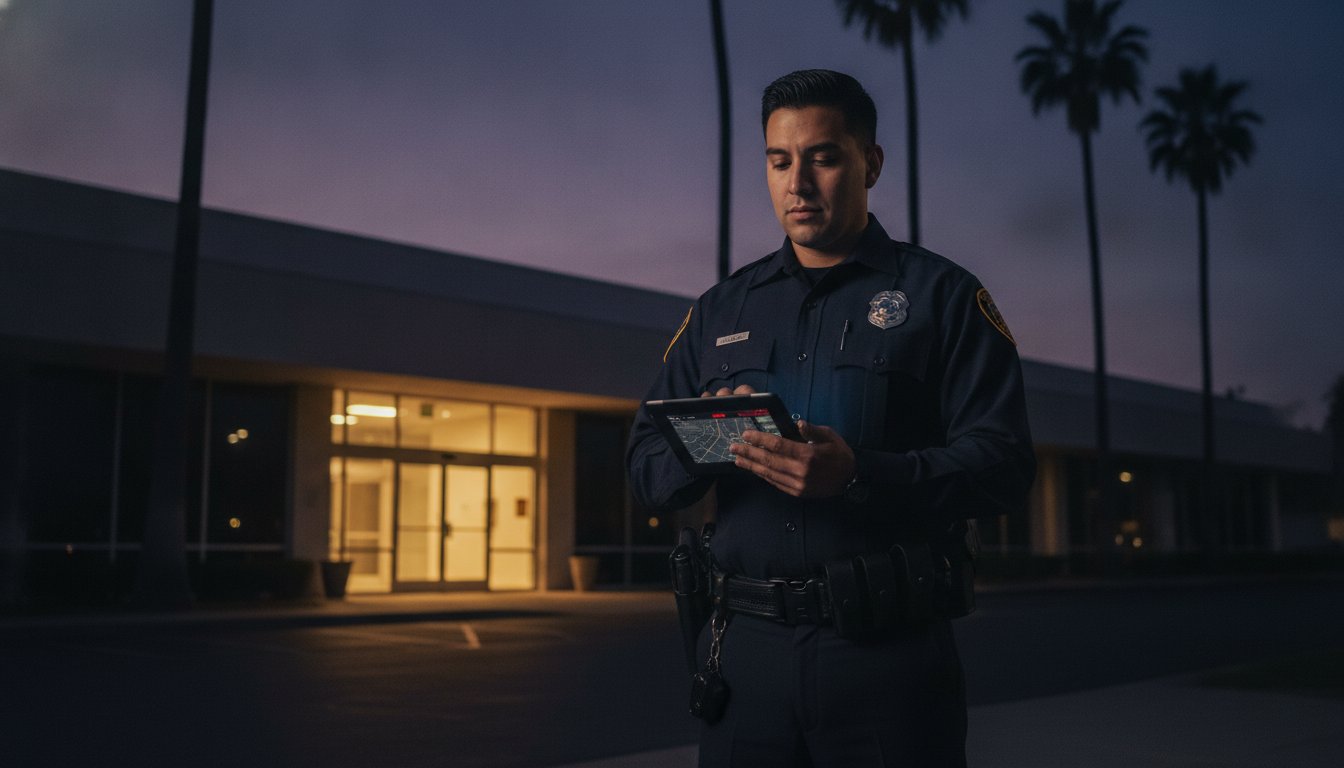
With shoplifting incidents in California surging by nearly 40% and local law enforcement moving toward strict “Verified Response” policies, your silent alarm is no longer a guaranteed shield. Southern California business owners often wonder if they’re paying for a professional deterrent or just a passive observer. Understanding the specific unarmed security guard duties required in 2026 is the difference between a secure facility and a liability nightmare. You need a modern guardian who respects traditional vigilance while leveraging contemporary tools.
You probably feel the weight of rising property loss and the anxiety of potential lawsuits. It’s a common concern, especially when past experiences with unprofessional guards have left your site vulnerable. This guide promises to clarify how proactive protection reduces loss and keeps your operations running smoothly. We will examine the specific tasks that justify your security budget, including access control, AI-integrated surveillance monitoring, and the legal authority granted under Penal Code 837. You’ll gain the clarity needed to transform security from a line-item expense into a strategic asset.
Key Takeaways
- Master the “Deter, Detect, Delay, Report” framework to transition your security from a passive presence to a proactive defensive layer.
- Understand the specific 2026 unarmed security guard duties that ensure every entry point is managed and every patrol is verified through GPS tracking.
- Discover industry-specific strategies tailored for Southern California, focusing on construction site theft prevention and retail loss mitigation.
- Leverage digital transparency tools like Daily Activity Reports to provide total accountability and justify security investments to stakeholders.
- Reduce legal liability and explore potential insurance savings by replacing passive observation with disciplined, professional on-site vigilance.
What are Unarmed Security Guard Duties in 2026?
In the current Southern California business environment, an unarmed guard is far more than a passive observer. They are a disciplined first line of defense. The primary unarmed security guard duties involve providing non-lethal protection through constant vigilance, professional communication, and the strict enforcement of site-specific procedures. While they do not carry firearms, they serve as a “protective shield” for your assets. By understanding the foundational duties of a security guard, business owners can better distinguish between a low-quality “warm body” and a professional security partner who actively mitigates risk.
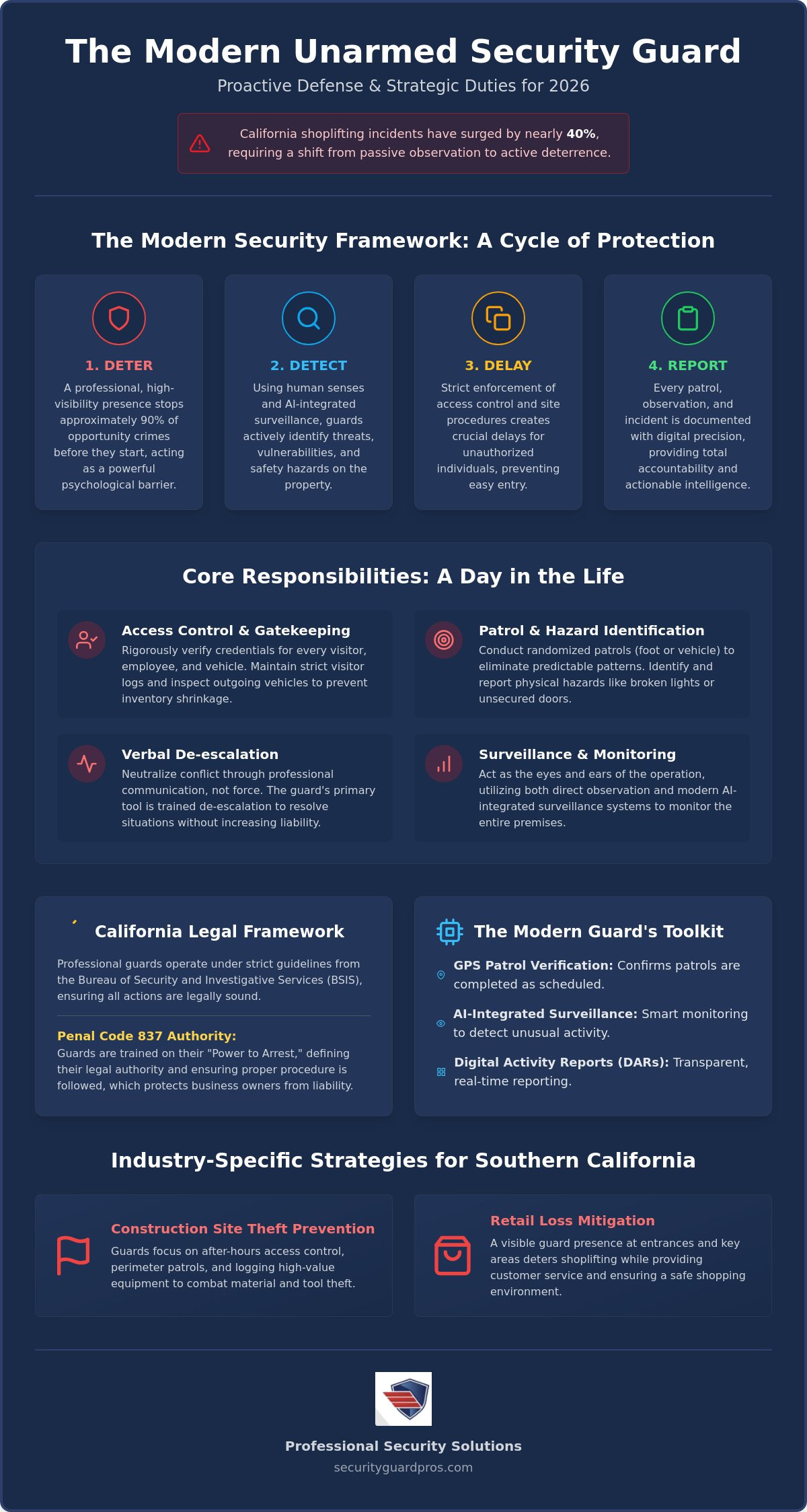
Modern private security operates under a specific tactical framework: Deter, Detect, Delay, and Report. This isn’t a passive checklist; it is an active cycle of protection. Guards deter crime through high-visibility presence. They detect threats using a combination of human senses and AI-integrated surveillance tools. They delay unauthorized access through strict procedural enforcement. Finally, they report every incident with digital precision. This disciplined approach transforms a security presence from a simple cost into a strategic asset that prevents loss before it occurs.
Deterrence vs. Intervention
Physical presence alone stops roughly 90% of “opportunity crimes” at retail and industrial sites. A professional uniform acts as a psychological barrier to potential bad actors. When a situation does arise, the guard’s primary weapon is verbal de-escalation. They are trained to neutralize conflict through communication rather than force. If a situation exceeds their non-lethal training, they immediately transition to calling 24/7 dispatch for rapid law enforcement backup. This ensures safety without escalating liability.
The Legal Framework in California
Professional unarmed security guard duties are strictly governed by the Bureau of Security and Investigative Services (BSIS). As of January 1, 2026, new training regulations under SB 652 require that “Power to Arrest” training be completed within six months prior to a guard card application. This ensures guards understand their authority under Penal Code 837. By hiring a licensed PPO (Private Patrol Operator), you ensure your site is managed by professionals who follow these legal standards. This disciplined adherence to California law provides critical liability protection for business owners, replacing the legal risks of unprofessional staff with the calm confidence of a certified guardian.
To ensure this level of professionalism, many agencies learn more about Program Enrollment and Subscription Fees through Cardinal Consulting CSM to access the coaching and software necessary to maintain high-growth, compliant operations.
Core Responsibilities: A Day in the Life of a Professional Guard
A professional guard’s shift is defined by disciplined routine and constant situational awareness. It isn’t just about standing at a post; it’s about executing a series of high-stakes protocols designed to mitigate risk. The scope of unarmed security guard duties encompasses everything from technical monitoring to physical site hardening. These professionals act as the eyes and ears of your operation, ensuring that security gaps are closed before they can be exploited by bad actors.
Access Control and Gatekeeping
Control the perimeter, and you control the site. In high-value environments like Orange County gated communities or industrial logistics hubs, access control is the primary defense. Guards verify credentials for every visitor, employee, and vehicle entering the premises. This isn’t just a courtesy; it’s a rigorous screening process. For logistics centers, this includes inspecting outgoing vehicles to prevent inventory shrinkage. These actions align with California’s official guard standards, which emphasize the guard’s role in protecting property through procedural enforcement. Maintaining a strict visitor log ensures every person on-site is authorized and accountable.
Patrol Procedures and Hazard Identification
Static security is predictable security. Professional guards utilize randomized patrol routes to eliminate patterns that criminals might track. Whether on foot or via vehicle mobile patrols, these rounds serve a dual purpose. First, they provide a visible deterrent that projects authority across the entire property. Second, they allow for the identification of “soft” hazards. A broken floodlight, a propped-open fire door, or a leaking pipe can be just as damaging as a break-in. By identifying these vulnerabilities early, guards prevent minor issues from escalating into major liabilities or safety incidents.
The modern guard also serves as the human interface for your technological investments. They monitor CCTV feeds and alarm systems, providing an immediate response to digital triggers. Every observation, patrol, and incident is documented in a Daily Activity Report (DAR). These digital logs provide a transparent record of all unarmed security guard duties performed during a shift. This level of accountability ensures you aren’t just paying for a presence, but for a verified and documented protective service that stands up to stakeholder scrutiny.
Industry-Specific Duties Across Southern California
Southern California’s economic landscape is diverse, ranging from sprawling logistics hubs in the Inland Empire to high-rise corporate offices in Los Angeles. Consequently, unarmed security guard duties must be customized to meet the unique threats of each sector. A “one-size-fits-all” approach leaves gaps that criminals are quick to exploit. While the foundational principles of guarding remain consistent with standards found in programs like the Texas Private Security Program, the practical application in California requires a deep understanding of local BSIS regulations and regional crime trends.
Construction and Jobsite Protection
Construction sites are prime targets for organized copper theft and heavy machinery pilferage. Professional construction site security guards focus on securing the perimeter during the vulnerable after-hours window. Their duties involve more than just watching the gate. They coordinate with project managers to secure late-night material deliveries and ensure that all high-value equipment is logged and immobilized. By maintaining a disciplined presence, they eliminate the “opportunity window” that thieves rely on for quick heists.
Logistics and Distribution Security
In the warehouse and distribution sector, security is an extension of inventory control. Guards monitor loading docks and verify bill of lading documents against physical cargo to prevent internal and external shrinkage. They ensure that only authorized personnel enter high-activity zones, which also serves a critical safety function. In these environments, the guard acts as a compliance officer, ensuring that both security protocols and warehouse safety standards are strictly followed to reduce liability and operational downtime.
In retail environments, the focus shifts toward visible loss prevention and shopper reassurance. Guards provide a “calm confidence” that deters shoplifters while making legitimate customers feel safe. For residential HOAs and healthcare facilities, duties often involve lobby management and parking enforcement. In Los Angeles hospitals, this includes managing high-traffic entry points and securing sensitive patient zones where unauthorized access could lead to severe legal consequences. Each industry demands a specific tactical profile, but the goal remains the same: total asset protection.
Technology and Reporting: The Modern Guard’s Toolkit
The image of a security guard carrying a tattered paper logbook is a relic of the past. In 2026, unarmed security guard duties are powered by integrated technology that provides total transparency for the business owner. This digital shift eliminates the guesswork. You no longer have to wonder if a patrol was completed; you can verify it with timestamped, GPS-validated data. Modern guards utilize specialized software to turn their observations into actionable intelligence, ensuring your property is managed with clinical precision rather than vague promises.
The Power of Digital Reporting
Digital Daily Activity Reports (DARs) provide a real-time window into your site’s security status. Unlike paper trails that are easily lost or falsified, electronic logs are immutable and instantly accessible. Guards use mobile devices to capture high-resolution photos and videos of maintenance issues, safety hazards, or security breaches. This visual evidence is critical for insurance claims and legal documentation. By analyzing these reports over time, you can identify recurring vulnerabilities and adjust your security plan accordingly. This data-driven approach moves your strategy from reactive defense to proactive risk management.
Communication and Dispatch Systems
Effective security relies on instant connectivity. Large industrial sites or multi-building complexes require robust two-way radio and mobile communication systems. This ensures that a guard on the perimeter can alert the main gate or a supervisor in seconds. These systems are linked to a 24/7 dispatch center, allowing for rapid deployment of additional resources when needed. For instance, if a fire suppression system fails, guards can immediately transition into fire watch services to maintain compliance with local Anaheim or San Diego fire codes.
Accountability is non-negotiable in professional security. Every patrol is tracked via GPS to verify the frequency and location of guard movements. If a guard deviates from their randomized route or fails to check a high-priority zone, supervisors are alerted instantly. This technology ensures that unarmed security guard duties are performed to the exact specifications of your contract. Real-time incident alerts can be sent directly to your mobile device, providing immediate peace of mind that a professional is handling the situation on the ground. To see how our tech-integrated approach can harden your site’s defenses, consult with our Southern California security experts today.
Why Professional Unarmed Guarding is a Strategic Asset
Viewing security as a mere expense is a mistake that leaves your balance sheet vulnerable. In reality, a disciplined security presence is a strategic asset that protects your profit margins. When unarmed security guard duties are executed with professional precision, they do more than stop crime. They stabilize your operations. By outsourcing your safety concerns to a seasoned partner, you reclaim the mental bandwidth needed to scale your business while we serve as your protective shield.
One of the most tangible benefits of a professional presence is the potential reduction of insurance premiums. Many commercial carriers offer lower rates to businesses that maintain a documented, licensed security presence. These firms recognize that professional guards significantly lower the statistical likelihood of catastrophic loss. This creates a direct ROI where the cost of the service is partially offset by insurance savings. Beyond the numbers, a professional “front-of-house” presence enhances your brand image. A sharp, uniformed guard projects a sense of order and safety that reassures your clients and employees alike.
Liability and Risk Mitigation
Fraudulent “slip and fall” claims are a persistent threat to Southern California businesses. Professional guards are trained to document these incidents with clinical detail, providing the visual and written evidence needed to defeat fraudulent lawsuits. They also ensure your site remains compliant with California OSHA safety standards by identifying hazards during their randomized patrols. Compare the predictable cost of a professional guard to the devastating cost of a single major equipment theft or a six-figure liability settlement. The math is simple. Vigilance is always more affordable than negligence.
Partnering with Security Guard Pros
Choosing a security provider is about more than filling a shift. It is about choosing a partner with the experience to handle the complexities of the SoCal market. We provide a customized approach to security guard services in Los Angeles, backed by over 70 years of collective management expertise. We don’t offer one-size-fits-all commodities; we build site-specific defensive plans that address your unique vulnerabilities.
Stop managing the anxiety of potential loss and start focusing on your core operations. A modern guardian is disciplined, vigilant, and accountable. Our BSIS-licensed professionals are ready to deploy and harden your facility against 2026’s rising threats. Reach out to our regional headquarters today. Request a customized security analysis and discover how professional unarmed security guard duties can provide the peace of mind you need to lead with confidence.
Secure Your Future with Proactive Protection
The Southern California business landscape of 2026 requires more than a passive presence. It demands a disciplined partner who integrates modern technology with seasoned human judgment. By mastering the core unarmed security guard duties of deterrence, detection, and digital documentation, you protect your bottom line from rising theft and liability risks. You’ve seen how GPS-tracked patrols and real-time reporting replace the uncertainty of the past with verified, data-driven safety.
Don’t leave your assets to chance. Partner with a BSIS Licensed PPO that brings over 70 years of collective management experience to your facility. We provide 24/7 dispatch and rapid deployment capability, offering customized security plans tailored to the specific needs of any industry. From construction sites to corporate hubs, we serve as the protective shield your operation deserves.
Secure your property today with a professional Southern California security plan. Take control of your site’s safety and focus on growing your business with absolute peace of mind.
Frequently Asked Questions
Do unarmed security guards have the power to arrest people in California?
Yes, but their authority is limited to the same arrest powers as a private citizen under Penal Code 837. They can detain an individual who commits a felony in their presence or a misdemeanor that constitutes a breach of the peace. However, professional guards prioritize observation and reporting to law enforcement to minimize the business owner’s legal liability. This disciplined approach ensures that situations are handled within the strict boundaries of California law.
What is the difference between a security guard and a security officer?
These terms are often used interchangeably in the private sector, but “security guard” is the official regulatory designation used by the California Bureau of Security and Investigative Services (BSIS). Some firms use “security officer” to designate a higher rank or a supervisory position within their internal hierarchy. Regardless of the title, the essential unarmed security guard duties remain centered on vigilance, access control, and procedural enforcement.
Can an unarmed security guard use physical force to remove a trespasser?
Physical force is a last resort used only for self-defense or the immediate protection of others from harm. For trespassing, guards are trained in verbal de-escalation to encourage the individual to leave voluntarily. If a trespasser refuses to comply, the standard protocol is to notify local law enforcement while maintaining a safe distance. This strategy protects the property owner from potential assault or battery lawsuits that often arise from unprofessional physical interventions.
What training is required for an unarmed security guard in Southern California?
All guards must hold a valid BSIS Guard Card, which requires a background check and 40 hours of mandated training. As of January 1, 2026, new regulations under SB 652 require “Power to Arrest and Appropriate Use of Force” training to be completed within six months of the application. Professional agencies often supplement this with site-specific training to ensure the guard can handle the unique technical and safety requirements of your specific industry.
How much does it cost to hire an unarmed security guard per hour in 2026?
The hourly rate for professional guarding services is influenced by several factors, including the location of your facility, the complexity of the unarmed security guard duties, and local minimum wage laws. In cities like Los Angeles, higher local mandates and the level of technological integration required for the post will impact the final cost. Business owners should view these rates as a strategic investment in asset protection rather than a generic commodity expense.
Can unarmed guards perform fire watch duties if my system goes down?
Yes, unarmed guards can perform critical fire watch services to keep your facility compliant with local fire codes. If your automated fire suppression or alarm system fails, the guard conducts continuous foot patrols to identify smoke, heat, or fire hazards. They maintain detailed logs required by the fire marshal, ensuring your business stays open and avoids the heavy fines associated with fire safety violations during system downtime.
What happens if an unarmed guard encounters a violent intruder?
If a guard identifies a violent threat, they follow the “Deter, Detect, Delay, Report” framework. They immediately contact 24/7 dispatch and local law enforcement while focusing on the safe evacuation of employees and visitors. Their role is to provide real-time intelligence to responding officers and act as a calm guide during the crisis. They are trained to avoid unnecessary physical confrontation that could further endanger lives or increase site liability.
Is an unarmed guard enough for a high-traffic retail location in Los Angeles?
For most high-traffic retail environments, a professional unarmed guard is the most effective deterrent. With shoplifting incidents in California increasing by nearly 40% recently, the psychological impact of a uniformed presence is significant. A visible guard discourages “opportunity crimes” and provides a reassuring environment for your customers. This proactive layer of security allows your staff to focus on customer service while the guard manages entry points and monitors for suspicious activity.