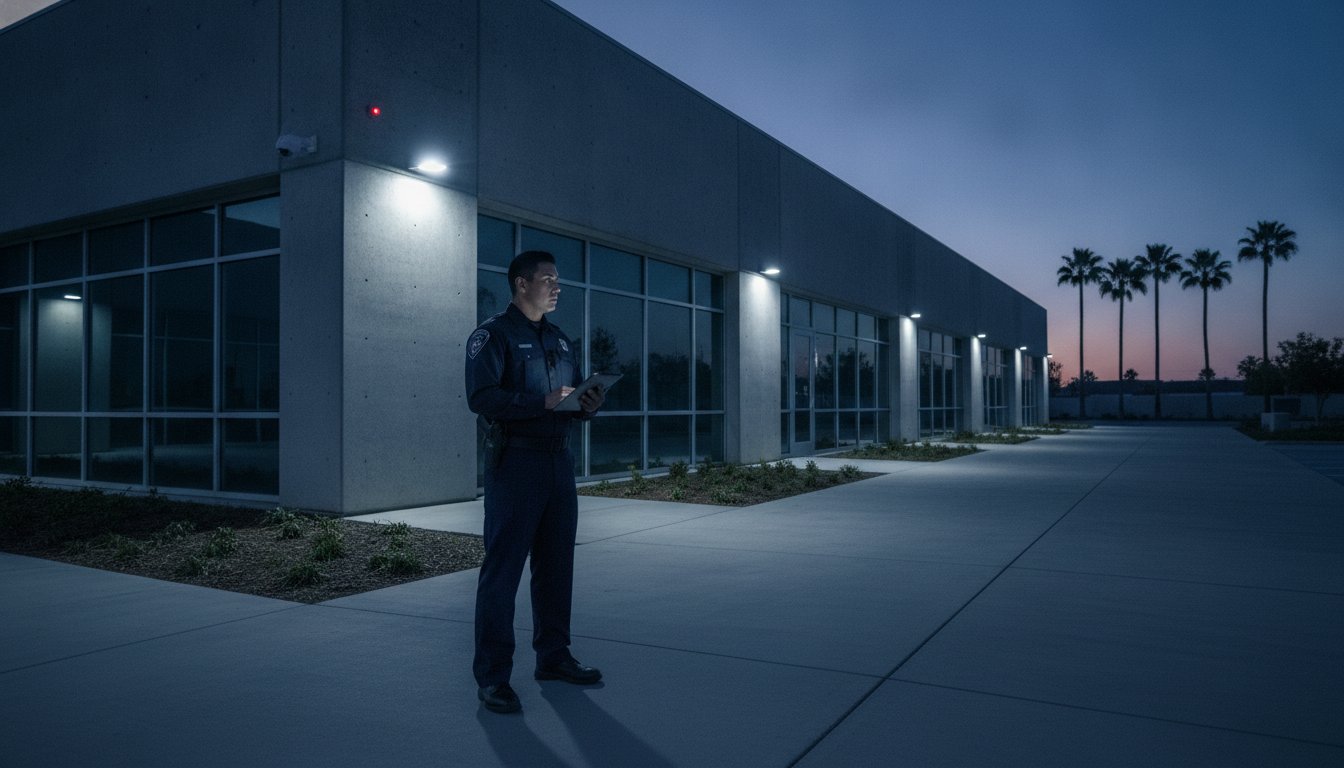
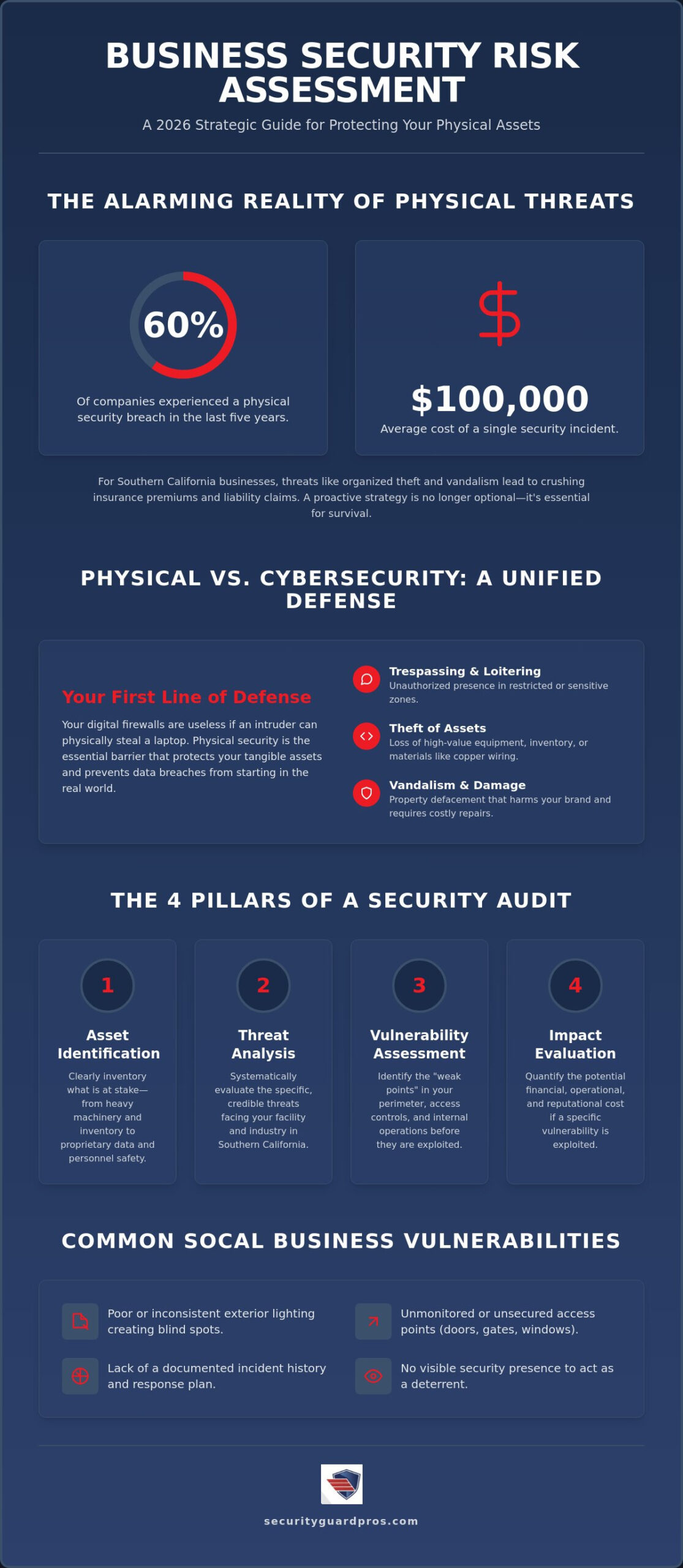
Did you know that 60% of companies have experienced a physical security breach in the last five years, with the average incident costing a staggering $100,000? For Southern California business owners, these aren’t just numbers on a page. They represent the very real threats of organized cargo theft, vandalism, and the crushing weight of rising insurance premiums. You likely feel the pressure of protecting your property while struggling to distinguish between your digital needs and your physical vulnerabilities. It’s exhausting to manage a company when you’re constantly looking over your shoulder for the next liability claim.
This 2026 guide is designed to replace that anxiety with a hard-hitting strategy. You’ll learn exactly how to conduct a business security risk assessment that identifies your weakest points before a criminal does. We’re providing a clear, professional roadmap to secure your assets and reduce your exposure to loss. By the end of this article, you’ll have the tools to build a protective shield around your operations. This allows you to focus on your core business with total confidence in your site’s safety, backed by the authority of seasoned security experts.
Key Takeaways
- Distinguish between digital vulnerabilities and physical threats to ensure your property, personnel, and inventory remain secure against real-world intrusion.
- Master the four essential components of a business security risk assessment to identify your most critical assets and analyze the specific threats facing your industry.
- Follow a step-by-step guide to conducting site audits, including perimeter walk-throughs and incident history reviews, to uncover hidden security gaps.
- Identify common Southern California vulnerabilities, such as poor lighting and unmonitored access points, that frequently lead to increased insurance premiums and liability.
- Learn how to transition from assessment to action by developing a customized security plan that leverages professional staffing and rapid deployment.
What is a Business Security Risk Assessment for Physical Sites?
A business security risk assessment is a systematic, ground-level evaluation of your property, people, and assets. While many modern guides focus exclusively on digital firewalls, a physical assessment scrutinizes the tangible world where your business actually operates. It’s the process of looking at your facility through the eyes of a professional intruder. By mid-2026, the landscape of urban risk in Southern California has shifted significantly. You can’t rely on the security standards of a decade ago. Criminal tactics have evolved. Your defensive strategy must outpace them. The primary goal is simple: identify every “weak point” in your perimeter and internal operations before they are exploited by criminals, which is why some proactive managers buy lockpick set tools to test the mechanical integrity of their own doors.
Physical vs. Cybersecurity: Why You Need Both
Think of your business as a fortress. You might have the most sophisticated encryption on your servers, but that data is physically vulnerable if your front gate is unmonitored. To understand the full scope of your vulnerability, you must ask: What is Physical Security? It is the first line of defense that prevents a “data breach” from starting as a physical theft. If a trespasser walks into an unlocked office and steals a laptop, your digital encryption is already compromised. We advocate for “converged security.” This approach treats physical barriers and cyber protocols as a single, unified shield. A locked server room is only effective if the human element and the physical perimeter are equally disciplined.
Common physical breaches include:
- Unauthorized trespassing and loitering in restricted zones.
- Theft of high-value equipment, copper wiring, or inventory.
- Vandalism and property defacement that damages your brand.
- Arson or environmental hazards like fire that threaten operations.
The Legal and Financial Stakes of Neglecting Risk
Liability is a silent predator for California business owners. If a “foreseeable” crime occurs on your premises, you are legally on the hook. This is especially true in high-traffic areas like Los Angeles, where the “duty of care” is strictly enforced by the courts. Neglecting a known risk, such as a broken fence or a dark parking lot, can lead to devastating lawsuits. In a legal context, negligent security is defined as a failure by a property owner to provide reasonable security measures to protect individuals from foreseeable criminal acts by third parties. Beyond the courtroom, your insurance provider is watching. Sites without a documented business security risk assessment often see surging premiums. Insurance companies reward proactive management because it reduces the likelihood of a claim. Peace of mind comes from knowing your liability is minimized and your assets are hardened against any threat.
The 4 Essential Components of a Commercial Security Audit
A professional business security risk assessment is far more than a simple walk-through. It is a strategic deep dive into the four pillars of protection: Asset Identification, Threat Analysis, Vulnerability Assessment, and Impact Evaluation. Without these components, your security measures are merely reactionary. By systematically evaluating what you own, who wants it, where your defenses fail, and the cost of a breach, you create a proactive shield that deters crime before it starts. This structured approach ensures that resources are allocated where they are needed most, rather than being wasted on generic solutions that don’t address your specific site needs.
To establish a baseline for your facility, you can reference frameworks like CISA’s Security Assessment at First Entry (SAFE). This methodology emphasizes that security is a layered process. It begins with the perimeter and moves inward to your most sensitive areas. When you understand the “why” behind your security protocols, you move from a state of perceived vulnerability to one of controlled safety. This transition is essential for maintaining operational continuity in a high-stakes environment like Southern California.
Identifying Your High-Value Assets
Effective protection starts with a clear inventory of what is at stake. Go beyond the obvious contents of a safe. Your high-value assets include heavy machinery on a construction site, proprietary client data in a corporate office, and the physical safety of your personnel. Categorize these assets by their operational criticality. If a piece of specialized manufacturing equipment is stolen, the loss isn’t just the replacement cost; it’s the weeks of downtime that follow. For gated communities or HOAs, the asset is often the peace of mind and perceived safety of the residents. Protecting these intangible assets is just as vital for your brand’s reputation as securing your physical inventory.
Mapping Local Southern California Threats
Threats are rarely generic; they are deeply regional. In Los Angeles and San Diego, businesses face specific trends like organized copper theft at construction sites and “smash and grab” incidents in high-end retail. Your business security risk assessment must account for these local crime patterns. Beyond criminal intent, environmental risks pose a significant threat to SoCal operations. Long wildfire seasons and strict local regulations often necessitate professional fire watch services to maintain compliance and protect property. Recognizing these specific threats allows you to build a customized defense. If you’re unsure where your facility stands, consider reaching out to a professional security consultant to help map out your regional risk profile.
Conducting a Security Risk Assessment: A Step-by-Step Guide
Executing a business security risk assessment requires a disciplined, boots-on-the-ground approach. You can’t secure a facility from behind a desk. For a structured methodology, many professionals refer to the NIST Guide for Conducting Risk Assessments, which provides a rigorous framework for identifying and ranking threats. Start with a perimeter walk-through. Inspect every foot of fencing and test every floodlight. If a gate is propped open for employee convenience, your security is already compromised. Review your incident history to identify patterns. A “near miss” last month is a warning of a successful breach next month. Evaluate your existing controls with skepticism. If your cameras produce grainy footage or your alarms have a 10-minute lag, they aren’t controls; they’re liabilities. Finally, interview your key personnel. Employees often see vulnerabilities that management misses, such as unauthorized shortcuts or broken locks.
Documentation is the final, critical step of the assessment process. You must create a “Risk Matrix” to rank issues by their severity and likelihood. This isn’t just paperwork. It’s your tactical plan. By the time you finish this step, you’ll know exactly which gaps are minor inconveniences and which ones are catastrophic failures waiting to happen. This clarity allows you to move from a state of reactive worry to one of proactive defense.
The Site Walk-Through Checklist
Don’t just look at what’s there; look at what’s missing. Perform a visual inspection of “blind spots” where your current camera system cannot reach. Test the actual response time of your alarm systems during a simulated event. In high-risk environments, you’ll often find that construction site security guards offer a far superior deterrent compared to passive systems. A physical presence can intervene in real-time, whereas a camera only provides a recording of your loss after the criminal has fled the scene.
Building Your Risk Mitigation Plan
Once you’ve identified the gaps, you must decide how to handle them. The four standard responses are: accepting the risk, avoiding it by changing operations, transferring it through insurance, or mitigating it with active defenses. Hiring professional guards is the ultimate mitigation strategy because it places a disciplined human shield between your assets and the threat. A risk matrix helps you allocate your security budget effectively by prioritizing high-impact vulnerabilities over minor inconveniences. This ensures every dollar spent on your business security risk assessment results in a tangible increase in safety and a measurable reduction in liability.
Common Vulnerabilities in Southern California Businesses
Identifying your site’s weaknesses is the most critical outcome of a business security risk assessment. In the dense commercial corridors of Southern California, criminals look for the path of least resistance. Often, that path is paved with basic oversight. Insufficient lighting remains the primary invitation for nighttime criminal activity. A dark parking lot or unlit loading dock provides the cover needed for theft and vandalism to go unnoticed. Similarly, unmonitored access points are a frequent failure. Whether it’s a side door propped open for a smoke break or a loading dock left unsecured during a shift change, these gaps render your perimeter defenses useless. Don’t let human error dismantle your security strategy.
Outdated technology creates a false sense of safety that can be more dangerous than having no system at all. Relying on low-resolution cameras that produce grainy, unusable footage provides zero deterrent to a determined intruder. These legacy systems create massive blind spots that sophisticated crews easily exploit. Furthermore, a total reliance on automated alarms without a human presence is a high-stakes gamble. In many Southern California jurisdictions, law enforcement may deprioritize unverified alarms due to high call volumes. Without eyes on the ground, your business is left exposed during the most critical minutes of a breach.
The “Alarm Fatigue” Problem
Many businesses suffer from “alarm fatigue,” where frequent false positives lead staff to ignore sirens or delay their response. This desensitization is a gift to criminals who use noise to test your reaction time. Contrast this passive failure with the immediate, disciplined intervention of professional security guard services in Los Angeles. A human responder can verify a threat instantly and take action. For larger facilities, the deterrent value of a marked vehicle mobile patrol cannot be overstated. It sends a clear message: this property is under active, professional watch. If your current system is just making noise without results, it’s time to schedule a professional security consultation to harden your defenses.
Regulatory Vulnerabilities: Fire Watch and Compliance
Security isn’t just about deterring theft; it’s about maintaining legal compliance to keep your doors open. In California, a malfunctioning fire sprinkler or alarm system is a critical regulatory failure. If your life-safety systems are down, the Fire Marshal can issue an immediate site shutdown, halting your operations and costing thousands in lost revenue. This necessitates a professional fire watch to maintain safety and compliance. For high-risk zones or facilities handling sensitive materials, integrating licensed armed security guards provides the highest level of protection against both criminal threats and liability. Addressing these regulatory gaps during your business security risk assessment ensures your business remains both safe and operational.
Partnering with Security Guard Pros for Expert Assessments
A business security risk assessment is only as effective as the expertise behind it. At Security Guard Pros, we leverage over 70 years of collective management experience to transform raw data into a tactical defense plan. We don’t just identify holes in your perimeter; we provide the professional staffing necessary to close them. Our team understands that a warehouse in the Inland Empire faces different threats than a retail center in Orange County. We treat every audit as a unique mission, applying a seasoned veteran’s eye to your specific operational challenges. This disciplined approach ensures that your security strategy is grounded in reality, not generic theory.
Local geographic expertise is our greatest asset. Our deep roots in Los Angeles, San Diego, and across Southern California allow us to anticipate regional crime trends before they impact your bottom line. We know the specific “follow-home” robbery patterns in affluent areas and the cargo theft tactics used near our major ports. By grounding our voice in local knowledge, we provide a protective shield that is both relevant and rigorous. We move your organization from a state of perceived vulnerability to a state of total security, maintaining a steady and professional pace throughout the entire implementation process.
From Analysis to Armed Protection
The transition from assessment to action is where our “Modern Guardian” philosophy truly shines. Once we’ve established your site’s unique risk score, we match our guard profiles to your specific needs. This might mean deploying unarmed guards for low-risk corporate environments or specialized armed security guards for high-value industrial assets. Our 24/7 dispatch center and rapid deployment capabilities ensure that we can respond to emerging threats in real-time. We prioritize transparent reporting and accountability, providing you with the metrics needed to verify that your property is being protected by the best in the industry.
Get Your Professional Risk Assessment Today
Stop guessing about your facility’s safety and start protecting your future. Vulnerabilities don’t disappear on their own; they are eventually found by those who wish to exploit them. Working with our team is a hassle-free process designed to alleviate the anxiety of liability and loss. We provide the clarity you need to focus on your core operations without the distraction of security concerns. Take the first step toward true peace of mind by securing your assets with a partner who takes your safety as seriously as you do. Contact Security Guard Pros for a Professional Consultation and let us build your customized security plan today.
Secure Your Perimeter and Focus on Growth
Hardening your facility against modern threats is no longer optional for Southern California enterprises. You’ve seen how identifying assets and mapping local crime trends can transform a vulnerable site into a fortified operation. Executing a comprehensive business security risk assessment is the first step toward total site hardening. By addressing common gaps like poor lighting and unmonitored access points, you eliminate the “path of least resistance” that criminals actively seek. This proactive discipline reduces your liability and protects your bottom line from the rising costs of theft and surging insurance premiums.
Security Guard Pros stands ready as your professional partner. As a licensed California Private Patrol Operator with over 70 years of collective management experience, we provide the authority and reliability your business deserves. Our 24/7 rapid deployment dispatch ensures that once a risk is identified, it’s immediately neutralized by our expert staff. Don’t leave your property to chance when professional protection is just a consultation away. Secure Your Business with a Professional Risk Assessment today. Take back your peace of mind and get back to the work that matters most.
Frequently Asked Questions
What is the first step in a business security risk assessment?
The first step is a comprehensive identification of your high-value assets. You must determine exactly what you’re protecting, whether it’s personnel, physical inventory, or proprietary operational data. Without a clear understanding of what’s at stake, your defensive measures will lack focus and leave critical gaps exposed. This foundational phase ensures that every subsequent security decision is driven by your specific business needs rather than generic assumptions.
How often should a Southern California business update its security assessment?
Update your assessment at least once a year or immediately following any significant operational changes. Southern California’s risk landscape is dynamic, with shifting crime trends and evolving regulatory requirements. If you expand your facility, change your shift hours, or notice a spike in local criminal activity, a new business security risk assessment is essential. Regular reviews ensure your defensive shield remains resilient against new tactics and environmental threats.
Does my small business really need a professional security audit?
Yes, because small businesses are often viewed as softer targets by criminals. While a large corporation might absorb a $100,000 loss, a single physical breach can be catastrophic for a smaller operation. A professional audit identifies vulnerabilities that you might overlook, such as inadequate lighting or propped-open side doors. Investing in a professional evaluation demonstrates a commitment to safety that protects your assets and your long-term viability.
What is the difference between a threat and a vulnerability?
A threat is an external force that can cause harm, while a vulnerability is an internal weakness that allows that harm to occur. For example, an organized theft crew is a threat; a broken perimeter fence is a vulnerability. Your goal is to identify and mitigate vulnerabilities so that external threats cannot exploit them. Understanding this distinction allows you to focus your resources on the factors you can actually control within your property.
Can a security risk assessment help lower my insurance premiums?
Yes, insurance providers frequently offer better rates to businesses that demonstrate proactive risk management. By completing a documented business security risk assessment, you provide proof of your “duty of care” and commitment to site safety. This documentation can be a powerful tool during premium negotiations. It shows your insurer that you’re a lower-risk client who takes the prevention of theft and liability claims seriously.
How long does a typical physical security assessment take?
The duration depends on the scale and complexity of your facility. A standard retail site or corporate office might take a few hours to evaluate, while a large industrial complex or logistics hub could require several days of detailed analysis. We prioritize a thorough walk-through over a rushed inspection. This ensures every blind spot is identified and every access point is tested against professional standards of protection.
Do you provide security assessments for construction sites in Los Angeles?
We specialize in Construction Site Security across the Los Angeles region. Our team understands the unique challenges of active jobsites, from high-value equipment theft to unauthorized trespassing after hours. We provide ground-level audits that inform a customized plan, often involving a combination of stationary guards and vehicle mobile patrols. This targeted approach protects your materials and ensures your project stays on schedule without costly interruptions.
What happens after the security risk assessment is completed?
The assessment culminates in a prioritized action plan that transitions your business from analysis to active protection. We provide a detailed report ranking your risks and recommending specific countermeasures, such as specialized staffing or rapid deployment dispatch. This roadmap allows you to address the most critical vulnerabilities first. Our team then works with you to implement these solutions, providing a professional shield that lets you focus on your core operations.