Hiring the wrong security guard company isn’t just a staffing mistake; it’s a direct invitation for legal liability and operational chaos. You’ve likely felt the frustration of high guard turnover or the anxiety of slow dispatch response times during a critical incident. It’s exhausting to manage a security vendor when they were supposed to be the ones managing your risks. You deserve a partner that acts as a protective shield, not an additional item on your to-do list.We’ve developed this professional selection framework to help California business owners vet their protection partners with surgical precision. You’ll learn how to master the vetting process by looking past sales pitches and focusing on the metrics that actually reduce theft and liability. We’ll examine the 2026 regulatory landscape, including the specific Senate Bill 652 training requirements and PPO insurance mandates that separate seasoned veterans from high-risk amateurs. By the end of this guide, you’ll have the tools to secure a reliable partner that provides clear ROI and the peace of mind you need to focus on your core operations.
Key Takeaways
- Learn to distinguish between a basic staffing vendor and a professional security guard company by verifying active BSIS credentials and California PPO licenses.
- Shield your business from liability by identifying the four non-negotiable compliance markers every reputable firm must maintain in 2026.
- Tailor your protection plan to industry-specific needs, ensuring your security strategy addresses the unique risks of construction sites or retail centers.
- Implement our step-by-step selection template to quantify your security needs through a professional site risk assessment.
- Discover how to evaluate management-to-guard ratios to ensure consistent performance and reduce the operational burden on your team.
What Defines a Professional Security Guard Company in 2026?
In the current Southern California climate, the gap between a “rent-a-guard” agency and a professional security guard company is widening. Low-cost vendors often provide little more than a physical presence. This “warm body” strategy fails against modern threats like organized retail crime in Los Angeles or sophisticated trespassing on construction sites in Anaheim. A professional firm operates as a disciplined, tactical extension of your business operations. They prioritize proactive threat deterrence over passive observation. This means guards don’t just watch a crime happen; they follow established protocols to prevent it from occurring in the first place.In California, this distinction begins with the Private Patrol Operator (PPO) license. This credential isn’t just a bureaucratic hurdle. It’s a regulatory guarantee that the leadership has met strict experience requirements. For instance, a Qualified Manager for a PPO must have at least 2,000 hours of paid security experience. When you vet a security guard company, you’re verifying that they have the seasoned leadership necessary to handle high-stakes emergencies. Professional firms also maintain a dedicated 24/7 dispatch center. This infrastructure ensures rapid deployment and immediate supervisor support when a situation escalates.The private security industry has evolved to meet these higher standards. In 2026, professional firms are defined by:- Real-time communication between field units and centralized command.
- Strict adherence to the latest BSIS training mandates, including the Power to Arrest and Appropriate Use of Force standards.
- The ability to provide industry-specific solutions rather than a generic, one-size-fits-all patrol.
The Evolution of Private Security
Modern protection requires total transparency. Gone are the days of handwritten logs that can be easily falsified. Leading firms now utilize GPS tracking and real-time electronic reporting. These tools provide business owners with a clear digital audit trail of every patrol and incident. Access to a dedicated security service number that connects directly to a live supervisor is a non-negotiable standard. This accountability is driven by management. With over 70 years of collective experience in the Southern California market, our leadership understands that a guard is only as effective as the supervision they receive.Liability Shield vs. Staffing Expense
Stop viewing security as a line-item expense. It’s a risk-mitigation strategy. Utilizing professional security guards in los angeles can significantly impact your commercial insurance standing. Many carriers look favorably on businesses that employ licensed firms with at least $1 million per occurrence in liability coverage. This “liability shield” prevents the astronomical costs associated with lawsuits, property damage, and internal theft. By choosing a firm that emphasizes rigorous training and legal compliance, you aren’t just buying hours. You’re buying a defensive perimeter for your bottom line.The 4 Non-Negotiables of Security Firm Compliance
Compliance isn’t a suggestion. It’s your primary defense against litigation. Many vendors claim they are “fully covered,” but a professional security guard company provides the documentation to prove it. In California, the regulatory floor is high for a reason. If a guard is injured on your property or an incident leads to a lawsuit, an uncertified vendor leaves your assets exposed. You must verify these four pillars before signing any service agreement.First, demand proof of an active Private Patrol Operator (PPO) license. Second, verify comprehensive liability insurance. California law requires a minimum of $1 million per occurrence and $2 million aggregate for PPOs. Third, ensure the company carries robust Worker’s Compensation. Without it, you are the one liable for a guard’s workplace injury. Finally, insist on rigorous background checks. A firm’s reliability is only as strong as the individuals they deploy. When assessing your security needs, prioritize these legal safeguards to ensure your provider acts as a shield, not a liability.Verifying California PPO Licenses
Don’t take a salesperson’s word for it. Visit the Bureau of Security and Investigative Services (BSIS) website to verify a company’s standing in real-time. A common red flag is a firm operating under another company’s license or using a “pending” status as an excuse. This is illegal. A legitimate security guard company will provide their PPO license number and current insurance certificates upon request. If they hesitate, walk away. You can consult with a licensed professional to see what a compliant documentation package looks like.Training Standards for 2026
As of January 1, 2026, California training requirements have tightened under Senate Bill 652. New guards must complete 32 hours of security officer skills training within their first six months, with 16 of those hours completed within the first 30 days. This includes mandatory “Power to Arrest and Appropriate Use of Force” training. Beyond these state minimums, professional firms provide specialized instruction for high-stakes roles like Fire Watch Services or armed posts. Effective de-escalation techniques are now a critical component of training, as they reduce the likelihood of physical altercations that lead to client liability. Professional training must include site-specific post orders to ensure every guard understands the unique vulnerabilities of your property.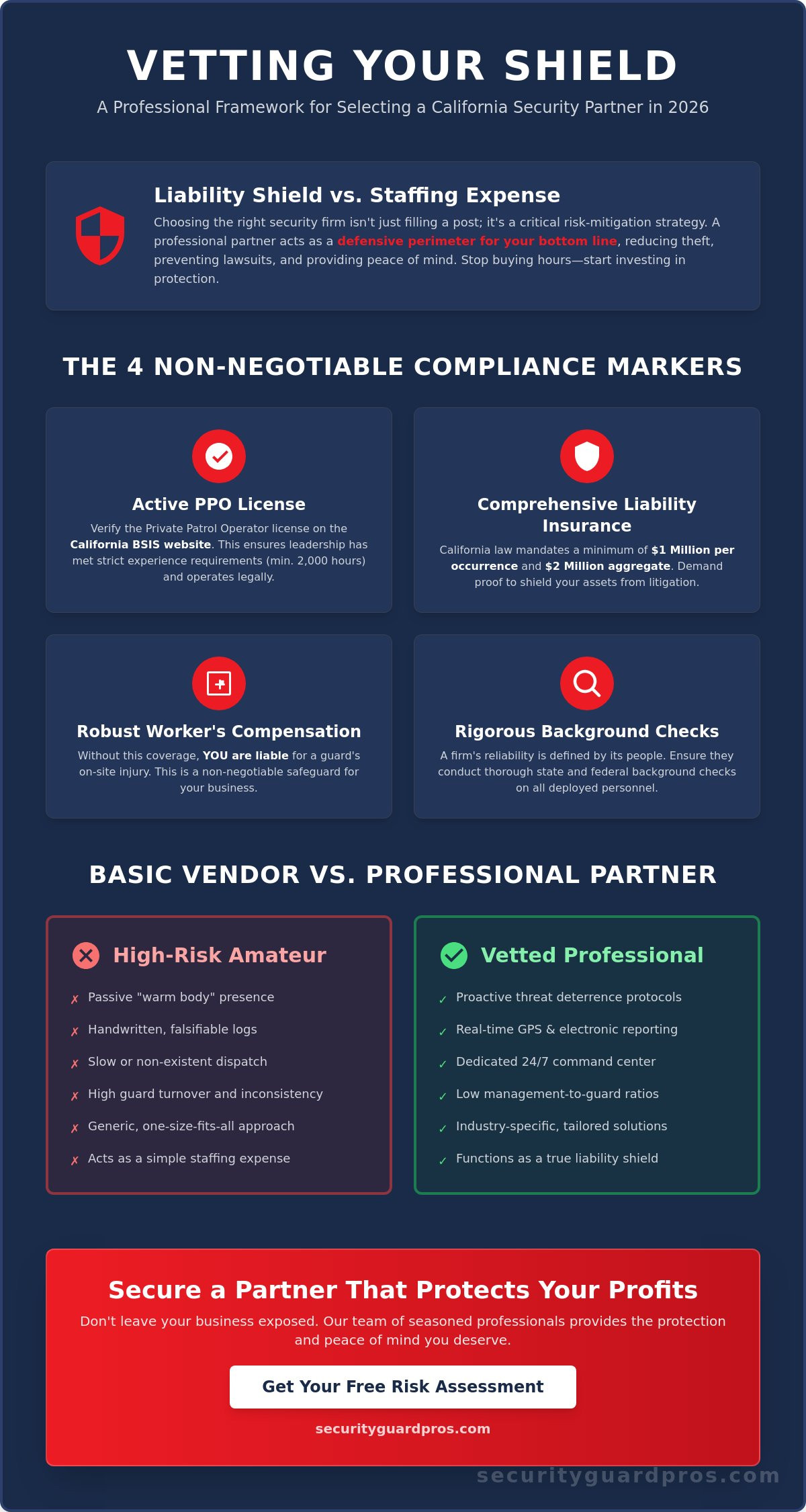
Matching Security Services to Your Industry Needs
Security needs aren’t static. A security guard company that treats a manufacturing plant the same way it treats a corporate office lobby is a liability. Every industry presents unique vulnerabilities that require specific tactical responses. For example, Construction Site Security focuses on the prevention of high-value equipment theft and unauthorized entry after hours. This requires guards who are trained in perimeter integrity and asset tracking. Without this specialized focus, your site remains a target for expensive losses and project delays.Fire Watch Services represent another critical industry-specific need. When fire alarm systems or sprinklers fail, California regulations mandate a physical fire watch to maintain occupancy. This isn’t just about safety; it’s about avoiding costly facility shutdowns. Similarly, Retail and Shopping Center Security requires a nuanced approach. Guards must balance firm loss prevention tactics with a customer-centric attitude. In gated communities and HOAs, the emphasis shifts toward high-visibility vehicle mobile patrols. These patrols act as a constant deterrent to property crime while providing residents with the peace of mind that comes from active supervision.High-Risk vs. Low-Profile Protection
Determining the right level of force is essential for risk management. High-value asset protection often necessitates armed security to provide a stern deterrent against violent threats. However, many environments benefit from a low-profile approach. For instance, hotel security services anaheim prioritize guest comfort alongside safety. In these settings, unarmed guards manage logistical support, such as access control and visitor logs, without creating an atmosphere of alarm. A professional security guard company will help you determine which model fits your specific risk profile during the initial assessment.Emergency and Short-Term Needs
Operational threats don’t follow a schedule. Whether you’re dealing with a sudden system outage or a scheduled corporate function, you need a partner capable of rapid deployment. Special event staffing requires a firm that can scale up quickly with trained personnel who understand crowd control and emergency protocols. During these critical times, communication is your most important tool. You shouldn’t have to wait for a callback during a crisis. A reliable partner ensures their security service number is answered by a live supervisor 24/7. This immediate access ensures that emergency requests are handled with the urgency they deserve.The 2026 Security Guard Company Selection Template
Stop guessing and start measuring. Vetting a security guard company requires a systematic approach that looks beyond the sales presentation. To ensure your assets are protected and your liability is minimized, use this five-step selection framework designed for the modern commercial environment. This template prioritizes operational transparency over empty promises.- Step 1: Conduct a site risk assessment. Before hiring, identify your specific vulnerabilities. Determine if you need high-visibility deterrents, access control, or specialized services like fire watch.
- Step 2: Request the PPO license and insurance. As previously emphasized, verify these through the BSIS. Do not accept “pending” documents or verbal assurances.
- Step 3: Evaluate the management-to-guard ratio. High-quality firms maintain a low ratio to ensure supervisors can provide actual oversight and support to guards on post.
- Step 4: Review reporting technology. Demand real-time digital logs and GPS verification. You should have instant visibility into your security status at any moment.
- Step 5: Ask for SoCal-specific references. A firm should prove their expertise with clients in your specific industry and region, from Los Angeles to San Diego.