In California, hiring the wrong security firm doesn’t just leave your doors unlocked; it hands you the legal liability for every action their guards take. You already know that protecting your Southern California assets requires more than just a person in a uniform. It’s a high-stakes decision where a single licensing oversight can lead to devastating lawsuits. Learning how to hire a security company in California is a legal compliance task first and a staffing task second. If the Private Patrol Operator (PPO) license isn’t valid, your business inherits the risk.
This guide provides the professional roadmap to navigate the 2026 BSIS landscape and the strict SB 652 training mandates. Our objective is to ensure you find a reliable partner that acts as a protective shield for your operations. You’ll learn how to verify a firm’s Qualified Manager, a role with a rigorous 49% exam pass rate, and why the state-mandated $1,000,000 liability insurance is only your starting point. We’ll examine the specific steps to identify a licensed partner that reduces property crime while maintaining a transparent, accountable presence on your site.
Key Takeaways
- Identify the legal distinction between a standard business license and the mandatory Private Patrol Operator (PPO) license required for all California security services.
- Learn how to hire a security company in california by navigating the BSIS portal to verify license status, expiration dates, and mandatory liability insurance.
- Assess guard quality through the lens of 2026 SB 652 training standards and specialized expertise for high-stakes sectors like construction or logistics.
- Avoid the vicarious liability trap by understanding how unlicensed contractors expose your assets to legal claims and insurance denials.
- Leverage the benefits of Southern California regional expertise to ensure your security partner understands local crime trends and deployment challenges.
Understanding the California Private Patrol Operator (PPO) License
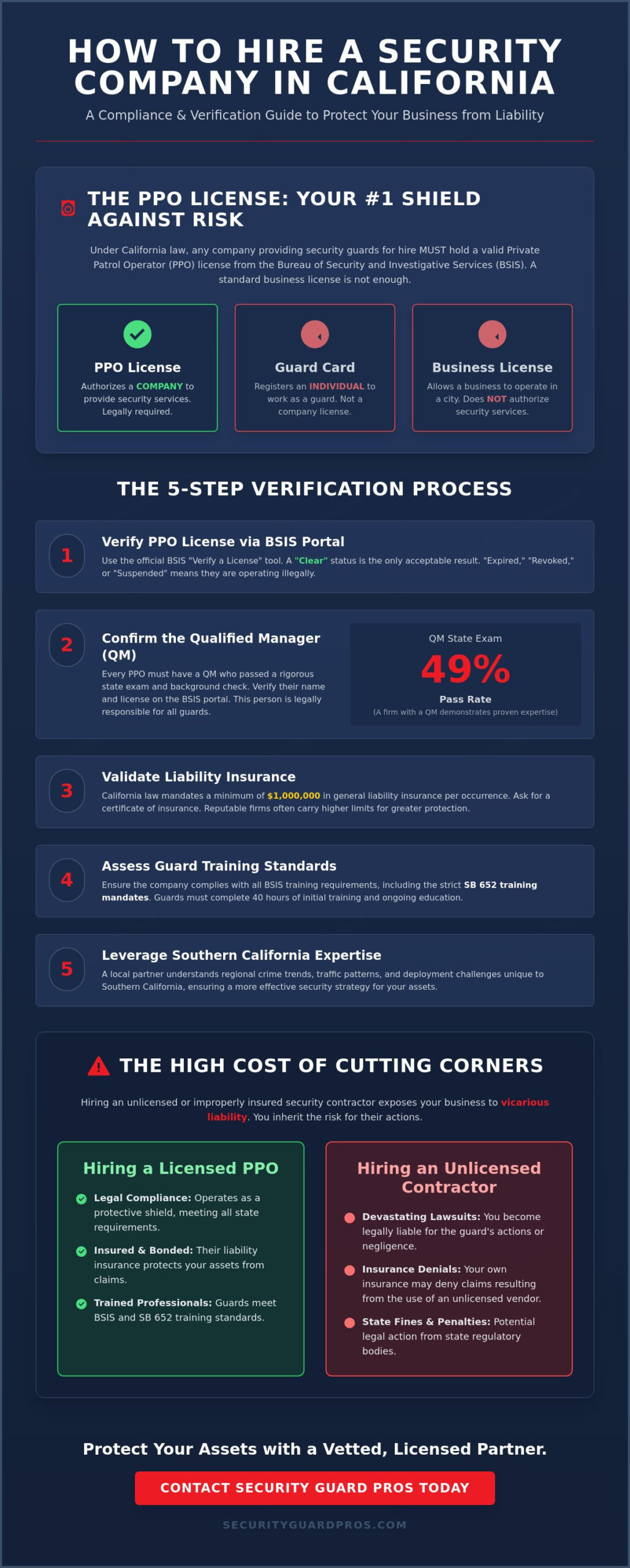
A standard business license allows you to pay taxes and operate within a city, but it does not grant you the legal authority to provide protection. Under California Business and Professions Code 7582.1, any entity providing security guards for hire must hold a Private Patrol Operator (PPO) license issued by the Bureau of Security and Investigative Services (BSIS). This isn’t a mere suggestion; it’s a criminal requirement. When researching how to hire a security company in california, your first step is verifying this specific credential. A legitimate private security company must undergo rigorous state vetting that a generic staffing agency simply ignores.
The backbone of a licensed PPO is the Qualified Manager (QM). California law dictates that every agency must have a designated manager who has cleared a federal background check and passed a comprehensive state examination regarding laws, regulations, and tactical management. This individual is legally responsible for the daily operations and conduct of every guard on your property. Because the state exam for this role has historically low pass rates, a firm with a standing QM demonstrates a high level of professional discipline and legal knowledge. Verify their QM status immediately. If they can’t provide a name and license number, walk away.
Why the PPO License is Your Primary Shield
The PPO license serves as your first line of defense against incompetence. It ensures the firm has paid the mandatory $770 application fees, submitted to Live Scan fingerprinting, and met the state’s stringent experience requirements. Never confuse a Guard Card with a PPO license. A Guard Card is an individual registration for a single employee; the PPO license is the corporate authorization to do business. Hiring a company that only uses “independent contractors” with Guard Cards is a massive liability trap. Only a PPO licensed firm is authorized to contract with you and provide the necessary insurance protections required by California law.
Proprietary vs. Contract Security in California
You face a critical choice: hire your own guards or outsource to a professional firm. If you hire internal staff, you must register as a Proprietary Private Security Employer. This path forces you to manage the 40 hours of mandatory BSIS training, maintain complex compliance records, and shoulder 100% of the liability for any incident. Outsourcing to professional security guard services shifts this administrative and legal burden to the experts. A contract partner handles the recruitment, the background checks, and the continuous 2026 training updates, allowing you to focus on your core business operations while they provide a dedicated protective shield.
The 5-Step Verification Process for California Security Firms
Do not rely on a glossy brochure or a firm handshake. When you’re determining how to hire a security company in california, you must act as your own auditor. The state provides the necessary tools to verify a firm’s legitimacy; you must use them to shield your organization from fraud and legal liability. A professional partner will welcome this scrutiny because their credentials are their badge of honor. Follow this disciplined 5-step process to separate the elite providers from the high-risk amateurs.
Using the BSIS License Search Tool Effectively
Your first destination is the Bureau of Security and Investigative Services (BSIS) “Verify a License” portal. This is the only definitive source for a firm’s legal standing. Search by the company’s name or their specific PPO license number. A “Clear” status is the only acceptable result. If the portal shows “Expired,” “Revoked,” or “Suspended,” the company is operating outside the law. Pay close attention to the Qualified Manager (QM) listed on the portal. If the person managing your account isn’t the QM or a registered corporate officer, you’re dealing with a firm that lacks proper regulatory oversight. This disconnect is a major red flag that suggests a lack of operational discipline.
Insurance Requirements: Beyond the Basics
California law mandates that every licensed Private Patrol Operator maintain a commercial general liability insurance policy with a minimum of $1,000,000 coverage per occurrence. However, a truly professional partner often carries limits that exceed this baseline to match the scale of your assets. Beyond liability, you must verify their Workers’ Compensation insurance. If a guard is injured on your property and the security firm lacks this coverage, you could be held responsible for medical costs and lost wages. Always demand a Certificate of Insurance (COI) and request an “Additional Insured” endorsement. This document legally binds the security firm’s insurance provider to protect your specific property or business in the event of a claim.
Next, confirm that every individual guard assigned to your site possesses a valid, state-issued Guard Card. This registration proves the employee has passed Department of Justice (DOJ) and FBI criminal history background checks. Finally, review the company’s uniform and patch design. The BSIS must approve these designs to ensure they don’t dangerously mimic local law enforcement. Using unapproved uniforms is a regulatory violation that reflects poorly on your brand and invites state fines. If you’re looking for a partner that maintains these high standards, Security Guard Pros provides fully transparent compliance documentation for every deployment. This level of transparency is the hallmark of a veteran security provider.
Evaluating Guard Training and Technology Standards
Hiring a security firm in the 2026 regulatory environment requires a deep dive into how guards are actually prepared for the field. It’s no longer enough to verify a license; you must audit the quality of the personnel behind it. In California, the baseline for entry is the 40-hour training mandate, which includes the initial 8-hour “Power to Arrest and Appropriate Use of Force” module. Following the implementation of SB 652, this initial training must be completed through a single, BSIS-approved provider to ensure consistency. When you’re determining how to hire a security company in california, ask to see their training curriculum. A firm that only meets the state minimum is providing a commodity, not a protective shield.
Professional agencies distinguish themselves through sector-specific expertise. A guard trained for a corporate lobby lacks the tactical mindset required for high-risk environments. For example, construction site security guards require specialized knowledge in perimeter breach detection and heavy equipment asset protection. Similarly, armed guards face even higher hurdles. In California, carrying a firearm requires a separate permit, a mandatory psychological evaluation, and annual re-qualification. If a firm offers armed services without proof of these recurring certifications, they are inviting a catastrophic liability event onto your property.
State-Mandated Training vs. Agency Excellence
The 40-hour state requirement is the floor, not the ceiling. Elite firms invest in continuous de-escalation and communication training to resolve conflicts without physical intervention. This proactive approach reduces the likelihood of use-of-force incidents that lead to expensive litigation. Demand a partner that provides specialized instruction for your specific industry, whether it’s hospital-grade sensitivity or retail loss prevention. This tailored training ensures guards don’t just stand post; they actively mitigate the unique risks of your Southern California facility.
Transparency Through Modern Security Technology
Traditional “paper logs” are a relic of an era defined by lack of accountability. Modern security is technology-enabled. You should prioritize firms that utilize GPS-based patrol verification systems, often called “Detex” systems. these tools provide real-time data on guard movements, ensuring that every corner of your property is inspected as contracted. This technology effectively prevents “sleeping on the job” and provides you with a digital audit trail. When you learn how to hire a security company in california, insist on seeing their digital reporting interface. Real-time incident reports with photo and video attachments provide the transparency you need to maintain peace of mind while focusing on your core operations.
Avoiding Liability: The Risks of Unlicensed Security
The most dangerous mistake a property manager can make is viewing security as a commodity where the lowest bid wins. In the 2026 legal landscape, failing to understand how to hire a security company in california can lead directly to the vicarious liability trap. If you contract with an unlicensed firm, the law often views those guards as your direct employees. You aren’t just paying for a service; you’re assuming the legal responsibility for every action, mistake, or use of force incident that occurs on your clock. Liability is not negotiable.
Insurance carriers are equally unforgiving. Most commercial general liability policies contain licensing exclusions. If an incident occurs involving an unlicensed security provider, your carrier will likely deny the claim entirely. You’ll be forced to cover legal fees and settlements out of pocket. This financial exposure far outweighs any perceived savings from a lower hourly rate. A licensed partner acts as a protective shield that keeps these risks off your balance sheet. To secure your assets without inheriting unnecessary legal risk, consult with the experts at Security Guard Pros for a compliant security analysis.
Legal Fallout of Hiring Unlicensed Guards
Contracting with an unlicensed Private Patrol Operator (PPO) invites immediate civil penalties from the state. Beyond fines, unlicensed firms frequently bypass the mandatory Live Scan fingerprinting and Department of Justice background checks. This means you could unknowingly have individuals with violent criminal histories patrolling your facility. If a failure occurs, the damage to your brand reputation is often permanent. Your insurance premiums will skyrocket because you failed to perform basic due diligence on your vendors. Cheap security is a debt that eventually comes due.
Contractual Safeguards for Property Owners
Protect your interests by demanding specific clauses in your security services agreement. Your contract must include robust indemnification and “hold harmless” language that specifically cites California law. This ensures the security firm remains the primary responsible party for their employees’ conduct. Additionally, include a “Right to Audit” clause. This allows you to verify guard credentials, training logs, and insurance renewals at any point during the contract term. Do not take their word for it. Verification is the only path to unwavering reliability and peace of mind.
- Indemnification: Shifts the financial burden of lawsuits back to the security firm.
- Evidence of Coverage: Requires the firm to provide updated COIs every six months.
- Background Verification: Grants you the right to see proof of Live Scan clearance for every guard on site.
California’s joint employer laws are aggressive. If you exert too much direct control over how unlicensed guards perform their tasks, you may be classified as their employer for tax and benefit purposes. Using a licensed, professional firm creates the necessary legal separation to protect your business from these labor law traps. Professionalism is a deterrent to both criminals and trial attorneys.
Southern California Expertise: Why Local Deployment Matters
National security conglomerates often manage Southern California properties from call centers located thousands of miles away. This distance creates a dangerous lag in response time and a fundamental misunderstanding of local criminal patterns. When you’re finalizing your decision on how to hire a security company in california, geographic proximity is your final vetting criterion. You need a partner with boots on the ground in Canoga Park, Anaheim, and San Diego. Regional headquarters ensure that supervisors can reach your site within minutes to handle emergencies, perform unannounced audits, or adjust deployment strategies in real time.
Security Guard Pros leverages over 70 years of collective management experience to protect your property. We don’t offer a one-size-fits-all commodity. Instead, we integrate into your local business operations as a disciplined, vigilant partner. Our regional presence allows us to maintain a rhythmic pattern of performance metrics and site-specific training, ensuring contract fulfillment across every shift. This is the implementation of a modern guardian model that respects traditional security values while utilizing contemporary tools to shield your assets.
Regional Threat Assessment and Rapid Response
Crime trends in Southern California are not monolithic. The retail theft surges currently impacting Los Angeles luxury districts require a different tactical approach than the heavy equipment theft plaguing construction sites in Riverside or San Bernardino. A local provider maintains a 24/7 dispatch center staffed by personnel who understand these regional nuances. They coordinate directly with local law enforcement agencies, from the LAPD to the San Diego County Sheriff’s Department, ensuring a seamless interface during critical incidents. This localized intelligence allows for customized protection plans that a generic national firm cannot replicate.
Industry-Specific Solutions for SoCal Businesses
High-value logistics and distribution hubs in the Inland Empire face unique cargo theft risks that demand specialized manufacturing and industrial security. For these high-stakes environments, you may require elite armed security guards who have cleared the psychological evaluations and annual re-qualifications mandated by the BSIS. Similarly, the logistical complexity of managing large-scale gatherings in Orange County requires a deep understanding of how to evaluate and hire event security companies.
Alleviate the anxiety of liability and loss by choosing a partner that knows your neighborhood as well as you do. Our consultation-based approach ensures that your security plan is a precise deterrent to the specific threats facing your Southern California assets. Stop settling for a generic staffing agency and secure a professional protective shield. Let our seasoned veterans provide the peace of mind you need to focus on your core operations without the distraction of security concerns.
Securing Your Assets with Professional Confidence
Protecting your property requires more than just a presence; it demands a partner who understands the intricate legal landscape of 2026. You now have the roadmap to verify a Private Patrol Operator license and ensure compliance with the latest SB 652 training mandates. Knowing how to hire a security company in california is your primary defense against the vicarious liability trap and the operational failures of unlicensed firms. By prioritizing local Southern California expertise and transparent, technology-driven reporting, you transform security from a line-item expense into a robust protective shield.
Security Guard Pros brings over 70 years of collective management experience to every deployment. As a fully Licensed California PPO #18115, we provide the unwavering reliability and 24/7 local SoCal dispatch required for rapid response and peace of mind. Don’t leave your liability to chance. Request a Professional Security Consultation with Security Guard Pros today to secure a tailored protection plan for your business. Take the decisive step toward safety and let our seasoned veterans handle the vigilance so you can focus on your core operations.
Frequently Asked Questions
Do I need a PPO license to hire my own in-house security guards in California?
You don’t need a PPO license to hire in-house guards, but you must register as a Proprietary Private Security Employer (PSE) with the BSIS. This registration is mandatory if you employ guards who work exclusively for your business and wear a distinctive uniform. As a PSE, you assume all liability for training and compliance. This is why many owners choose to learn how to hire a security company in california instead of managing the significant risks and administrative burdens internally.
How can I verify if a security guard’s ‘Guard Card’ is actually valid?
Verify any security guard registration by using the BSIS “Verify a License” online portal. Enter the guard’s name or registration number to confirm their status is “Clear.” A valid Guard Card indicates the individual has passed criminal history background checks through the DOJ and FBI. Professional firms will provide a roster of their guards’ registration numbers upon request, allowing you to audit your site’s security team for total transparency and peace of mind.
What is the difference between armed and unarmed security guard requirements in CA?
Armed guards must possess both a valid Guard Card and a BSIS Firearms Permit, which requires 14 hours of initial training and a psychological evaluation. Unarmed guards only require the standard 40-hour registration training. Armed personnel must also re-qualify at a firing range twice a year to maintain their permit. This higher level of regulation is designed to mitigate the extreme liability associated with carrying a weapon on private property and ensures a disciplined response to threats.
What insurance coverage should a California security company carry?
A California security agency must carry a minimum of $1,000,000 in commercial general liability insurance per occurrence. Beyond this legal floor, a reliable partner should maintain Workers’ Compensation to protect you from injury claims and commercial auto insurance for vehicle patrols. Always request a Certificate of Insurance that names your business as an “Additional Insured.” This document ensures the policy provides a direct protective shield for your assets in the event of an incident.
How much does it typically cost to hire a security company in California?
The cost of security services depends on several factors, including the risk level of the site, the required technology, and whether the guards are armed or unarmed. Urban centers like Los Angeles often have different rate structures than rural areas due to varying overhead and insurance requirements. When determining how to hire a security company in california, focus on the value of liability reduction rather than the lowest hourly bid. Cheap security often results in expensive legal fallout.
Can a security guard in California make a ‘citizen’s arrest’?
Yes, security guards in California can perform a “citizen’s arrest” under California Penal Code Section 837. However, professional guards are trained to prioritize de-escalation and observe-and-report techniques over physical detention. An arrest should only occur if a public offense is committed in their presence or for a felony not committed in their presence. This disciplined approach minimizes the risk of false imprisonment lawsuits for the property owner and maintains a professional environment.
How long does it take to deploy security guards to a new job site in Los Angeles?
Deployment times vary, but a firm with deep Southern California expertise can often mobilize guards to a new job site in Los Angeles within 24 to 48 hours. This rapid deployment is made possible by maintaining a local pool of vetted, BSIS-compliant personnel and a 24/7 regional dispatch center. National agencies often struggle with local logistics, whereas a localized partner can conduct a site analysis and post guards immediately to deter active threats.
What are the BSIS requirements for security guard uniforms and badges?
The BSIS requires all security guard uniforms and badges to be distinct from local law enforcement to prevent public confusion. The agency’s name or logo must be clearly visible, and the word “Security” must appear on the outermost garment. Companies must submit their patch and badge designs to the state for formal approval. Using unapproved uniforms is a regulatory violation that signals a lack of professional discipline and can lead to significant state-issued fines.