
Did you know that 95% of U.S. businesses experience internal theft, resulting in a staggering 5% loss of annual revenue on average? For SoCal business owners, the question isn’t if it’s happening, but how to prevent employee theft before it guts your bottom line. You’ve likely noticed unexplained inventory shrink or felt the sting of rising insurance premiums in Los Angeles. The fear of confronting a long-term staff member often leads to costly hesitation, creating a state of perceived vulnerability that saps your focus. It’s a heavy burden to carry while trying to scale a commercial operation.
This guide provides a professional roadmap to identify your specific vulnerabilities and implement the human deterrents necessary to eliminate internal theft. We’ll examine the 2026 regulatory landscape, including the impact of California’s SB 648, and demonstrate how a disciplined security presence transforms your workplace into a secure, high-performance environment. Learn how to protect your assets and gain the peace of mind that comes from unwavering reliability. By replacing opportunity with accountability, you can finally focus on your core operations without the distraction of security concerns.
Key Takeaways
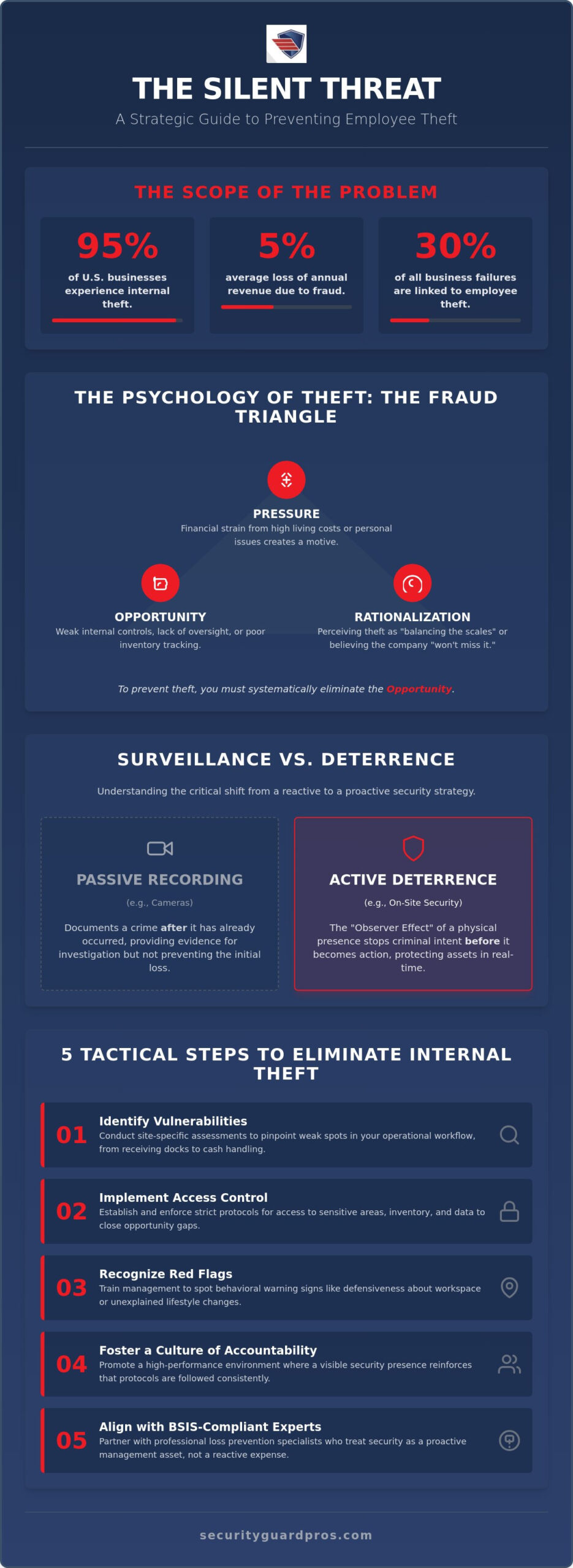
- Internal theft contributes to nearly 30% of business failures; learn to identify the subtle signs of asset misappropriation to protect your operational stability.
- Master the psychology of the Fraud Triangle and discover how to prevent employee theft by systematically eliminating the opportunity for staff misappropriation.
- Shift your strategy from passive recording to active deterrence by understanding how a physical security presence utilizes the “Observer Effect” to stop crime before it occurs.
- Implement a tactical five-step plan featuring site-specific vulnerability assessments and strict access control protocols tailored for the Southern California landscape.
- Align your business with BSIS-compliant experts who treat loss prevention as a proactive management asset rather than a reactive expense.
Defining Employee Theft: The Silent Threat to Your 2026 Bottom Line
Employee theft is the deliberate misappropriation of company assets by staff members for their own personal gain. It’s a quiet drain on your resources that often goes unnoticed until the damage is severe. By the middle of 2026, industry data suggests that internal theft accounts for approximately 30% of all business failures. This “shrink” crisis isn’t inevitable. Understanding how to prevent employee theft starts with viewing it as a manageable risk through proactive deterrence rather than an unavoidable cost of doing business.
In the Southern California commercial landscape, theft manifests in diverse and damaging ways. Retailers often struggle with “sweethearting,” where employees provide unauthorized discounts or free merchandise to friends. Logistics hubs face inventory diversion, while corporate offices might deal with Embezzlement or sophisticated skimming operations. Even time theft, where staff members are paid for hours they didn’t actually work, contributes to the significant annual revenue loss seen across U.S. enterprises. These actions erode your competitive edge in a crowded market.
The Hidden Costs of Internal Shrinkage
The financial impact of theft extends far beyond the sticker price of a missing product. Los Angeles businesses face a compounding effect of direct losses and skyrocketing insurance liability. When theft goes unchecked, your premiums rise, and your legal exposure increases. Beyond the ledger, internal shrink destroys team morale. Honest employees feel devalued when they see peers profiting from dishonesty. This creates a toxic workplace culture that is difficult to reverse without professional intervention and clear, visible standards of accountability.
Loss Prevention vs. Basic Security
There’s a critical distinction between general safety and dedicated loss prevention. While standard security focuses on protecting people and property from outside threats, loss prevention is designed to protect your profit margins from internal ones. Professional security guard services bridge this gap by providing a vigilant human presence that monitors internal workflows. These experts are trained to spot administrative anomalies and vendor fraud that cameras often miss. If you want to know how to prevent employee theft at the source, you must integrate these professionals into your daily operations. They serve as a disciplined shield, ensuring that your protocols are followed to the letter.
The Psychology of Theft: Why Employees Steal in 2026
Understanding the “why” behind internal misappropriation is the first step in learning how to prevent employee theft effectively. In 2026, the Fraud Triangle remains the definitive framework for analyzing workplace crime. This model identifies three critical conditions: pressure, opportunity, and rationalization. When these three elements intersect, even previously reliable staff members can become a liability. To protect your assets, you must address the psychological drivers that lead an employee to cross the line from trusted associate to internal threat.
Southern California’s specific economic climate plays a significant role in the “pressure” leg of the triangle. Persistent inflation and the high cost of living in Los Angeles and San Diego exert immense financial strain on workforce populations. This often manifests as “survival” theft, where employees take essentials or small amounts of cash to cover personal shortfalls. When combined with a “Robin Hood” rationalization, where the employee views a large firm as a faceless entity that won’t miss the loss, the mental barrier to stealing vanishes. They don’t see themselves as criminals; they see themselves as balancing an unfair scale.
Vigilant managers must recognize behavioral red flags before they escalate into major losses. Irritability during standard inventory checks or a sudden, unexplained change in lifestyle are classic signs of trouble. Employees who become overly defensive about their specific workstation or refuse to take mandatory time off may be hiding ongoing fraud. Identifying these patterns early is a core component of how to prevent employee theft before it impacts your annual revenue. If you notice these shifts, it’s time to evaluate your internal controls.
The Opportunity Gap: Where Your Business is Vulnerable
Unsupervised shifts and facility blind spots are open invitations for theft. Weak point-of-sale (POS) controls often lead to “sweethearting,” where cashiers undercharge friends or associates. Integrating tactical loss prevention strategies like strict POS monitoring and dual-verification for refunds is essential. In industrial and jobsite settings, construction site security guards play a vital role. They prevent internal equipment diversion by maintaining a constant, disciplined presence at exit points, ensuring that company property stays where it belongs.
Rationalization in the Modern Workplace
A lack of visible management presence fuels the belief that theft will go unpunished. The rise of organized retail crime culture in 2026 has unfortunately desensitized some employees to the gravity of theft. You must counter this by creating a culture of accountability through a professional, uniformed presence. This serves as a constant, silent reminder that protocols are enforced and assets are monitored. If you are concerned about your current vulnerabilities, consulting with a security expert can help you identify and close these psychological gaps before they cost you your business.
Surveillance vs. Deterrence: Why Cameras Aren’t Enough
Many SoCal business owners mistakenly believe that installing high-definition cameras is the final answer for how to prevent employee theft. While technology has advanced, a camera remains a passive observer. It records the crime for the police, but it does not stop the inventory from leaving your facility. By the time you review the footage, the asset is gone and the damage to your bottom line is done. Relying solely on surveillance is a reactive strategy that accepts loss as a prerequisite for evidence. If you are researching how to prevent employee theft, you must recognize that recording a crime is not the same as stopping one.
The physical presence of a professional guard introduces the “Observer Effect.” This psychological principle states that individuals modify their behavior when they know they are being watched by a person of authority. Unlike a fixed lens, a guard moves, interacts, and observes in real-time. While technical systems, such as those from expert security camera installation NJ providers, are essential for documentation, they are often plagued by blind spots, low resolution in dim lighting, and the ease of “masking,” where employees hide theft behind legitimate activities. A trained human eye detects these nuances instantly. Visible human deterrence represents the highest return on investment in loss prevention because it eliminates the opportunity for theft before the financial loss occurs.
The ROI of Active Human Presence
Active intervention provides immediate resolution. Instead of spending hours reviewing grainy footage after a shift, a guard identifies and addresses suspicious behavior as it happens. This proactive stance deters both internal “survival” theft and external organized crime threats. For businesses managing jewelry, pharmaceuticals, or high-end electronics, armed security guards provide the necessary level of elite protection. Their presence ensures that high-value assets remain secure under constant, disciplined watch.
Liability and Post-Theft Litigation
Confronting a suspected thief is a high-risk maneuver for untrained managers. Without professional training, these interactions can lead to physical altercations or significant legal pitfalls, such as wrongful accusation lawsuits. Professional guards mitigate this risk by following established protocols for detention and documentation. They provide expert testimony and detailed incident reports that hold up in court. This disciplined approach reduces your exposure to “slip and fall” scams or litigation in retail environments, protecting your reputation alongside your assets.
5 Tactical Steps to Eliminate Internal Theft Opportunities
Theory alone does not protect your inventory. You must convert your loss prevention strategy into a series of disciplined, tactical maneuvers. While understanding the psychology of the thief is useful, removing the physical opportunity is the most effective way to secure your business. Follow these five steps to harden your facility against internal threats and regain control over your assets.
- Conduct a site vulnerability assessment. Analyze your facility through the lens of a dishonest employee. Focus on specific Southern California risks, such as proximity to high-traffic transit corridors or isolated industrial zones. Identifying these gaps is the first move in how to prevent employee theft at scale.
- Implement strict access control. Establish “two-person” verification rules for high-value transactions, inventory counts, and trash removals. Never allow a single individual to manage the entire chain of custody for valuable assets.
- Deploy visible deterrents. Position uniformed guards at high-risk transition points, including loading docks, employee exits, and locker areas. A disciplined presence signals that your business is a “hard target.”
- Establish a zero-tolerance policy. Draft a clear anti-theft policy and provide a confidential tip line. Ensure every staff member knows that misappropriation results in immediate termination and legal action.
- Partner with a licensed PPO. Secure your perimeter with randomized Vehicle Mobile Patrols. Unpredictable checks are the most effective way to disrupt planned theft.
Optimizing Your Physical Site Layout
Eliminate blind spots in your warehouses and retail stockrooms. High shelving and poorly lit corners are sanctuaries for dishonest activity. Secure your loading docks and vendor entry points, as these are primary zones for inventory diversion. Professional security guard services in Los Angeles manage these access points with military precision. They ensure that every person and pallet entering or leaving your facility is documented and authorized. This level of oversight removes the “blind spot” excuse and forces compliance with your internal protocols.
The Power of Randomized Mobile Patrols
Predictable security schedules are a gift to a dishonest employee. If they know exactly when a manager leaves or when a camera rotates, they will exploit that gap. Randomized vehicle checks in your parking lots and garages disrupt this planning. These patrols are especially critical during seasonal inventory surges or when managing high-value shipments that require extra vigilance. Scaling your security to match your risk level ensures that your protection never becomes stagnant or easy to bypass. Stop the drain on your revenue today by requesting a professional security analysis for your facility.
Security Guard Pros: Your Partner in SoCal Loss Prevention
Choosing a security partner is a decision that impacts your liability and your profitability. At Security Guard Pros, our 70+ years of collective management experience allows us to provide a superior deterrent strategy that generic staffing agencies cannot match. We don’t just provide bodies in uniforms; we deploy disciplined professionals trained to identify and neutralize internal threats. Experience has taught us that how to prevent employee theft effectively requires a blend of high-level industry expertise and unwavering vigilance. Our no-nonsense professionalism ensures your protocols are respected and your assets are protected.
Every guard we deploy is fully compliant with the Bureau of Security and Investigative Services (BSIS) standards. As a Licensed California PPO #17573, we prioritize legal compliance and rigorous, California-specific training. This commitment protects you from the legal pitfalls associated with unprofessional security providers. We provide customized security plans tailored to the unique demands of the retail, logistics, and industrial sectors. Whether you need to secure a high-volume distribution center or a luxury retail storefront, our team delivers a protective shield that allows you to focus on your core operations.
Regional Expertise in Los Angeles and San Diego
Crime trends in Southern California are highly localized. Our deep understanding of the specific risks in Anaheim, Canoga Park, and Riverside allows us to anticipate threats before they manifest. We maintain localized headquarters across the region to ensure faster response times and better management accountability. This geographic expertise means our guards aren’t just watching a door; they are navigating the specific cultural and criminal landscape of your community. We support local businesses by providing professional, non-intrusive protection that enhances your customer service while securing your facility.
Secure Your Bottom Line Today
Stop allowing unexplained shrink to erode your hard-earned revenue. A professional security consultation is the most effective way to identify the hidden risks in your current operation. Our 24/7 dispatch and rapid deployment capabilities mean you can transition from a state of vulnerability to a state of total security in as little as 48 hours. Don’t wait for the next inventory discrepancy to realize your system is broken. Take a proactive stance and harden your business against internal threats with a partner who takes your safety as seriously as you do. Request a professional loss prevention consultation today and gain the peace of mind that comes from true professional protection.
Harden Your Business Against Internal Threats
Internal shrink is not an unavoidable cost of doing business; it’s a manageable risk that you can neutralize today. You’ve seen that while cameras provide evidence, they don’t provide active deterrence. Mastering how to prevent employee theft requires a shift from passive observation to disciplined, human-led oversight. By disrupting the Fraud Triangle and implementing tactical controls like randomized patrols, you remove the opportunity for misappropriation and protect your annual revenue.
Security Guard Pros stands ready as your protective shield. With 70+ years of collective security management experience and our status as a Licensed California PPO #17573, we deliver the professional authority your facility requires. Our 24/7 dispatch and rapid deployment capabilities ensure you’re never left vulnerable. Take the decisive step toward a secure work environment and focus on growing your operations with absolute peace of mind. To maintain that same level of reliability for your online presence, visit SiteGuardian for expert website uptime monitoring.
Secure Your Business with a Professional Loss Prevention Plan
Frequently Asked Questions
What are the most common signs of employee theft in retail?
Common signs include frequent register discrepancies, unexplained inventory shortages, and an unusual volume of voided transactions or refunds. Observe behavioral shifts like employees who suddenly refuse to take vacations or become defensive about their workspace. These red flags often signal that internal controls are being bypassed. Identifying these patterns early is a critical step in learning how to prevent employee theft before the financial damage becomes irreparable.
How much does employee theft cost the average California business?
U.S. businesses lose an average of 5% of their annual revenue to employee fraud, according to industry research. For a California business, this translates to thousands of dollars in direct losses and increased insurance premiums. With the median loss due to occupational fraud reaching $120,000, the cost of inaction is far higher than the investment in professional protection. Secure your bottom line by addressing these vulnerabilities before they jeopardize your operational stability.
Are security guards more effective than cameras for preventing internal theft?
Security guards are more effective than cameras because they provide active deterrence rather than passive recording. While cameras capture evidence for post-theft investigations, professional guards utilize the “Observer Effect” to stop the crime before it happens. A camera cannot intervene in a theft or question a suspicious transaction. By deploying a disciplined human presence, you remove the opportunity for theft and create a secure environment that technology alone cannot replicate.
What is the ‘Fraud Triangle’ and how does it apply to my business?
The Fraud Triangle consists of Pressure, Opportunity, and Rationalization. In your business, “Opportunity” is the only factor you can fully control. By implementing strict access controls and professional oversight, you break the triangle and make theft impossible to justify or execute. This framework is essential for understanding how to prevent employee theft because it highlights that even trusted employees may steal if the opportunity is left open and unmonitored.
Is it legal to hire security guards to monitor employees in California?
Yes, it’s entirely legal to hire licensed security guards to monitor employees in California, provided you adhere to state labor laws and privacy regulations. Professional guards from a licensed PPO ensure that all monitoring is conducted ethically and legally. This disciplined approach protects you from liability while maintaining a high standard of accountability. Always verify that your security partner holds a valid BSIS license to ensure full regulatory compliance and professional conduct.
How can a small business afford professional loss prevention services?
Small businesses can afford professional loss prevention by focusing on high-ROI strategies like randomized mobile patrols or customized part-time guard services. Instead of a one-size-fits-all approach, we design security plans that target your most significant vulnerabilities. The cost of professional protection is a strategic investment that pays for itself by reducing inventory shrink and lowering insurance liability. Professional security is a management asset that allows you to focus on growth.
What is the role of a security guard in a ‘sweethearting’ incident?
A security guard prevents “sweethearting” by monitoring point-of-sale transactions and verifying that all merchandise leaving the store has been properly scanned and paid for. Their presence at exits and transition points makes it difficult for employees to provide unauthorized discounts or free items to associates. Guards act as a neutral third party, ensuring that your established retail protocols are followed to the letter by every member of your staff without exception.
Can mobile patrols help prevent theft in large industrial facilities?
Randomized mobile patrols are highly effective for large industrial facilities where stationary guards cannot monitor every entry point simultaneously. These patrols disrupt the predictable schedules that dishonest employees often exploit to divert equipment or inventory. By using marked vehicles to check loading docks, parking garages, and perimeter fences at irregular intervals, you create a constant sense of vigilance. This strategy effectively secures expansive sites and protects high-value assets across multiple zones.