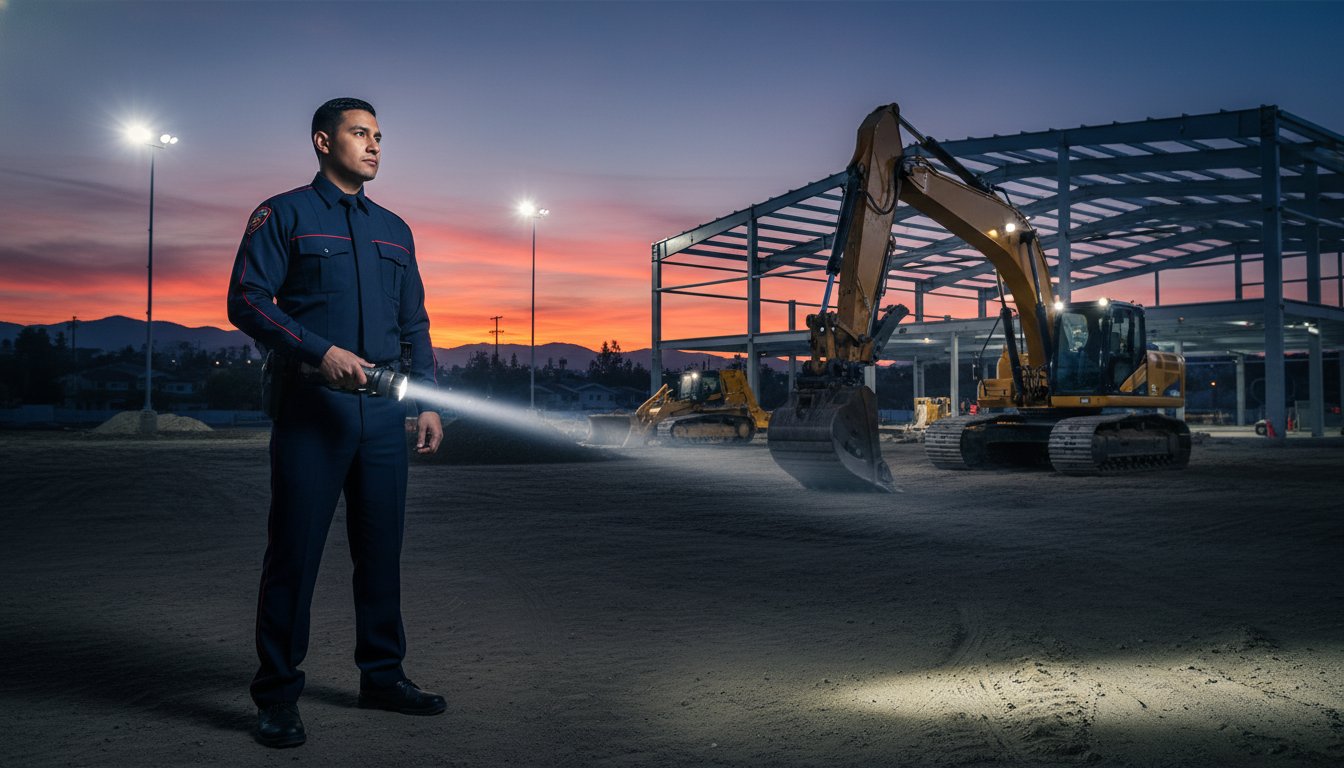
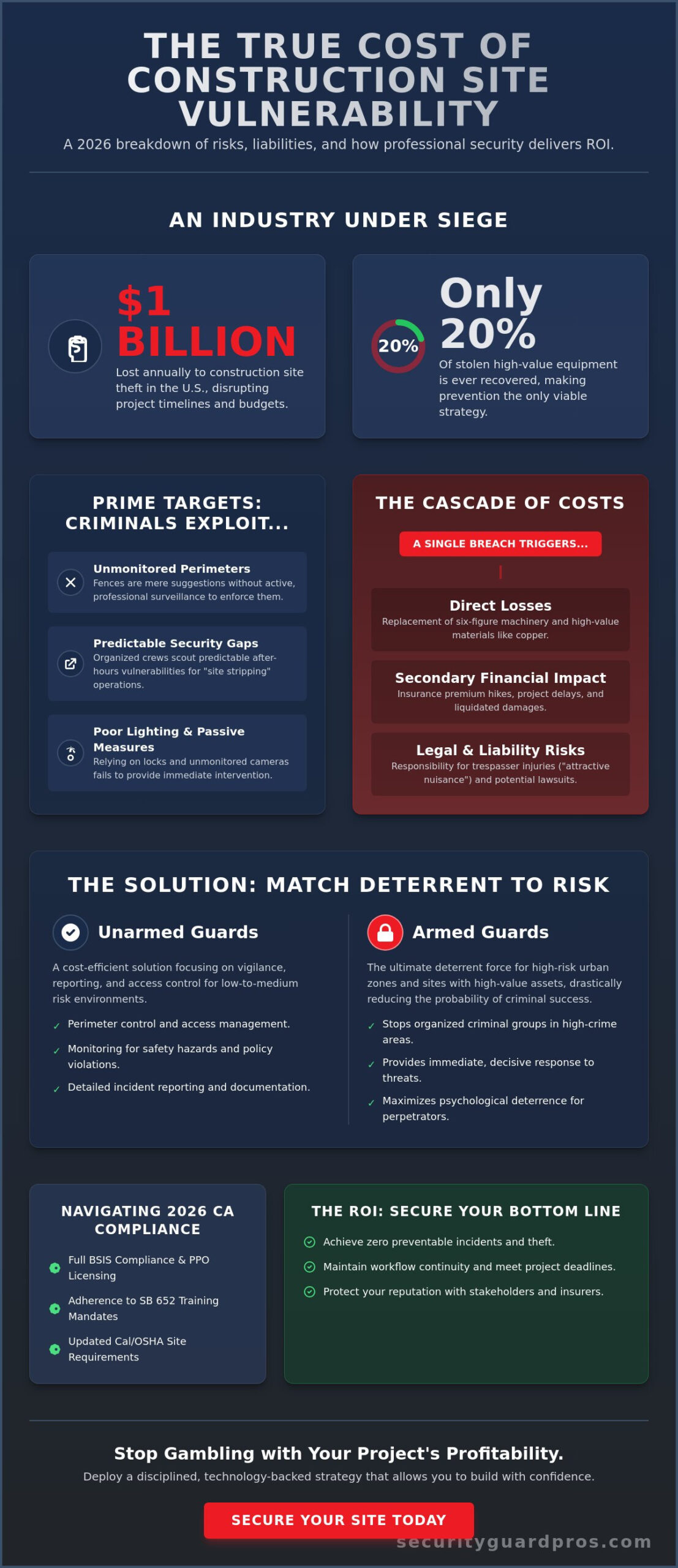
Did you know that construction site theft now costs the U.S. industry up to $1 billion annually, yet only 20% of stolen equipment is ever recovered? In the high-stakes environment of Southern California, hiring a professional construction security guard is no longer a luxury; it’s a critical safeguard against project-stalling losses. You’ve likely felt the anxiety of leaving an expensive jobsite vulnerable or the frustration of unreliable guards who compromise your safety mandates. It’s difficult to balance tight project deadlines with the constant threat of liability and equipment loss.
We’ll help you master the essentials of jobsite protection and select a security partner that actively mitigates theft and project delays. This guide provides a clear path to achieving zero incidents while maintaining full compliance with 2026 California regulations. We will preview the latest SB 652 training mandates, updated Cal/OSHA confined space requirements, and the impact of the 5% retention cap on your security budget. Stop settling for passive observers. Learn how to deploy a disciplined, technology-backed strategy that allows you to focus on building while we handle the protection.
Key Takeaways
- Identify the true cost of security breaches, including high-value equipment loss and secondary insurance hikes.
- Master the selection process for a construction security guard by matching specific site risks to the right level of deterrent force.
- Navigate California’s complex 2026 regulatory environment with a focus on BSIS compliance and PPO licensing.
- Execute a data-driven hiring strategy that prioritizes site risk assessments and proven regional performance metrics.
- Secure your project’s bottom line and ensure zero incidents by leveraging professional-grade security management.
The Real Cost of Jobsite Vulnerability in 2026
Leaving a jobsite unmonitored in 2026 is a calculated gamble with your project’s profitability. Modern theft trends have evolved from opportunistic scavenging to highly organized “site stripping” operations. These professional crews target high-value copper and heavy machinery with surgical precision, often moving stolen assets across state lines before your crew arrives for the morning shift. While the loss of materials is staggering, the secondary financial impact often hurts more. Insurance companies have responded to rising claims by hiking premiums for contractors who fail to demonstrate a robust security plan. A single breach can trigger a cascade of project delays, missing deadlines, and liquidated damages that far exceed the value of the stolen goods.
Legal liability adds another layer of financial risk. Construction sites are legally viewed as “attractive nuisances,” meaning you are responsible for injuries sustained by trespassers, even those with criminal intent. Deploying a professional construction security guard provides a stern deterrent that prevents these incidents from occurring. Contrast the manageable investment in proactive protection against the reactive nightmare of replacing a six-figure excavator or defending a multi-million dollar personal injury lawsuit. One is a strategic business expense; the other is a potential project-killer.
Why Construction Sites are Prime Targets
Criminals exploit three primary weaknesses: unmonitored perimeters, poor lighting, and predictable after-hours gaps. In high-density development hubs like Los Angeles and San Diego, the sheer volume of active projects allows organized crews to scout multiple targets simultaneously. These groups utilize advanced physical security principles to identify entry points where a lack of human presence makes a site an easy mark. Without a disciplined guardian on-site, your perimeter fence is merely a suggestion rather than a barrier. Relying solely on passive measures like locks or cameras often fails because they don’t provide the immediate intervention required to stop a theft in progress.
The ROI of Professional Deterrence
Deterrence is the psychological barrier created by the presence of a uniformed, authoritative professional who signals that a site is actively defended. Investing in construction security functions as a comprehensive insurance policy for your equipment and your timeline. Every incident-free day contributes directly to your bottom line by maintaining workflow continuity and protecting your reputation with stakeholders. By integrating physical security principles into your daily operations, you shift from a state of vulnerability to a position of control. This proactive stance ensures your focus remains on meeting construction milestones rather than filing police reports and negotiating with insurance adjusters.
Essential Features of a Construction Security Guard Service
Every jobsite requires a specific mix of human intelligence and procedural discipline. A professional construction security guard must demonstrate more than just physical presence; they need mastery in vigilance, accurate reporting, and rapid emergency response. These core competencies ensure that threats are identified before they escalate into costly losses. Effective protection relies on guards who can analyze a situation and follow a strict protocol, turning a passive post into an active defense. When you hire for these roles, you aren’t just buying a body in a uniform; you’re investing in a system designed to preserve your project’s continuity.
Armed vs. Unarmed: Making the Strategic Choice
Choosing between armed and unarmed protection depends entirely on your site’s specific risk profile. In high-crime urban zones across Southern California, armed security guards provide the necessary level of deterrent force to stop organized criminal groups. According to a U.S. Department of Justice report on construction theft, the perceived probability of success is a major factor in criminal decision-making. An armed presence drastically lowers that probability by increasing the risk to the perpetrator. Conversely, unarmed guards are highly effective for low-risk sites focused on perimeter control and access management. They offer a cost-efficient solution for maintaining high visibility and ensuring that only authorized personnel enter the jobsite.
For large-acreage developments, stationary guards aren’t enough. Vehicle mobile patrols fill the gaps by providing coverage across expansive perimeters that a single guard on foot cannot reach. This mobility ensures that even the most remote corners of your jobsite remain under constant watch, making it difficult for intruders to find a blind spot.
Technology Integration: Beyond the Human Eye
Modern protection requires digital accountability to eliminate the “sleeping guard” syndrome. Professional security guard services now integrate GPS tracking and electronic reporting to provide clients with total transparency. Digital Daily Activity Reports (DARs) and body camera footage prove that patrols were completed as scheduled and according to your specific safety mandates. These tools are backed by 24/7 dispatch centers that monitor on-site guards and provide immediate support during an incident. This combination of human vigilance and technological precision creates a fail-safe environment. If you want to ensure your site is truly protected, request a professional security analysis to design a customized plan for your next project.
Navigating California Compliance and Local Risk Factors
Southern California’s regulatory environment is among the strictest in the nation. To protect your project, you must look beyond basic patrol services and demand strict adherence to state mandates. Every security provider you consider must hold a valid Private Patrol Operator (PPO) license issued by the Bureau of Security and Investigative Services (BSIS). This license is your primary assurance that the company meets rigorous standards for training, background checks, and professional accountability. In 2026, compliance isn’t just a box to check; it’s a defensive wall against regulatory fines and legal challenges that can halt your progress.
Local risk factors vary significantly across the region. In high-density Los Angeles neighborhoods, urban theft and vandalism are the primary threats. Conversely, more remote sites in Riverside and San Bernardino counties face organized crews that operate equipment “chop shops,” where stolen machinery is dismantled within hours. A professional construction security guard must understand these geographic nuances to provide effective protection. They serve as a disciplined deterrent tailored to the specific criminal patterns of your site’s location.
The Legal Shield: Licensing and Insurance
Hiring an unlicensed or under-insured guard creates massive legal exposure for the developer and can lead to devastating financial consequences. Verify that your provider carries multi-million dollar general liability and workers’ compensation insurance before they set foot on your jobsite. Under California’s SB 652, effective January 1, 2026, all guards must complete their “Power to Arrest and Appropriate Use of Force” training within six months of their application. Proposed legislation like SB 1203 further emphasizes the trend toward increased training hours and de-escalation skills. Ensuring your team holds a valid “Guard Card” and stays current with these evolving mandates is non-negotiable for project safety.
Fire Watch and Site Safety Compliance
A construction security guard often serves as the first line of defense for more than just theft. When fire suppression systems are absent or malfunctioning, local fire marshal standards in San Diego and Orange County mandate a dedicated fire watch. Guards trained in these protocols provide continuous monitoring to prevent catastrophic fire loss. Additionally, new 2026 Cal/OSHA regulations for confined spaces (Title 8, CCR §§ 1951-1956) require a “competent person” to conduct surveys and maintain written permits. Your security partner assists in maintaining these OSHA safety standards, ensuring your site remains compliant with both fire codes and labor laws. This integrated approach allows you to focus on construction deadlines while we manage the complexities of jobsite safety.
Buying Guide: How to Evaluate and Hire Your Security Partner
Selecting a construction security guard provider is a decision that dictates your site’s safety and your company’s liability. Do not settle for a generic staffing agency that treats security as a commodity. Instead, follow a disciplined evaluation process to ensure your partner acts as a true protective shield for your assets. A professional firm begins with a multi-step security analysis rather than a simple price sheet. This methodical approach identifies vulnerabilities before they become expensive incidents.
- Step 1: Conduct a Comprehensive Site Risk Assessment. Your provider must walk the jobsite to determine optimal guard placement, blind spots, and high-risk entry points.
- Step 2: Verify Regulatory Credentials. Confirm an active Private Patrol Operator (PPO) license and request regional references from other SoCal jobsites.
- Step 3: Establish Management Oversight. Demand a clear chain of command. You need to know exactly who is accountable when an incident occurs and how supervisors verify guard performance.
- Step 4: Audit the Technology Stack. Ensure the firm uses GPS-verified reporting and digital DARs to provide total transparency into patrol completion.
- Step 5: Demand a Site-Specific Security Plan. Reject one-size-fits-all quotes. Your plan should outline specific protocols for access control, emergency response, and fire watch duties.
Questions to Ask During the Consultation
Interrogate your potential partner’s operational standards to separate professionals from amateurs. Ask directly: “How do you ensure guards don’t leave their posts or sleep during the night shift?” A reliable firm will point to real-time electronic monitoring and unannounced supervisor field checks. Inquire about their average response time for emergency guard replacement in building site security. Finally, insist on seeing a site-specific security plan before you sign any contract. If they cannot produce these details, they lack the discipline required to protect a high-stakes construction project.
Red Flags to Avoid in Security Staffing
Avoid companies that offer “rock bottom” rates. Low prices typically indicate underpaid, untrained guards and a lack of proper insurance coverage. Beware of firms that do not maintain a physical local office in Southern California; geographic expertise is vital for navigating local crime trends and regulatory nuances. Flag any provider who cannot produce an active BSIS license or proof of multi-million dollar liability insurance on demand. These omissions are not just clerical errors; they are signals of professional negligence. To secure your jobsite with a partner that values accountability, contact our regional headquarters for a consultation and experience the standard of professional protection.
Why Security Guard Pros is the Standard for SoCal Construction
Security Guard Pros represents the pinnacle of professional jobsite protection in Southern California. We bring over 70 years of collective management experience to every project, ensuring that your construction security guard is backed by a seasoned leadership team. Unlike traditional staffing agencies that simply place a body at a gate, we employ a management-heavy model. This means we don’t just staff; we supervise. Our field managers conduct unannounced site visits and rigorous performance audits to maintain a standard of excellence that passive competitors cannot match. We transform security from a line-item expense into a strategic asset.
Our operational infrastructure is designed for high-stakes environments. We maintain a 24/7 dispatch center that serves as the nerve center for our field operations, providing real-time support to guards and immediate communication to clients. Through our advanced electronic reporting system, you receive digital DARs and GPS-verified patrol data as it happens. This level of transparency eliminates the uncertainty often associated with night-shift security. We provide the proof of protection that modern developers demand. Our rapid deployment capabilities across Los Angeles, Orange County, and San Diego ensure that your site is protected from day one.
Localized Expertise in Southern California
Success in security requires deep geographic knowledge. We understand the specific crime patterns and logistical challenges in neighborhoods ranging from Canoga Park to Anaheim. Our local headquarters ensure that our field supervisors are always nearby and ready to respond to any situation. This proximity allows for a nuanced understanding of local risks that a national, disconnected firm simply cannot provide. Whether you are managing a retail center renovation or a massive industrial build, our regional expertise ensures your site is defended by professionals who know the terrain and the specific threats facing SoCal jobsites.
Commitment to Accountability and Peace of Mind
We maintain a “Shield of Protection” philosophy that prioritizes your project’s continuity above all else. Our guards undergo rigorous screening and industry-specific training that exceeds standard California requirements. We focus on de-escalation, asset protection, and safety compliance to ensure your site remains incident-free. This disciplined approach allows you to focus on meeting construction deadlines while we handle the complexities of guarding your perimeter. Don’t leave your investment to chance with an unproven agency. Get a customized construction security quote today from Security Guard Pros and secure the professional standard your project deserves.
Secure Your Jobsite with Professional Authority
Protecting your Southern California development requires more than just a visible presence. It demands a disciplined strategy that addresses the evolving theft trends and strict 2026 regulatory mandates we’ve explored. By prioritizing PPO-licensed expertise and management-heavy oversight, you eliminate the vulnerabilities that lead to equipment loss and legal liability. A professional construction security guard acts as a proactive shield, allowing your team to maintain focus on construction deadlines without the distraction of safety breaches.
Security Guard Pros stands ready to defend your investment with Licensed PPO #119861 and over 70 years of collective management experience. We provide the 24/7 rapid dispatch and real-time accountability needed to secure jobsites across Los Angeles, Orange County, and San Diego. Don’t wait for a costly incident to expose the gaps in your perimeter. Secure Your Jobsite Today: Contact Security Guard Pros for a Professional Quote and gain the peace of mind that comes with elite protection. Your project’s success depends on the safety of your site; let’s build it together with unwavering reliability.
Frequently Asked Questions
What are the primary duties of a construction security guard?
The primary duties of a construction security guard involve active deterrence, perimeter monitoring, and strict access control. They are responsible for verifying the credentials of everyone entering the jobsite and conducting regular patrols to identify vulnerabilities. Beyond preventing theft, these professionals document safety hazards and maintain a detailed log of site activities. This disciplined approach ensures that your project remains secure and compliant with site-specific safety protocols.
How much does it cost to hire a security guard for a construction site in California?
The cost of hiring security in California depends on the guard’s experience level, the site’s risk profile, and the specific licensing requirements. Factors such as the need for specialized equipment or vehicle patrols will also influence the final investment. It’s important to avoid providers offering exceptionally low rates, as these prices often indicate a lack of proper insurance or inadequate guard training. Request a customized analysis to determine a budget that matches your site’s needs.
Is it better to hire armed or unarmed guards for my jobsite?
Selecting between armed and unarmed guards depends on a thorough risk assessment of your jobsite’s location and the value of on-site assets. Armed guards provide a stern psychological deterrent in high-crime zones and are often necessary for sites with history of organized theft. Unarmed guards are highly effective for lower-risk sites where the main focus is perimeter control and safety compliance. We recommend evaluating your specific threat level before making a strategic choice.
How many security guards do I need for a 5-acre construction site?
A 5-acre site typically requires a strategic blend of stationary gate control and vehicle mobile patrols to ensure full coverage. The exact count depends on your site’s topography, the number of access points, and the quality of existing lighting. A single guard at a fixed post cannot effectively monitor a large perimeter. Utilizing a mobile patrol allows for rapid response and constant surveillance of remote corners that are otherwise vulnerable to intruders.
What is the difference between a security guard and a fire watch guard?
A construction security guard focuses on preventing theft and unauthorized entry, while a fire watch guard monitors for fire hazards and smoke. Fire watch is a specialized service mandated by local fire marshals when a site’s fire suppression or alarm systems are non-functional. While the roles are distinct, professional guards are often trained to perform both duties. This ensures your site remains protected from both criminal activity and catastrophic fire loss simultaneously.
Can a security guard help reduce my construction insurance premiums?
Professional security guard services can lead to lower insurance premiums by reducing the frequency and severity of theft and liability claims. Insurance providers value the mitigation of “attractive nuisance” risks, where the developer is held responsible for trespasser injuries. By maintaining a disciplined security presence, you demonstrate a commitment to risk management. This proactive stance makes your project more attractive to underwriters and helps protect your long-term project profitability.
How quickly can you deploy a guard to a new site in Los Angeles?
Deployment timelines for security in Los Angeles are determined by your specific site requirements and the complexity of the security plan. Every project begins with a multi-step security analysis to ensure the right personnel are assigned to your location. To ensure your jobsite is protected by the start of your next phase, contact our regional headquarters to discuss your project’s timeline. We prioritize efficient implementation without compromising our rigorous screening and training standards.
What reporting will I receive regarding the guard’s activity at night?
Clients receive comprehensive digital Daily Activity Reports (DARs) that provide a detailed log of all nightly patrols and observations. These reports utilize GPS-verified timestamps to prove patrol completion and ensure total guard accountability. If an incident occurs, you will receive an immediate notification followed by a formal incident report. This transparent system eliminates the uncertainty of unmonitored shifts and provides the documented proof of protection required for project stakeholders and insurance providers.