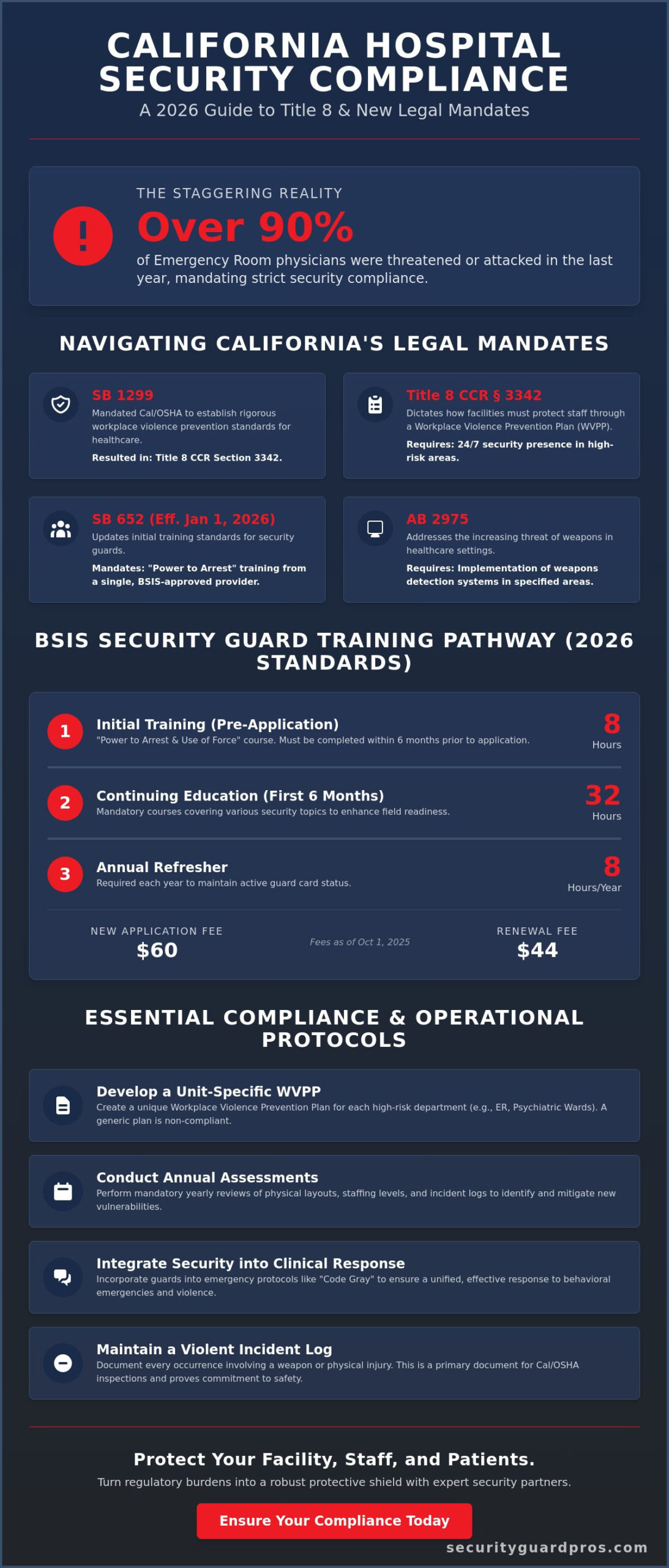
Over 90% of emergency room physicians were threatened or attacked in the last year, according to a 2024 poll by the American College of Emergency Physicians. This staggering data proves that meeting the hospital security guard requirements california mandates is no longer a simple administrative task; it’s a critical life-saving necessity. You likely feel the daily pressure of balancing a patient-first philosophy with the rising threat of workplace violence and the looming shadow of heavy Cal/OSHA fines for non-compliance.
You can master these complex legal standards to ensure your facility remains a safe haven for both staff and patients. This 2026 compliance guide provides the professional clarity needed to achieve 100% adherence to Title 8 CCR Section 3342 while fostering a seamless partnership between security and clinical teams. We’ll examine the new SB 652 Power to Arrest training standards, updated BSIS fee structures, and the implementation of weapons detection systems required under AB 2975. Secure your facility’s future by turning regulatory burdens into a robust protective shield.
Key Takeaways
- Identify your hospital’s specific classification under SB 1299 to ensure you maintain the mandatory 24/7 security presence required for legal compliance.
- Learn how to navigate the current hospital security guard requirements california enforces, including BSIS licensing and the specialized IAHSS certifications that bridge the gap between guarding and patient care.
- Perform mandatory annual physical layout and staffing assessments to identify vulnerabilities in high-risk zones like psychiatric wards and Emergency Departments.
- Integrate security personnel into clinical response protocols like “Code Gray” to create a unified front against behavioral emergencies and workplace violence.
- Vet Southern California Private Patrol Operators based on rigorous license verification and regional expertise to protect your facility from liability and non-compliance fines.
The Legal Mandate: Understanding SB 1299 and Cal/OSHA Title 8
California law demands more than just a visible presence; it requires a disciplined, regulatory-compliant protocol. Senate Bill 1299 transformed the state’s healthcare landscape by mandating that Cal/OSHA establish rigorous standards for workplace violence prevention. This resulted in Title 8 CCR Section 3342, a regulation that dictates how facilities must protect their staff and patients. Understanding basic Security Guard Roles and Responsibilities provides a baseline, but California’s specific mandates raise the bar significantly for healthcare environments. Neglecting these standards is not just a safety risk. It’s a massive financial and legal liability.
The core of SB 1299 is the requirement for a 24/7 security presence in specific hospital settings. This isn’t a suggestion. It’s a legal necessity designed to mitigate the high frequency of assaults in Emergency Departments and psychiatric units. By April 1, 2018, every covered facility was required to have a fully functional plan in place. In 2026, the stakes are higher. Cal/OSHA has increased its oversight, and non-compliance can lead to six-figure fines, increased insurance premiums, and irreparable damage to your hospital’s reputation. Don’t let your facility become a statistic of negligence.
Which Facilities are Covered?
Not every medical office falls under the full weight of Title 8 CCR Section 3342, but the scope is broader than many administrators realize. The law primarily targets General Acute Care Hospitals, acute psychiatric hospitals, and special hospitals. Per the California Health and Safety Code, a General Acute Care Hospital is a facility with a governing body and organized medical staff providing 24-hour inpatient care, including medical, nursing, surgical, anesthesia, laboratory, radiology, pharmacy, and dietary services. If your facility meets this definition, you must adhere to the strictest hospital security guard requirements california mandates. While smaller clinics or outpatient centers may have partial exemptions, any facility that provides emergency medical services or handles high-risk behavioral health patients must implement robust preventative measures to avoid litigation.
The Role of the Workplace Violence Prevention Plan (WVPP)
A generic, facility-wide security manual is no longer sufficient for compliance. Your Workplace Violence Prevention Plan (WVPP) must be unit-specific. The risks in a Labor and Delivery unit differ fundamentally from those in a high-traffic ER. Compliance requires a granular analysis of each department’s physical layout and staffing levels. Furthermore, the law mandates the active involvement of employees and their bargaining agents in the creation and annual review of these plans. This collaborative approach ensures that those on the front lines have a voice in their own protection. You must also maintain a violent incident log that documents every occurrence involving a weapon or physical injury. This data isn’t just for internal use; it’s a transparent record of your commitment to safety and a primary document during any Cal/OSHA inspection.
Personnel Requirements: BSIS Licensing and Specialized Training
A basic Guard Card is merely the price of admission. In high-stakes medical environments, personnel must possess specialized clinical awareness and legal expertise. Meeting the hospital security guard requirements california mandates involves a multi-tiered approach to training. This ensures every officer acts as a stabilizing force in a crisis rather than a liability. Relying on untrained generalists in an Emergency Room is a recipe for disaster. Professional hospital security requires a blend of tactical discipline and clinical empathy.
The BSIS Guard Card Process
Effective January 1, 2026, Senate Bill 652 requires the initial 8-hour “Power to Arrest and Appropriate Use of Force” training to be completed through a single, BSIS-approved provider. This training must occur within the six months prior to submitting a registration application. Beyond this initial step, guards must complete 32 hours of mandatory continuing education within their first six months of employment. To maintain an active status in 2026, guards must complete an 8-hour annual refresher course. As of October 1, 2025, BSIS registration fees reflect a 10% increase; new applications cost $60 and renewals are $44. These regulations, reinforced by California Senate Bill 1299, ensure that personnel are legally authorized and professionally prepared to handle the unique stressors of a healthcare environment.
Healthcare-Specific Certifications
Standard security training often fails to address the nuances of patient care. This is where IAHSS (International Association for Healthcare Security and Safety) certifications become indispensable. These levels, Basic, Advanced, and Supervisory, equip guards with the specific vocabulary and tactical skills needed for clinical settings. Additionally, Assembly Bill 508 mandates de-escalation training for personnel in psychiatric and emergency departments. Crisis Prevention Institute (CPI) training provides non-violent intervention techniques that prioritize patient safety while maintaining order. Every officer must also understand HIPAA regulations to protect patient privacy during security interventions. If you are evaluating a provider’s credentials, prioritize those with proven hospital and healthcare security expertise. For facilities requiring a higher deterrent level, firearm-permitted guards must hold a valid BSIS Firearms Permit, which requires separate, rigorous qualification and biannual range testing.
The choice between armed and unarmed guards depends on your specific annual security assessment. While unarmed guards are standard for patient floors, armed personnel may be necessary at main entrances or high-risk trauma centers. The decision should always be data-driven, balancing the need for a stern deterrent with the reassuring environment patients expect. Ensure your security partner can provide the specific tier of protection your facility’s risk profile demands.
Mandatory Annual Security Assessments and Planning
Compliance is not a static achievement. California Health and Safety Code sections 1257.7 and 1257.8 require hospitals to conduct comprehensive annual security assessments. These evaluations form the backbone of your Workplace Violence Prevention Plan. They bridge the gap between abstract policy and the specific hospital security guard requirements california facilities must meet to ensure safety. You must evaluate every high-risk zone, from the chaotic environment of the Emergency Department to the sensitive corridors of psychiatric wards and ICUs. A failure to identify a single blind spot can lead to catastrophic liability.
Integration of technology is no longer optional in 2026. Your physical guards must work in tandem with synchronized CCTV, access control, and panic button systems. This technological shield allows for immediate response when a “Code Gray” is called. Effective planning translates these assessments into actionable post orders. It ensures that every guard is positioned where they are most effective, rather than just filling a slot on a roster. Secure your perimeter by aligning physical presence with advanced digital monitoring.
Conducting the Annual Safety Assessment
Begin your assessment by reviewing every documented incident from the previous 12 months. Look beyond the obvious. Analyze “near-miss” violence incidents by consulting directly with nursing staff. Research shows that 88% of healthcare workers experience workplace violence that they never officially report. Uncovering these hidden risks is vital. You must also scrutinize the physical layout. Check for inadequate lighting, unsecured entry points, and areas where staff might be isolated. Verifying that your team meets all BSIS Security Guard Registration Requirements is a non-negotiable step. Maintaining strict adherence to the hospital security guard requirements california enforces ensures your facility remains compliant during state inspections.
Cooperation with Local Authorities
Establish a formal liaison with local agencies like the LAPD, San Diego PD, or LASD. California law mandates a 72-hour reporting window for any hospital assault involving a weapon or resulting in serious injury. Clear reporting protocols and Memorandums of Understanding (MOUs) with local law enforcement streamline this process. These agreements define exactly when and how police will intervene. This clarity reduces hesitation during a crisis. Emphasize the legal protections available to staff who report violent acts. A culture of accountability, backed by a strong relationship with local authorities, serves as a powerful deterrent to potential aggressors. It transforms your hospital from a vulnerable target into a fortified, professional environment.
Operational Excellence: Guard Integration in Medical Environments
Static guarding is a relic of the past. Modern healthcare facilities require a “Security as a Partner” model where officers are integrated into the clinical team’s daily operations. Meeting the hospital security guard requirements california mandates is the baseline; operational excellence is achieved when security personnel act as a proactive shield for medical staff. Unlike unprofessional agencies that provide “warm bodies” to sit at a desk, a disciplined security partner understands clinical workflows and patient care values. This integration ensures that when a crisis occurs, the response is immediate, coordinated, and effective.
Guards must be proficient in responding to “Code Gray” behavioral emergencies. In these high-stress moments, security provides the necessary support to clinical staff, allowing doctors and nurses to focus on medical intervention. Beyond emergency response, security personnel often handle “Patient Watch” or sitter duties to prevent patient elopement and self-harm. This requires a delicate balance of force. Officers must know exactly when to intervene to prevent injury and when to observe from a distance to avoid escalating a patient’s distress. Ensure your facility is protected by experts who understand these nuances by hiring professional hospital and healthcare security services today.
De-escalation and Behavioral Health
Verbal judo and non-confrontational stance techniques are essential tools in an Emergency Room setting. Guards must manage family members and visitors in high-stress waiting areas where emotions often boil over. A professional presence can diffuse a situation before it turns violent. The Least Restrictive Environment principle requires that security personnel use the most minimal level of physical or mechanical restraint possible to maintain safety without compromising a patient’s legal rights or clinical progress. This approach protects the facility from both physical threats and legal liability.
Emergency Response and Drills
Security integration must extend to regular emergency drills. Guards play a central role in “Code Silver” active shooter training, directing staff to safety and securing perimeters. They also provide essential fire watch duties when hospital alarm or sprinkler systems fail, ensuring the facility remains in compliance with fire codes. During mass casualty incidents (MCIs), security manages crowd control and ensures that triage areas remain unobstructed. This level of preparedness transforms a security team from a passive observer into an elite response unit. Every drill is an opportunity to refine the partnership between security and clinical staff, creating a safer environment for everyone.
Choosing a Hospital Security Partner in Southern California
Vetting a Private Patrol Operator (PPO) is the final, most critical step in your compliance journey. A valid PPO license is the minimum legal requirement, but for healthcare environments, you must look much deeper. Verify that your potential partner maintains comprehensive liability insurance and a spotless record with the Bureau of Security and Investigative Services. Regional expertise in Los Angeles and San Diego is non-negotiable. These areas face unique urban security challenges and high-density trauma center demands that generalist agencies cannot handle. A provider with localized knowledge understands the specific law enforcement reporting protocols and community dynamics that affect your facility’s risk profile. Selecting an inexperienced firm is a risk you can’t afford to take.
The right partner acts as a protective shield, allowing your clinical staff to focus on patient outcomes without the distraction of safety concerns. We provide a disciplined, veteran-led approach that transforms your security posture from a state of vulnerability to one of total control. By meeting every facet of the hospital security guard requirements california mandates, we eliminate the anxiety associated with Cal/OSHA inspections and workplace violence liability. Our management team utilizes over 70 years of combined experience to ensure your facility remains a safe, professional environment.
Key Questions for Your Security Provider
When interviewing potential partners, demand transparency and proof of expertise. Use this checklist to separate professional guardians from unprofessional “warm body” agencies:
- Does the firm provide guards specifically trained in IAHSS and CPI protocols?
- How does the company handle 24/7 dispatch and rapid deployment for behavioral emergencies?
- Can they provide a comprehensive hospital and healthcare security standard audit?
If a provider hesitates on these questions, they aren’t prepared for the hospital security guard requirements california enforces in 2026. You need a partner that views security as a specialized medical support service, not a generic commodity. Every post order must be tailored to your specific unit-based risks.
The Security Guard Pros Solution
Security Guard Pros delivers customized security plans that meet all California SB 1299 mandates. Our professional, uniformed presence serves as a stern deterrent to threats while offering a reassuring sense of safety to patients and staff. We take the burden of compliance off your shoulders by managing the rigorous training, licensing, and documentation required by law. Contact our Los Angeles or San Diego regional headquarters to schedule an expert-led consultation. We will perform a multi-step security analysis to identify your facility’s specific vulnerabilities and implement a robust implementation plan. Protect your facility and staff with Security Guard Pros and ensure your hospital remains a beacon of safety in the community.
Secure Your Facility’s Future with Expert Compliance
Mastering California’s healthcare security landscape requires more than just meeting basic standards. It demands a proactive, unit-specific strategy that integrates clinical empathy with tactical discipline. You’ve seen that SB 1299 and Title 8 CCR Section 3342 are the legal foundations, but true operational excellence comes from specialized training and rigorous annual assessments. Adhering to the strict hospital security guard requirements california mandates protects your staff, reduces liability, and ensures your facility remains a safe space for healing. Don’t let regulatory gaps become physical vulnerabilities.
Secure your peace of mind by partnering with a modern guardian. As a licensed California PPO with over 70 years of management experience, we offer the specialized training and 24/7 dispatch capabilities needed for rapid deployment across Southern California. Our expertise in healthcare-specific de-escalation ensures your team is prepared for any behavioral emergency. Get a Professional Hospital Security Assessment Today to fortify your facility against rising threats. You have the power to transform your security posture into a robust protective shield that supports your clinical mission every day.
Frequently Asked Questions
Is a security guard legally required in every California hospital?
Senate Bill 1299 and Title 8 CCR Section 3342 mandate a 24/7 security presence for all General Acute Care, acute psychiatric, and specialty hospitals. This requirement ensures that facilities provide a safe environment for both patients and staff. While smaller outpatient clinics may have different standards, any facility meeting the Health and Safety Code definition of an acute care hospital must adhere to these strict staffing protocols.
What is the difference between a Guard Card and IAHSS certification?
A Guard Card is the mandatory state registration issued by the BSIS that allows an individual to work as a security officer. In contrast, IAHSS certification is a specialized professional credential designed specifically for medical environments. Most risk managers prioritize IAHSS-certified personnel because they understand clinical workflows and patient privacy laws better than generalists who lack healthcare-specific training.
How often must a hospital conduct a security assessment in California?
California Health and Safety Code requires hospitals to conduct a formal security and safety assessment at least once every 12 months. This annual review must analyze the physical layout, lighting, and incident history of the previous year. You should use these findings to update your unit-specific Workplace Violence Prevention Plan to remain compliant with hospital security guard requirements california regulations.
Are hospital security guards in California allowed to carry firearms?
Security guards may carry firearms if they possess a valid BSIS Firearms Permit and the hospital’s annual security assessment identifies a specific need for armed protection. Armed guards are typically stationed at main entrances or high-traffic trauma centers to serve as a stern deterrent to external threats. The decision to deploy armed personnel must balance the need for high-level protection with the facility’s clinical environment.
What are the reporting requirements for workplace violence in CA hospitals?
Hospitals must report any violent act involving a weapon or resulting in serious injury to local law enforcement within 72 hours. Additionally, Title 8 Section 3342 requires facilities to maintain a detailed violent incident log for all occurrences. This documentation is a critical component of Cal/OSHA compliance and serves as an accountable record during state inspections and audits.
Can a hospital use its own employees instead of a private security firm?
Hospitals can utilize proprietary security employees, but these individuals must still register with the BSIS and meet all state training mandates. Many facilities choose to partner with a Private Patrol Operator (PPO) to offload the burden of specialized hospital security guard requirements california training and liability management. This partnership ensures that the team remains disciplined and vigilant without distracting hospital administration from core operations.
What training is required for guards working in psychiatric units?
Guards in psychiatric units must complete specialized de-escalation training as mandated by Assembly Bill 508. This includes learning non-violent intervention techniques and verbal judo to manage behavioral health crises safely. Effective January 1, 2026, the 8-hour “Power to Arrest” course must also be delivered by a single BSIS-approved provider to ensure consistent standards across the state.
How does SB 1299 affect hospital liability and insurance?
SB 1299 increases a hospital’s liability by establishing clear, enforceable standards for workplace violence prevention. Failure to maintain a compliant plan can lead to significant Cal/OSHA fines and higher insurance premiums due to increased risk profiles. By implementing a professional security shield, you reduce the frequency of compensable workplace injuries and position your facility as a low-risk, safety-conscious institution.